Get Full Government Meeting Transcripts, Videos, & Alerts Forever!
Get email alerts on the Department Overview topic
No spam. Unsubscribe anytime.
Cooperative Extension, veterans, EMS and 911 give department updates to Northampton County commissioners
Summary
County department heads and program leads briefed commissioners on staffing, program activity and technology upgrades, including Cooperative Extension staffing and shared SNAP-Ed funding, veterans services casework, EMS appreciation and 911 operations and network upgrades.
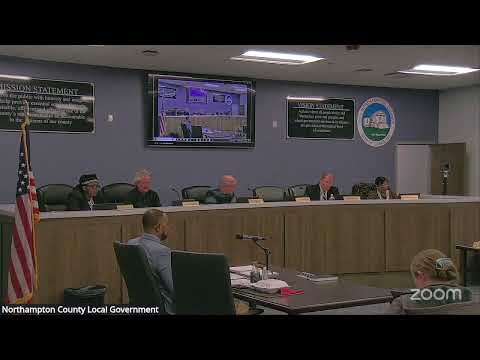
Multiple county and partner department representatives updated the Northampton County Board of Commissioners on staffing, programs and operations during the board's department head overview segment.
Cooperative Extension: Kelly Clark, the county extension director, described the office's program structure and staffing. Clark said the office covers agriculture, 4‑H, family and consumer sciences and support staff, noting vacancies in a horticulture agent role and in administrative support. Clark said some positions are shared with neighboring counties and that certain positions are funded through a mix of county and state percentages; for example, she said SNAP‑Ed and other shared roles carry split funding arrangements. She told commissioners the office is leveraging state funding and plans to hire for a vacant EFNEP position in March.
Veterans affairs: Reggie Faith, the county veteran service officer, described his role coordinating benefit claims between the county, the North Carolina Department of Veterans Affairs and the U.S. Department of Veterans Affairs. Faith said the position is part time (about 25 to 30 hours per week) and reported that roughly 10% of the county population are veterans. He said he has submitted compensation applications since certification and indicated a high volume of paperwork: in the transcript he said he had filed "about a hundred and 809 applications." Faith also raised homelessness among some veterans and asked the board to consider temporary housing options or a plan to address that need.
EMS and naloxone: Commissioners and a speaker from EMS discussed community paramedicine and the local distribution and use of naloxone to prevent opioid overdose deaths. Several commissioners and community members praised EMS staff and emphasized collaboration with local recovery resources.
9‑1‑1 communications: The county's 9‑1‑1 telecommunicator supervisor, identified in the meeting as Miss Ransom, reviewed center operations, staffing and technology. She said the center operates four 12‑hour shifts (A, B, C and D), described a staffing goal of five seated positions per shift, and summarized recent technology transitions to ESInet and SIP-based phone administration. Ransom described daily duties, partnerships with GIS and land records to maintain response maps, and the telecommunicator role in medical dispatch and launching air and ground critical transport. She closed by saying, "The true first responder is your 9‑1‑1 dispatcher," and asked commissioners to note the center's role in public safety.
Commissioners thanked staff and volunteers and asked that department heads bring back any budgetary or staffing requests during the upcoming budget calendar process.