Get Full Government Meeting Transcripts, Videos, & Alerts Forever!
Get email alerts on the Compassionate Cities topic
No spam. Unsubscribe anytime.
Compassionate Tulsa committee reviews decade of work and weighs reaffirmation amid political risks
Summary
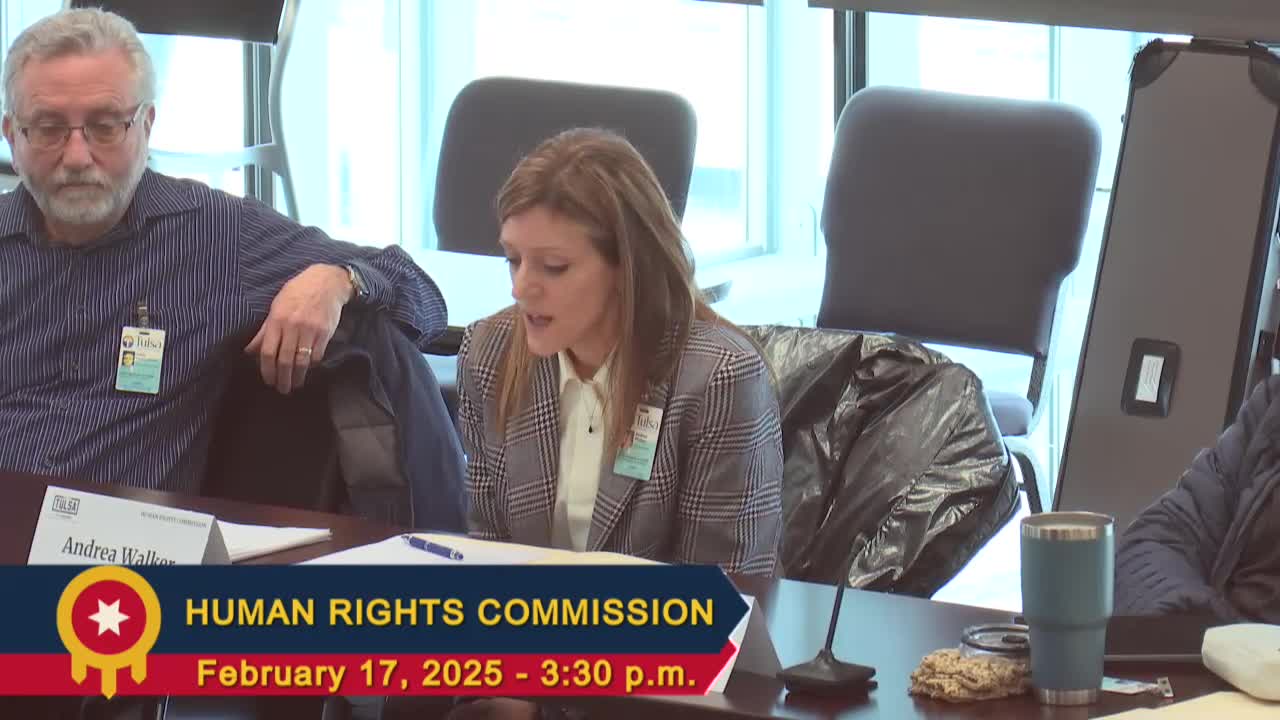
At a Tulsa Human Rights Commission meeting, Compassionate Tulsa chair Gary Paluzzo reviewed the initiative's history and ongoing activities and commissioners debated whether to seek formal reaffirmation by the mayor and council amid concerns about political backlash.
The Tulsa Human Rights Commission heard a presentation from Dr. Gary Paluzzo, chair of Compassionate Tulsa, on the group's origins, activities and a question the committee is now weighing: whether to seek reaffirmation of the city’s earlier pledge to the international Charter for Compassion.
Paluzzo told commissioners that the initiative grew from Karen Armstrong’s Charter for Compassion and a global Compassionate Cities movement, and that local organizers secured a city resolution and mayoral support in about 2014–15. "To be present with those who are suffering in a way that helps," Paluzzo said, describing the core meaning of compassion in the Charter’s framing. He said the Tulsa committee has operated mostly as an unpaid volunteer group of "about 8 or 9 persons" and has focused on public recognition, small vigils, awards for people acting compassionately, and occasional benefit events for local organizations such as the Day Center for the Homeless.
The panel discussed whether to ask the mayor and city council to reaffirm Tulsa’s commitment to the Charter for Compassion. Commissioners and committee members offered several approaches: asking individual Title 5 commissions to sign on as part of onboarding or annually, asking the mayor to issue an executive order or an informational reaffirmation, or instead prioritizing an educational memo to put Compassionate Tulsa back on the mayor’s and city staff’s radar.
Commissioners raised practical and political concerns. Some said a formal reaffirmation could draw political scrutiny tied to national debates over diversity, equity and inclusion; others said a lighter educational approach would preserve momentum without creating controversy. A staff member, Lexi, suggested an educational memo to the mayor’s office that city staff could deliver so the committee’s work "stays on the mayor's office's radar and, like, continues to be an important part of the work that we do here." Paluzzo said the committee is debating whether to seek reaffirmation now, noting that several of the officials who originally approved Tulsa’s pledge are no longer in office.
Commissioners also suggested operational steps if the group pursues renewal: broaden committee membership and succession planning, invite the mayor or councilors to speak to the commission on the subject, place reaffirmation materials into new-council onboarding, and involve other commissions in cross-collaboration. Paluzzo said the committee would welcome help identifying nominations for its compassion awards and suggested collaboration on public education about the initiative.
The commission did not take a formal vote on reaffirmation. Discussion ended with agreement to consider a lower-profile education and outreach path while weighing the political timing for any formal request to the mayor and council.
Compassionate Tulsa and the Charter for Compassion The commission reviewed the text of the city resolution that affirmed Tulsa’s support for the Charter for Compassion; the resolution named Tulsa "the mother road of compassion in America" and tasked the Human Rights Commission with establishing a steering committee to cultivate compassion and partner with public and private entities. Paluzzo and committee members said the group’s volunteer status and lack of a steady budget limit what it can accomplish compared with cities that have funded offices dedicated to the work.
The discussion placed Compassionate Tulsa’s future direction alongside the HRC’s year-long focus on civic engagement and representation. Commissioners recommended collecting baseline information on representation in Title 5 commissions, exploring partnerships (for example, with Leadership Tulsa or local foundations), and using the commission’s meetings to advance actionable civic-engagement initiatives.
Ending: next steps and outreach Commissioners asked Compassionate Tulsa to circulate materials and possible language for a reaffirmation or an informational memo, and to consider wider outreach for new volunteers and partners. Paluzzo said the committee will follow up with staff and commissioners about next steps and about invitations to participate in award nominations and education efforts.