Get Full Government Meeting Transcripts, Videos, & Alerts Forever!
Get email alerts on the State Housing Reforms topic
No spam. Unsubscribe anytime.
State housing reforms and ADU, middle‑housing mandates highlighted for Spokane Valley
Summary
Washington State Department of Commerce staff told Spokane Valley planners on Feb. 13 that state law changes require the city to plan for housing across income bands and update local rules on accessory dwelling units, middle housing, unit‑lot subdivision, co‑living and conversions.
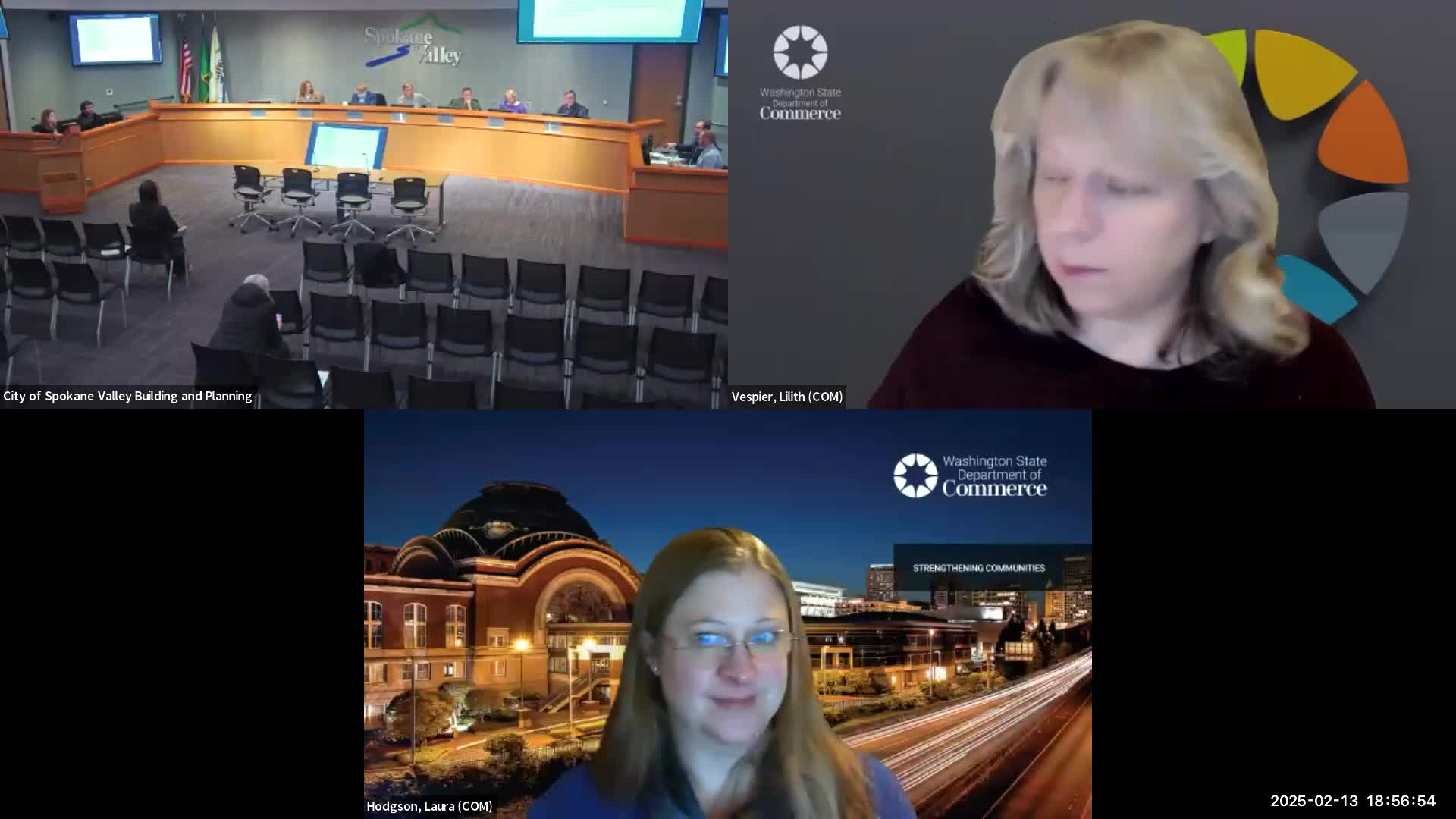
Washington State Department of Commerce staff gave the Spokane Valley Planning Commission an overview Thursday of state-level housing changes the city must address during its comprehensive-plan update and subsequent code revisions.
Commerce officials said legislative changes that began in 2021 require jurisdictions to plan for housing “affordable to all economic segments,” provide a common projection methodology for housing need, and translate housing needs by income band into local zoning capacity and implementation actions. Laura Hodgkin, housing and planning and data manager at the Washington State Department of Commerce, and Lilith Besper, infill housing manager, presented the guidance and timelines.
Key takeaways from Commerce’s presentation: - Housing needs by income: Commerce projects housing needs by income level and the county and its cities decide how to allocate those needs among jurisdictions. Local governments must show sufficient land capacity for each income segment or enact zoning changes to create capacity. - Accessory dwelling units: State law requires jurisdictions within urban growth areas to allow up to two ADUs on a lot, allows ADUs to be sold separately (for example through condominiumization), removes an owner‑occupancy requirement (except where short‑term‑rental rules apply), sets a typical minimum ADU size at 1,000 square feet in statute discussion, and limits impact fees for ADUs to 50% of those charged against a principal unit. - Middle housing and unit‑lot subdivisions: Tier‑1 cities such as Spokane Valley must allow multiple middle‑housing types (duplexes, triplexes, courtyard apartments, townhomes and others). Where six units are allowed by local rules, jurisdiction may offer an option to allow six units if two are income‑restricted (long‑term affordability). Unit‑lot subdivision rules enable individual ownership within multi‑unit developments while keeping some site controls at the parent‑lot level. - Co‑living and conversions: Co‑living (lockable sleeping units with shared kitchens) must be allowed where six or more units are permitted; state rules treat a co‑living unit as 1/4 of a dwelling unit for density and parking metrics. Jurisdictions also must allow conversion of commercially or mixed‑use buildings to residential uses and may allow up to 50% more units within the existing building envelope in those conversions. - Emergency and supportive housing: Cities must allow emergency shelters, transitional housing and permanent supportive housing in the same zones that allow hotels or residential development; jurisdictions may adopt spacing or occupancy limits only if adequate land capacity is retained elsewhere.
Commerce provided tools and checklists (including the Housing Action Planning tool and middle‑housing guidance) and said timelines require local code updates tied to the periodic comprehensive‑plan update. Hodgkin told commissioners counties and cities are to coordinate how much of the countywide need each jurisdiction will plan for, and noted that jurisdictions will have to document barriers to housing and adopt a work program of actions and policies to address those barriers.
Commissioner reaction and local questions Commissioners raised concerns about infrastructure capacity, parking spillover and neighborhood character. Commissioner Wilson said removing the owner‑occupancy requirement for ADUs could open the door to absentee investors and increase traffic and demands on public services. Commissioner Winkler asked how the state’s allocation process is being handled locally; Spokane Valley planning staff said county planners and elected officials are coordinating and that a steering committee and technical advisory team have produced preliminary outputs.
Commerce staff responded to cost‑and‑capacity questions by noting that some deeply affordable housing (below 50% area median income) typically requires subsidy and that many of the state’s new options are intended to increase capacity for moderate‑ and middle‑income households unless paired with funding. Hodgkin said the state and counties are attempting to map displacement risk and racially disparate impacts so jurisdictions can tailor policies to preserve affordable housing and reduce displacement.
Timing and compliance notes Commerce staff said many of the regulatory changes have fixed deadlines tied to a jurisdiction’s periodic update: ADU and middle‑housing regulations must be adopted within six months after the periodic update or the state may impose preemption; co‑living rules must be adopted by Dec. 31, 2025; unit‑lot subdivision and conversion requirements also have near‑term deadlines tied to the periodic update. Staff stressed the statutes require cities to “plan for and accommodate” needs but said local governments are not the builders; instead they are required to change zoning, permit timelines and other policies to enable housing production. Hodgkin said there is no statutory penalty for failing to meet projected housing needs, but the state can preempt inconsistent local regulations.
Commerce also pointed commissioners to detailed checklists and model ordinances and offered follow‑up technical help. Several commissioners asked staff for more local examples and data; Commerce agreed to provide jurisdiction‑level examples and referenced a range of technical guidance on its website.
What commissioners said at the meeting reflected a range of viewpoints: some criticized the state mandates as “central planning” that could alter neighborhood character and raise local costs; others supported finding ways to increase housing options and ownership opportunities. Planning staff said the Valley’s next steps will include mapping local capacity against the countywide housing allocation, drafting alternatives to address any capacity shortfalls, and returning materials for public hearings and council review.