Get Full Government Meeting Transcripts, Videos, & Alerts Forever!
Get email alerts on the Right Of Way Permits topic
No spam. Unsubscribe anytime.
Spokane Valley planning commission advances rewrite of right-of-way permit rules
Summary
The Spokane Valley Planning Commission voted to forward a code-text amendment that would repeal sections of the development code governing right-of-way permits, remove an ambiguous “normal maintenance” exemption, and relocate permit regulations to a different title of the municipal code for clearer standards and enforcement.
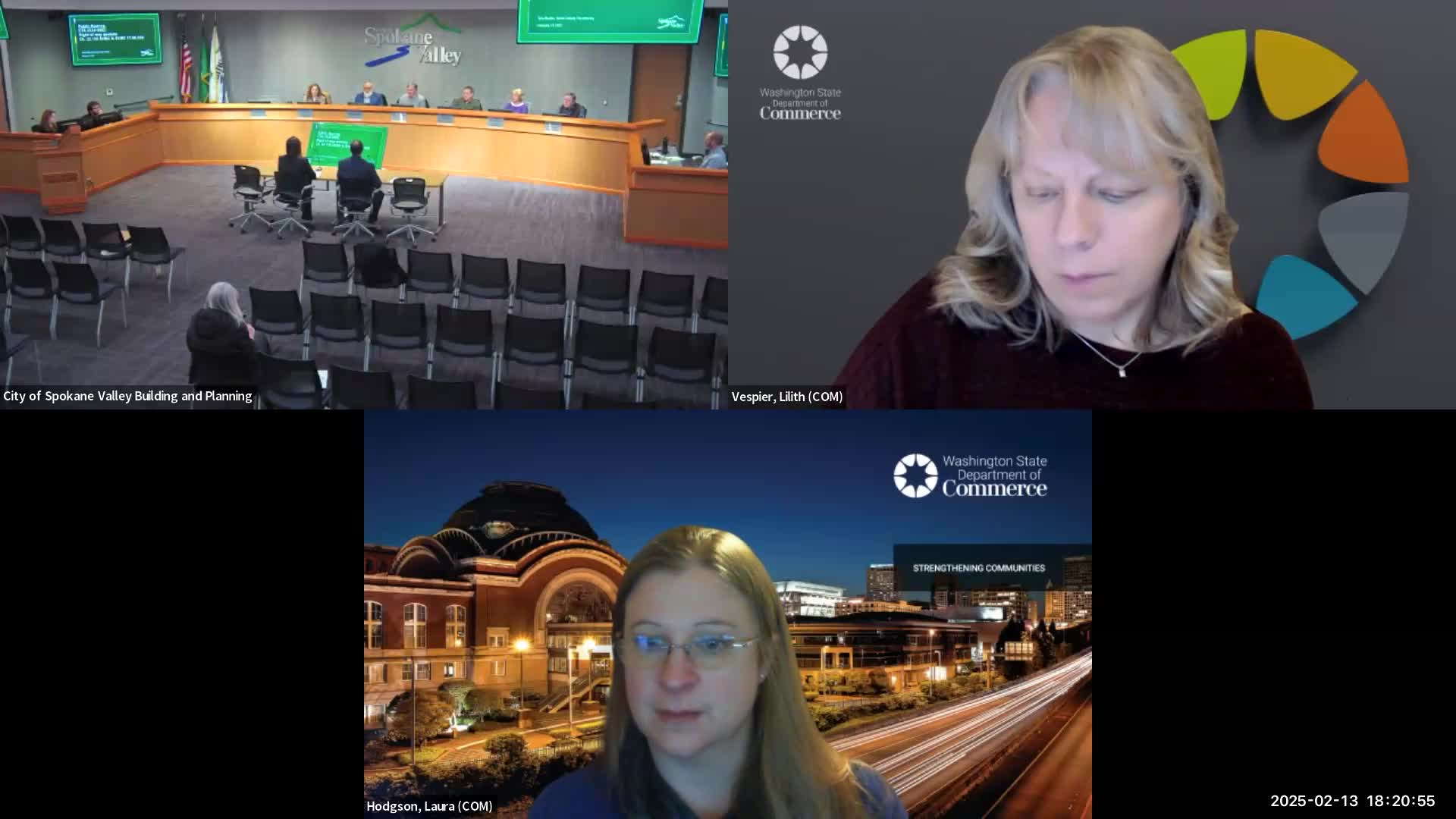
The Spokane Valley Planning Commission voted Thursday to send a code-text amendment (CTA) that would remove current right-of-way permit language from Title 22 of the Spokane Valley Municipal Code and advance a replacement set of regulations to the City Council.
The change, discussed during a public hearing, would repeal section 22.1.30.100 of the city code and related language and move right-of-way permit regulations into a different title (staff said Title 9 is the current plan). The commission voted to forward the amendment to council with findings; the roll call indicated six members present and the motion carried unanimously.
The amendment’s sponsors told the commission the goal is to clarify when a right-of-way permit is required, shorten and standardize permit-processing timelines, and remove a vague exemption that city staff said has been invoked by contractors to avoid permitting and traffic control requirements. “We get a lot of [right-of-way permits], as you can expect,” a planning staff member said during the presentation, noting many applications come from utility purveyors and commercial contractors.
Why it matters: Staff and commissioners said the current code contains ambiguous language—specifically a provision in SVMC Title 17 described in the presentation as allowing “normal or emergency repair or maintenance” without a permit—that has been used by some businesses to avoid permitting requirements and, in at least two cited cases, contributed to unsafe conditions in the traveled right-of-way.
What staff proposed: Senior Deputy City Attorney and Building Official Jenny Nickerson and planning staff described these key elements: - Repeal of the current 22.1.30.100 right-of-way permit section and relocation of permit rules into a new chapter (staff said Title 9 is the likely destination but the council will set final placement). - Removal of the undefined “normal maintenance” exemption in Title 17 so that routine activities no longer create loopholes contractors can use to skip permits and traffic controls. - Elimination of an unused “conditional use permit” provision (22.1.30.090) that staff said was never implemented. - Clarification of timelines and a stated target of issuing most permits within three business days; staff said current processing typically takes two to three days. - Alignment with the regional pavement-cut policy, including rules that limit pavement cuts for a set period after paving (staff said generally that period is five years and repairs in that time trigger more stringent repair requirements).
Staff said the city issued about 1,100 right-of-way permits in 2024 and that the traffic engineering team coordinates scheduling, flagging plans and insurance requirements to protect travelers when work occurs in the public right-of-way.
Questions from commissioners focused on: how far the public right-of-way extends across properties (staff said it varies by street and parcels and called out the Valley Viewer GIS map as a public tool to estimate rights-of-way); how the change will affect developers (staff said development-related infrastructure work would still require right-of-way permits and coordination with building/land‑disturbance review); and whether emergency repairs would still be exempt (staff said emergency repairs typically remain exempt).
The commission also discussed where the new regulations should live. Staff explained that development regulations historically come before the planning commission, but regulations adopted outside the development code (e.g., in Title 9 or Title 7) commonly go directly to council; staff said the planned right-of-way regulations are expected to go to council for adoption while the repeal of the existing text is handled through the planning‑commission process.
Vote and next steps: The commission voted to advance the CTA to City Council. Commissioners present at the roll call were Chair Bob McKinley, Vice Chair Robertson, Commissioners Meyer, Kelly, Winkler, and Wilson; Commissioner Weathermon had notified the commission he would be absent. Staff said they will prepare findings of fact and forward the record to council in the coming weeks.
Context and caveats: Staff emphasized that the draft relocation of the rules (the full replacement language) was not before the commission and will be considered by council; the commission’s action removes the current language from Title 22 and clears the path for council to adopt a consolidated right-of-way permitting chapter in the appropriate title. Several commissioners urged staff and council to ensure the replacement language preserves reasonable, low-cost options for homeowners while closing the loopholes used by contractors to avoid required traffic control and insurance.
Next scheduled steps: Staff told commissioners they expect to return with findings at the commission’s next meeting and to forward the package to council likely in March.