Get Full Government Meeting Transcripts, Videos, & Alerts Forever!
Get email alerts on the Employee Health Insurance topic
No spam. Unsubscribe anytime.
Joint finance committee approves higher health-insurance funding per employee
Summary
The Joint Finance-Appropriations Committee approved raising the state's health insurance funding to $14,130 per eligible full-time position for FY2026 after debate about reserves and prior use of one-time funds.
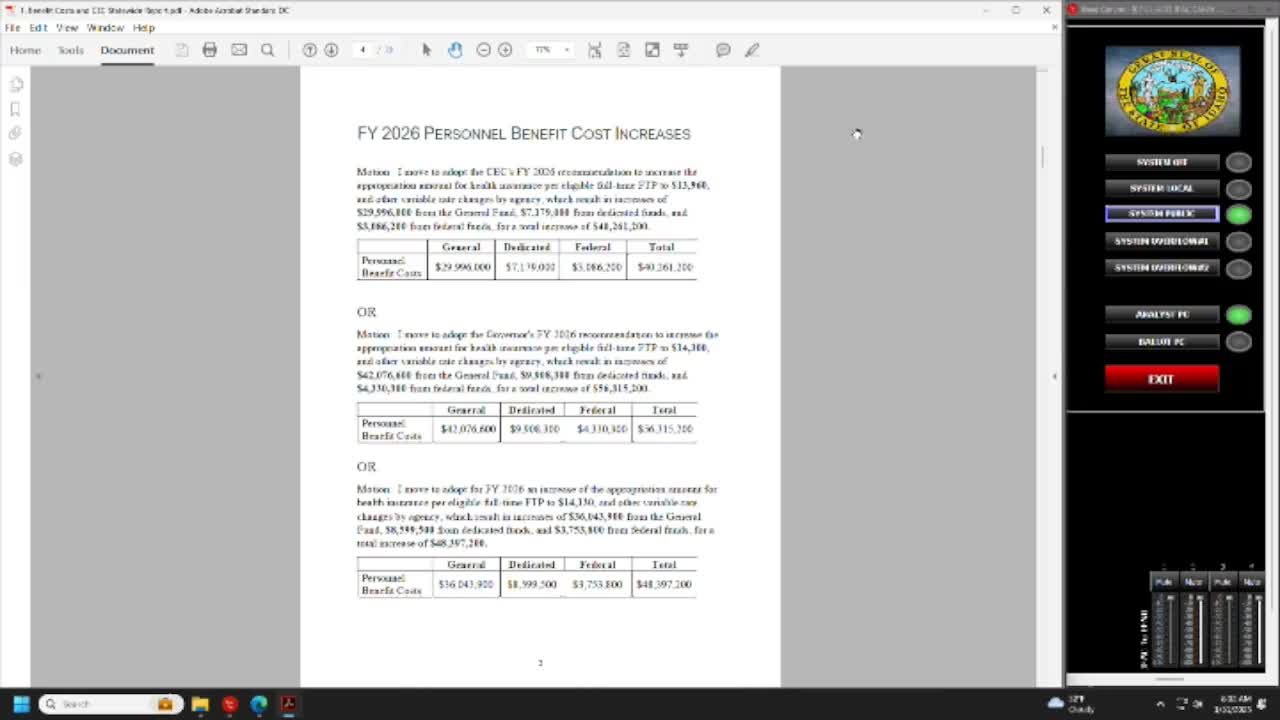
The Joint Finance-Appropriations Committee voted to raise the state's FY2026 health-insurance funding to $14,130 per eligible full-time equivalent position, a move the panel said reflects current cost trends for the Office of Group Insurance.
The action, taken during the committee's Jan. 31 meeting in Boise, increases appropriations by $36,043,900 from the general fund, $8,599,500 from dedicated funds and $3,753,800 from federal funds, for a total increase of $48,397,200. The motion was moved by Senator Woodward and seconded by Representative Tanner before passing by the joint committee vote that met the required majorities in each chamber.
Committee members said the decision should reflect the actual cost of insurance rather than masking out-year changes with one-time reserves. "This reflects the actual cost of insurance," said Senator Ward Engelking during debate, arguing that buying down premiums with reserve funds in prior years distorted the true cost trajectory.
Analysts told the committee the three dollar-level options before members would leave different projected reserve balances. "The projections with the amended substitute motion, that's at health insurance costs at 13,960. The projected reserve balance for fiscal year 2026, the ending balance is $51,600,000," Mr. Bybee said, adding that the governor's $14,300 option projected an ending reserve of $61,400,000.
Debate touched on how prior use of reserves affected perceived premium increases. Representative Furness urged caution about using reserves to artificially lower premiums, saying actuarial projections from the firm Milliman have been conservative in the past and that reserve levels had grown in recent years.
The committee approved the $14,130 figure by the committee's joint roll call. The clerk recorded the Senate vote as 8 ayes, 0 nays, 2 absent/excused and the House vote as 9 ayes, 0 nays, 1 absent/excused, for a combined 17 ayes, 0 nays and 3 absent/excused. The committee announced the motion would carry a due-pass recommendation.
The committee then moved on to further compensation and CEC items on the agenda.