Get Full Government Meeting Transcripts, Videos, & Alerts Forever!
Get email alerts on the Prison Security Transport topic
No spam. Unsubscribe anytime.
After shootings during transport, Idaho DOC seeks cameras, drone detection and expanded transport unit
Summary
Following a spring ambush that left three Department of Correction staff shot during an inmate transport, the Idaho Department of Correction told the Joint Finance‑Appropriations Committee it needs cameras, drone detection and a larger, specially trained transport bureau to reduce future risks.
The Idaho Department of Correction asked the Joint Finance‑Appropriations Committee on Feb. 4 for a package of security enhancements after a spring incident in which staff were ambushed while transporting an inmate to and from a hospital.
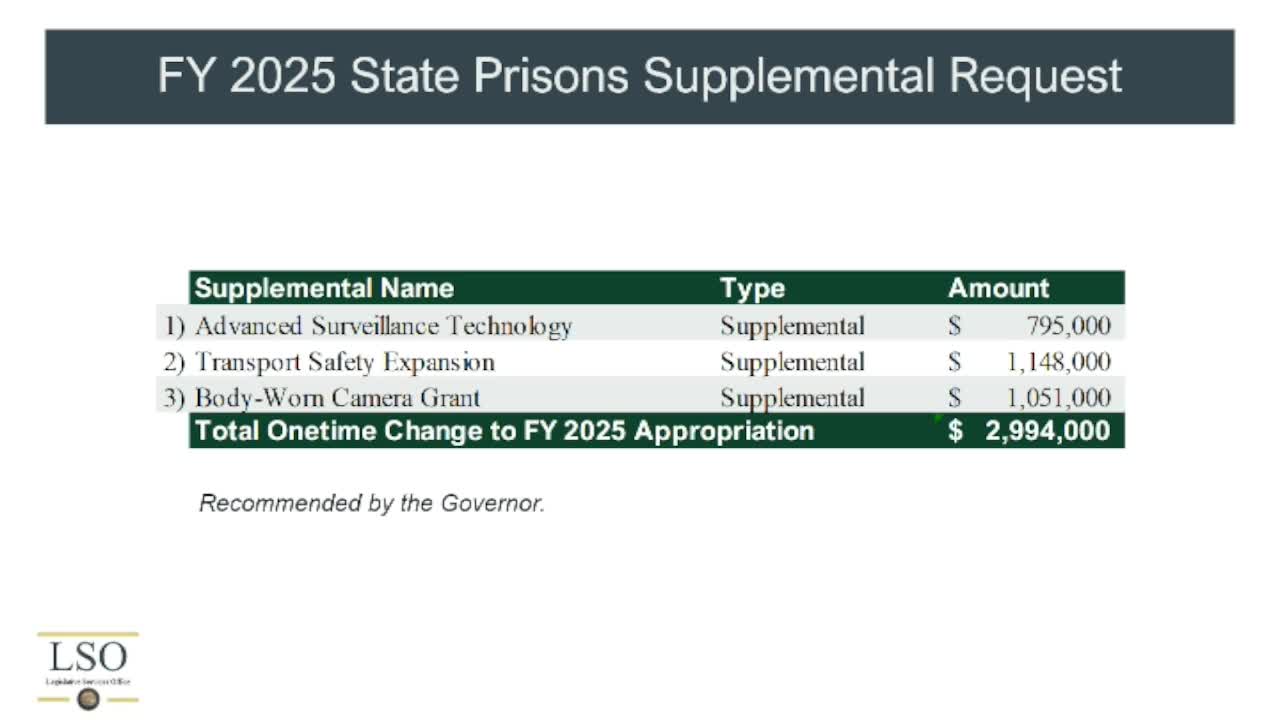
Noah Peterson, budget policy analyst with the Legislative Services Office, told the committee the state prisons division’s supplemental and ongoing requests are designed to address vulnerabilities discovered after the transport ambush. He described three categories of surveillance and detection technology the agency is seeking: digital mail scanning, drone detection, and phone‑call transcription/analysis (described as LEO intelligence software). Peterson said the agency requested $795,000 in FY2025 to begin implementation and $2.397 million annually thereafter to cover full‑year operations.
The requested digital mail scanning would redirect incoming mail to an off‑site facility where it would be opened, scanned and delivered to inmates digitally — a change the director said would remove a “most porous point of entry” for contraband.
The transport bureau expansion: The department requested a $1.148 million one‑time supplemental to expand the Transport Safety Bureau and fund 12 full‑time positions to handle high‑risk and emergency transports, plus seven equipped vehicles. Peterson said the transport bureau currently handles scheduled and non‑emergent transports but not emergency medical transports, a gap exploited in the spring attack.
Director Josh Tewalt told the committee the decision to add dedicated transport staff reflects operational realities: emergency transports historically have been filled by staff assigned other duties, which requires calling teams, creating staffing gaps and triggering large amounts of overtime. He said the department logged roughly 20,000 overtime hours at one facility and 14,000 at another during the period in question.
“Historically we have relied on emergency transports as being unknown,” Tewalt said. “This was a planned event where they were able to manipulate our transport and get our staff in a really vulnerable position in ways that, candidly, as their director, I do not believe they were trained to respond to.” He described the proposed structure as a targeted resource to respond to high‑risk transports rather than replacing every facility’s emergency response capabilities.
Body‑worn camera pilot: The department also requested federal funds to pilot body‑worn cameras at Idaho Maximum Security Institution, a District 3 probation and parole office, and special investigations. Peterson said the FY2025 supplemental would be primarily federal funds ($1.204 million federal; $27,000 general fund) covering cameras, docking stations, licenses and evidence storage; the state would carry a portion of the match in FY2026 if the pilot continues.
Director Tewalt urged the committee to consider the increasing sophistication of contraband channels, citing drones and chemical‑treated printing inks as emerging threats. He said the combination of mail scanning, drone detection and call transcription would allow the department to redeploy staff from manual mail screening to higher‑value security tasks and improve coordination with law enforcement when interception is possible.
Governor’s recommendation: The governor recommended most items; a single difference involved a snow‑removal skid‑steer for St. Anthony’s Work Camp, for which the governor recommended contracting snow removal at $30,000 annually rather than a one‑time $83,200 capital purchase. Department of Administration representatives explained the governor favored contracting seasonal services rather than buying specialized seasonal equipment.
No formal appropriation was recorded during the hearing. Committee members asked for written follow‑ups on implementation details, cost comparisons and whether other staffing options were considered.