Get Full Government Meeting Transcripts, Videos, & Alerts Forever!
Get email alerts on the Historic Preservation topic
No spam. Unsubscribe anytime.
Utah Main Street announces Revive and Reside grants to convert historic upper floors to housing and activate downtown interiors
Summary
Utah Main Street announced a new Revive and Reside grant program that will fund interior rehabilitation of historic downtown buildings, with applications opening Wednesday, Feb. 5 and closing March 21.
Utah Main Street announced a new Revive and Reside grant program that will fund interior rehabilitation of historic downtown buildings, with applications opening Wednesday, Feb. 5 and closing March 21. The program is intended to help convert underused upper floors to housing and reactivate ground floors for commercial use in designated Utah Main Street historic districts.
The program "has one overarching vision, which is to fund improvements to interior spaces of historic buildings in Utah's communities," said Carly Stauffer, grants administrator for Utah Main Street. Stauffer said the program includes separate rural and urban grant tracks with different funding sources and requirements.
Why it matters: This is the first grant of this type offered by Utah Main Street, the presenters said, and targets vacant or underused interior spaces in Tier 2 Main Street districts to encourage downtown housing and street-level economic activity. Awardees will enter preservation agreements and must meet federal or state preservation standards depending on the funding source.
Program structure and funds The Revive and Reside program is split into two tracks. The Rural Revive and Reside track uses federal funds passed through the National Park Service; projects awarded on the rural track will remain federal funds and are therefore subject to National Park Service oversight and federal requirements, including NEPA review where applicable. The Urban Revive and Reside track is funded directly by Utah Main Street with state funds and is subject to state-level requirements, the presenters said.
Stauffer said rural awards are reimbursement-based because of federal fund rules; urban award disbursement schedules will be handled case by case. All projects must meet the Secretary of the Interior's Standards for Rehabilitation and enter into a preservation agreement of at least five years. Awarded projects will be required to submit short monthly status updates with photos and a more comprehensive biannual report.
Eligible scope and exclusions Eligible work targets interior rehabilitation to activate commercial ground floors and convert upper floors to residential use. Examples given included repair or rehabilitation of historic interior architectural features, installation or repair of fire suppression systems, interior accessibility upgrades required by code, electrical and plumbing upgrades, flooring repair or replacement, and repair of restorable windows. Presenters explicitly said exterior façade work, new construction, or reconstruction of properties that no longer exist are not eligible under this grant.
Application, eligibility and required documentation Stauffer said eligible applicants include property owners and tenants of qualifying historic buildings located within the designated boundaries of a Tier 2 Utah Main Street historic district. Tenants must submit property-owner consent for the proposed scope of work. Corporations and nonprofits must supply a board resolution authorizing the applicant signer.
Applicants must determine whether they are in the rural or urban track using the U.S. Department of Agriculture (USDA) Rural Development eligibility map (the presenters said the USDA tool is a National Park Service requirement for determining rural/urban status). If the USDA map marks an address as eligible, applicants should follow the rural packet; if the map shows an address as ineligible, applicants should use the urban packet, Stauffer said. Presenters also recommended using the Historic Utah Buildings GIS hub (hub.utah.gov) to confirm National Register status and Main Street district boundaries.
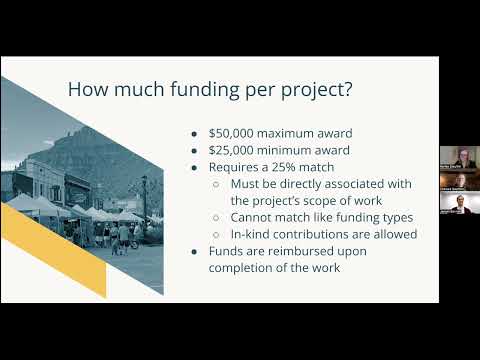
Funding mechanics, match and timelines Presenters said the grant requires a 25% match, which may be cash or eligible in-kind contributions directly associated with the project scope. As an example provided in the briefing, a $50,000 project would require a $12,500 match. Stauffer also noted project schedules in awarded contracts will generally allow two to three years to complete construction deliverables; each award will include a timeline in the grant contract.
Application and review schedule Stauffer said the application window opens Feb. 5 and closes March 21; applications will be reviewed after the deadline and applicants should hear decisions within about 30 days for the urban track, with additional National Park Service review time for rural awards. The program packets, sample applications, sample preservation agreement and a sample scoring sheet will be posted on the Utah Main Street website, and staff will publish tutorials for obtaining an EIN and a UEI (required for applicants receiving federal funds).
Assistance and contacts Presenters encouraged potential applicants to consult with Utah Main Street staff during application development. "The consultation with us is going to be beneficial," said Janssen Bennett, preservation architect with the State Historic Preservation Office, who said staff can advise whether a building is contributing to the National Register and which documentation may shorten review periods. Carly Stauffer is the lead for grant application questions; Chelsea Gauthier, Utah Main Street program manager and statewide coordinator, participated in the presentation and posted resource links in the webinar chat.
What remains unspecified in the briefing Presenters described program elements and provided an example match calculation, but the briefing included one contradictory phrasing about award size in the slide narration; applicants were directed to the program packets for official figures and scoring details and were told to rely on the posted program documents for exact award amounts, reimbursement schedules and scoring priorities.
Next steps Utah Main Street will post the Rural and Urban Revive and Reside program packets, sample applications, preservation agreement templates and scoring sheets on its website and provide step-by-step tutorials for obtaining required federal identifiers prior to the application opening. Interested property owners or tenants were asked to sign up via the contact form shared in the webinar chat and to email questions to the staff leads listed in the packet.