Get Full Government Meeting Transcripts, Videos, & Alerts Forever!
Get email alerts on the Transit topic
No spam. Unsubscribe anytime.
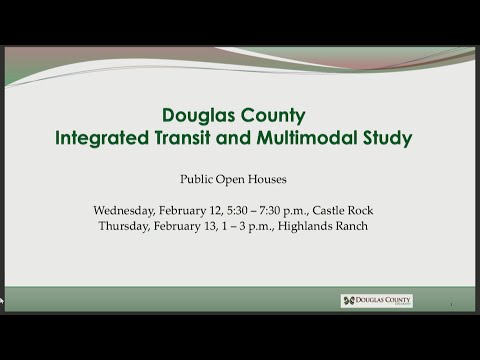
Douglas County holds open house on integrated transit options; DRCOG-funded pilots eyed for 2026–27
Summary
Douglas County project staff and consultants presented transit-service options including subregional fixed routes, local circulators and microtransit at a public open house, seeking public feedback and prioritization; DRCOG improvement-program funding was identified for pilot projects in 2026–27 and an online survey is open through Feb. 23.
Douglas County staff and consultants outlined short- and long-term transit options and solicited public input at the county’s first open house for the integrated transit and multimodal feasibility study.
The presentation, led by Zeke Lynch of Douglas County, consultant Jason of Farron Pierce and project team member Morgan, reviewed existing conditions, three categories of potential service (subregional fixed routes, local circulators and on‑demand microtransit), safety and infrastructure needs, and next steps including pilot-definition and public outreach.
County staff said the study, which has been under way for about 10 months, focuses on the county’s more urbanized areas rather than low‑density recreation zones such as Deckers. Lynch said the county covers about 843 square miles, “roughly a third of which is Pike National Forest, the third of which is rural residential, and the other third is more suburban and urban areas of the Northern tier.”
Consultant Jason described the three service categories under consideration. He said subregional fixed routes would run on schedules across longer distances—routes of about 5 to 20 miles—connecting multiple communities and major activity centers. Local circulators would operate on fixed routes inside single communities with more frequent stops but generally lower speeds; Jason noted a typical local service might run every hour. Microtransit would operate on demand within a defined zone using smartphone or call‑in requests and “connect any two points within a defined zone,” with typical vehicle-fulfillment times of about 20 to 30 minutes.
The presenters discussed tradeoffs among cost, coverage and usability: microtransit can be convenient and adaptable but has higher operating cost per passenger and may require additional vehicles as ridership grows; fixed routes can provide faster longer-distance travel but may offer less local access and lower off‑peak frequency; local circulators improve intra‑community connectivity but can add travel time for longer trips. Jason also noted that services that are not fixed-route would still require provision of ADA‑complementary paratransit where applicable under the Americans with Disabilities Act.
Safety, customer service and physical infrastructure were emphasized as critical supportive elements regardless of service type. Jason listed driver training, visible security, bus-stop design, pedestrian connections, park-and-ride availability and integration with the county’s existing bike‑ped network as items the study will detail.
On funding, Morgan told attendees that the local metropolitan planning organization has provided improvement‑program funding to support pilot implementation in 2026 and 2027. She said longer‑term, sustainable funding would likely be a mix of local contributions, regional funding (including potential RTD partnerships), state and federal sources, and that municipalities could elect to add local funding.
Project staff outlined next steps: incorporate public and stakeholder feedback (an online survey open through Feb. 23), prioritize options, and further detail pilot projects with their safety and connectivity needs before the study concludes in mid‑summer. The presentation also invited attendees to review display boards and speak with project team members after the formal remarks.
No formal motions or votes were taken at the open house; the meeting was an informational public outreach event to gather input for the ongoing feasibility study.