Get Full Government Meeting Transcripts, Videos, & Alerts Forever!
Get email alerts on the Surgical Abortion Regulation topic
No spam. Unsubscribe anytime.
Committee advances bill requiring surgical abortion facilities to be licensed as ambulatory surgical centers
Summary
House Bill 42 would require surgical abortion facilities to be licensed as ambulatory surgical centers, require Wyoming-licensed physicians with hospital admitting privileges within 10 miles, and add reporting and inspection provisions; the committee advanced the bill after testimony and a 4-1 roll call.
CHEYENNE, Feb. 14 — The Senate Labor, Health & Social Services Committee voted to advance House Bill 42, a measure that would bring surgical abortion facilities in Wyoming under the state ambulatory surgical center licensing regime and add related reporting, inspection and admitting-privileges requirements.
Representative Volley, sponsor of House Bill 42, told the committee the state has an obligation "to protect the health and safety of women who are getting surgical abortions." Volley described the bill as aligning surgical abortion facilities with existing ambulatory surgical center standards and said the measure would require such facilities to be licensed and inspected, require procedures to be performed by physicians licensed in Wyoming, and require those physicians to have admitting privileges at a hospital within 10 miles of the surgical facility.
Under the bill text discussed at the hearing, a surgical abortion facility would be defined as an ambulatory surgical center and subject to licensing, periodic on-site surveys (the bill mentions a three-year inspection cycle consistent with department practice), annual license renewals and reporting to the Wyoming Department of Health. The bill also sets penalties for violations, ranging from misdemeanor fines to a felony for performing abortions without a Wyoming medical license.
Representative Volley said the 10-mile admitting-privileges requirement was intended to ensure continuity of care in the rare event of an emergency during a procedure. He said the exemption threshold for the licensing requirement — facilities that perform fewer than a specified number of first-trimester procedures per month — reflected input from clinicians who provide occasional procedures in physician offices rather than dedicated surgical centers.
Stefan Johansen, director of the Wyoming Department of Health, told the committee the department's Office of Healthcare Licensing and Surveys handles licensure and compliance for hospitals, nursing homes and ambulatory surgical centers and that the office currently averages on-site ambulatory surgical center surveys about every three years. Johansen said the department could absorb these responsibilities initially but would need to monitor provider volume and might seek resources if the number of providers rises; he also said rule changes to align state licensure would typically take six to nine months on the standard timeline and that emergency rules could be used to implement an immediate effective date.
Opponents and supporters gave sharply contrasting accounts. Supporters, including former clinicians and several citizen witnesses, said inspections, physician licensing and admitting-privileges requirements are routine patient-safety measures. Opponents, including practicing physicians and reproductive-rights advocates, said the proposal targets a single provider type and risks creating access problems without demonstrable patient-safety benefits; several witnesses cited guidance from the American Medical Association and ACOG arguing that admitting-privileges requirements do not improve patient safety.
Committee members raised drafting issues, including whether the statutory definitions should align with other related bills (members noted the two abortion-related bills under consideration used different definitions of "abortion" and "fetal demise") and the scope of exemptions for low-volume providers. Representative Volley said the low-volume exception was requested by pro-life physicians who perform urgent procedures in office settings and are not full ambulatory surgical centers.
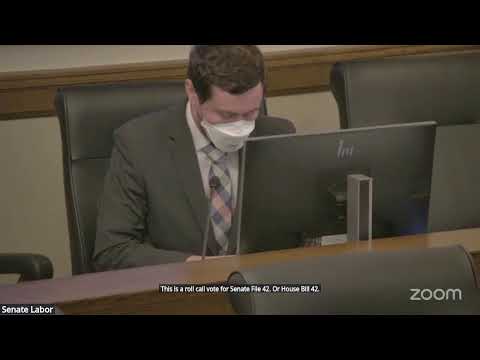
After committee discussion and public testimony, the committee took a roll-call vote. Senators recorded on the roll call: Crum — Aye; Hutchings — Aye; Scott — No; Steinmetz — Aye; Chairman Barlow — Aye. The clerk announced the recorded vote as 4 ayes and 1 no and the bill advanced from committee.
What’s next: The measure will be scheduled for further Senate consideration; sponsors and committee members indicated additional drafting to harmonize definitions with other pending measures may follow.
Votes at a glance: House Bill 42 — advanced from committee on a roll call announced as 4 ayes, 1 no.