Get Full Government Meeting Transcripts, Videos, & Alerts Forever!
Get email alerts on the Medication Abortion Ultrasound topic
No spam. Unsubscribe anytime.
Wyoming committee advances bill requiring ultrasound and 48-hour wait for medication abortions
Summary
The Senate Labor, Health & Social Services Committee voted to advance House Bill 64, which would require a time-stamped ultrasound and a minimum 48-hour waiting period before dispensing medication for a chemical (medication) abortion; the measure drew extensive testimony both for and against and passed the committee by a 4-1 roll call.
CHEYENNE, Feb. 14 — The Senate Labor, Health & Social Services Committee voted to send House Bill 64 forward after testimony and questions about safety, rural access and medical standards for medication (chemical) abortion.
Speaker Nyman, sponsor of House Bill 64, told the committee the bill is intended to reduce harms he described as resulting from medication abortions being obtained and taken without in-person medical verification. "Abortion is... chemical abortion is becoming the more favored choice," Nyman said, arguing that an ultrasound helps confirm gestational age and location and that the proposed 48-hour requirement would give women information before receiving pills.
The bill requires a certified ultrasound, dated and time stamped and performed by a named provider, before a pharmacist or physician may dispense drugs used for a medication abortion. It would also require the pregnant person the opportunity to view the ultrasound image and the fetal cardiac motion. Sponsors said the measure is aimed at confirming gestational age (they cited manufacturers' guidance that the drugs are designed for early gestation) and detecting ectopic pregnancies.
Supporters who testified at the hearing said the measure protects patients. Dr. David Lind, a retired OB-GYN, said many patients do not know how far along they are and that ultrasound-based dating is standard medical practice. Several speakers representing faith-based organizations and pregnancy support groups said state regulation of medication abortion would protect women and unborn children.
Opponents — including practicing physicians, reproductive-rights groups and the ACLU of Wyoming — said the requirement is medically unnecessary and would impose burdensome delays, especially for people in rural areas. Dr. Renee Henkel, an OB-GYN in Cheyenne, told the committee she opposed both bills and cited studies she said show increases in maternal and infant mortality in states with restrictions; she characterized a required ultrasound as discriminatory and unnecessary for medication abortion. The ACLU's Advocacy Director Antonio Serrano noted that the American College of Obstetricians and Gynecologists (ACOG) generally does not require ultrasound for medication abortion and said the bill would create an extra barrier for rural patients.
Wyoming Department of Health director Stefan Johansen said his office would conduct licensure and inspection activity if the measure passed and that, while the department could incorporate additional requirements into existing workflows, formal rulemaking would likely be required and could take months. Johansen said the department could use emergency rulemaking if needed but could not guarantee that no new resources would be necessary if volume increased.
Committee members pressed sponsors on technical drafting points: whether other prescribers (advanced practice nurses or physician assistants) would be covered, whether nontransvaginal versus transvaginal sonography would satisfy the requirement, and how the bill would treat a pregnancy already determined to be nonviable. Sponsor responses repeatedly framed the bill as intended to ensure "compassion" and confirm clinical facts before medication is dispensed.
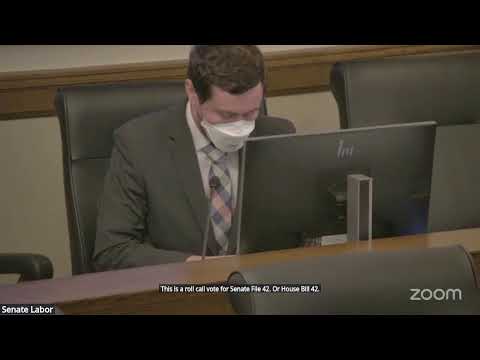
After public comment and committee discussion, the committee took a roll-call vote on HB 64. Senators listed on the roll call recorded: Crum — Aye; Hutchings — Aye; Scott — No; Steinmetz — Aye; Chairman Barlow — Aye. The clerk announced the vote as 4 ayes and 1 no and the bill advanced from the committee.
The hearing included roughly a dozen in-room and a similar number of online public commenters who testified both for and against the bills. Arguments in favor focused on patient safety, detection of ectopic pregnancies and confirming gestational age; arguments against emphasized medical guidance from national specialty groups, rural access problems created by additional required visits, bodily autonomy and existing standards of care.
The bill text cited by sponsors would require: a dated/time-stamped ultrasound that identifies location and estimated gestational age; a minimum 48-hour wait between the ultrasound and dispensing of medication for the abortion; and documentation that the ultrasound was performed by a named clinician or technician. The sponsor repeatedly said the drugs are intended for early gestation and that a verified ultrasound is necessary to ensure correct use.
The committee did not adopt final amendments to specify whether an abdominal ultrasound would suffice in all cases, nor did it resolve whether advanced practice clinicians would be authorized prescribers under the measure. Sponsors and committee members indicated those drafting issues could be adjusted before further floor consideration.
Votes at a glance: House Bill 64 — advanced from committee on a roll call announced as 4 ayes, 1 no.
What’s next: The bill will be scheduled for further Senate consideration; sponsors indicated they expected additional drafting changes addressing prescriber types and ultrasound modality before floor action.