Get Full Government Meeting Transcripts, Videos, & Alerts Forever!
Get email alerts on the Elections Appropriations topic
No spam. Unsubscribe anytime.
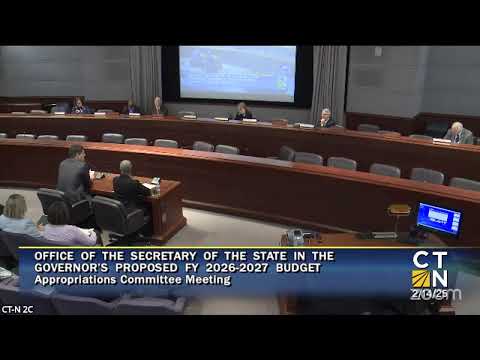
Secretary of the State says governor's budget leaves towns without early voting grants
Summary
At a Feb. 14 General Government A Subcommittee hearing, the Secretary of the State told legislators the governor's proposed budget contains no passthrough funds for towns' early voting expenses and cuts other election-related lines, while tabulator rollout and training continue.
Madam Secretary (name not specified), Secretary of the State, told the General Government A Subcommittee on Feb. 14 that the governor's proposed budget contains no funds to pass through to towns for early voting and reduces several election-related lines that the office has historically used to support municipalities.
The secretary said, "between 2023 and 2026, this office will have implemented more election reforms than in the past 15 years combined, and we do this with a great amount of pride. Yet our budget has not kept pace with this reality, and it's just not sustainable." That testimony framed a hearing focused on the agency's budget requests and the effect of the proposed cuts on both election operations and local governments.
Why it matters: without passthrough funding, towns would have to cover costs that the secretary's office previously supported, such as running secure lines to the central voter registration system, paying for certain printing, and hosting early voting sites. The secretary told the committee that early voting passthroughs included allocations in the current biennium but "there's no funding for the towns at all" in the governor's budget.
Key details and committee discussion
- Early voting allocations: The transcript shows the secretary describing two rounds of passthrough funding. She said the second year of the biennium included "$1,000,000 allocated" and that a minimum town allocation under the formula was "$2,500," with larger towns receiving higher amounts based on turnout and cost. The testimony contains a numerical exchange that is not fully consistent in the record about the first-year total; the secretary and committee agreed they would provide a town-by-town allocation to the committee on request.
- Voting equipment and training: The secretary said tabulators from a pilot have started shipping and are being prioritized for towns with upcoming elections. "Everything will be shipped and people trained by June," she said. She also described coordinating training for about "1,002 people," who would come to Hartford for three- to four-hour sessions depending on town size. The vendor provides machine training, but the office must cover staff time to coordinate the sessions.
- Printing and administrative cuts: The secretary said a printing line has been reduced and that the line previously funded items beyond the Blue Books, including statutorily required election forms and business-services mailings. She said she had reduced the Blue Books line from $92,000 when she arrived to $21,000, and that the current cut affects election forms and business mailings as well.
- Voting Rights Act and staff positions: The secretary said some functions funded through ARPA and tied to the Voting Rights Act, including six staff positions, will not be funded after June 30 unless new funds are allocated. "There's also 0 funds for the ARPA funded, Voting Rights Act. So there were 6 staff positions and other components of the Voting Rights Act that, after June 30 won't be funded at all," she told the committee.
Legislative reaction and follow-up
Several committee members expressed concern. Representative Acker described the reduction as a "blaring number" that would leave 69 towns without additional resources. Senator Anwar and others asked the secretary to provide a tabulated version of the office's budget requests versus the governor's budget; the secretary agreed to provide those figures to the committee.
Representative Brian asked whether the staffing and procedural requirements for running early voting sites could be adjusted to reduce local costs; the secretary said the system is at a bare minimum for statutory and ADA reasons and explained why some minimum staffing levels remain necessary.
Ending
The secretary and staff told the committee they would share town-by-town allocation details and a tabulated list of agency requests. Committee members said they would use those materials in further budget deliberations about whether to restore passthrough funding or adjust agency lines. No formal committee actions or votes were recorded in the transcript.