Get Full Government Meeting Transcripts, Videos, & Alerts Forever!
Get email alerts on the Housing Element Middle Housing Adus topic
No spam. Unsubscribe anytime.
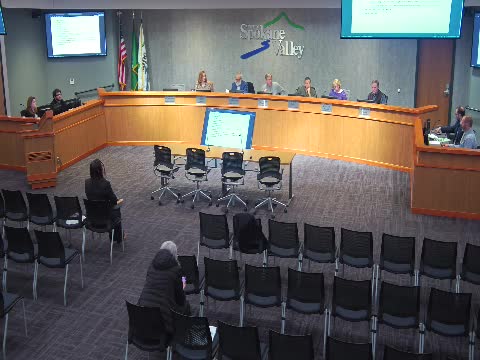
State Commerce briefs Spokane Valley on new housing rules: ADUs, middle housing, co-living and conversion
Summary
Representatives from the Washington State Department of Commerce presented the new 2021 and later legislative requirements on housing elements, accessory dwelling units, middle housing, unit-lot subdivisions, co-living and conversion rules and explained how the county and cities must coordinate to allocate housing needs by income level.
Representatives from the Washington State Department of Commerce outlined state-mandated changes to housing planning and local regulations and spoke at length about what Spokane Valley will need to include in its periodic comprehensive-plan update.
Laura Hodgkin, housing and planning and data manager at the Department of Commerce, told the Planning Commission that the 2021 changes to the Growth Management Act require jurisdictions to "plan for and accommodate housing affordable to all economic segments," and that Commerce now projects housing need by income segment so counties and cities can divide responsibilities.
Hodgkin described the multi-step process Commerce recommends: use countywide projections from Commerce's HAP tool, agree with neighboring jurisdictions on how to allocate housing need by income level, inventory local land capacity for different housing typologies and, where capacity is insufficient, adopt zoning or regulatory changes to provide the needed capacity. She said jurisdictions must also document programs and actions that will remove barriers to housing and address racially disparate impacts and displacement risk.
Lilith Vesper, Commerce's infill housing manager, summarized recent and pending regulatory changes and deadlines that Spokane Valley will need to address as part of the comprehensive-plan update and follow-on code amendments: - Accessory dwelling units: State law requires jurisdictions to allow up to two ADUs on a lot in urban growth areas, removes owner-occupancy requirements in most cases, allows sale of ADUs separate from the principal unit, and sets a minimum unit size standard of 1,000 square feet in some contexts. Commerce also limited impact fees on ADUs to 50% of the principal unit fee in many cases. The statute includes automatic preemption if local codes are not updated within six months after the periodic update. - Middle housing: Tier 1 cities (including Spokane Valley) must allow a range of "middle housing" types; at a minimum jurisdictions must enable four units on residential lots and have options to increase to six units where two of those units are required to be affordable for a defined period or where properties lie near major transit. Commerce provided model ordinances and a user guide to help local governments implement the requirement. - Unit lot subdivision: The legislature requires jurisdictions to allow unit-lot subdivisions that enable ownership of individual units (for townhouse/rowhouse conversions) without changing parent-lot coverage rules. - Conversion: Jurisdictions must allow conversion of commercial or mixed-use buildings to housing (including increased density up to 50% more units within the existing building envelope) where residential uses are allowed. - Co-living: Cities must allow co-living where six or more units are permitted; a co-living unit counts as one-quarter of a dwelling unit for density and parking calculations. The statutory deadline for co-living regulation adoption is Dec. 31, 2025.
Hodgkin and Vesper emphasized that counties and cities must work together to allocate projected housing needs for each income band. Commissioners and staff discussed local implementation questions: how to translate housing typologies into expected affordability bands, whether single-family lots could absorb low-income needs, the logistics of pavement moratoria when new development requires utility connections, and how permit streamlining or regulatory changes could be used as incentives.
Questions from commissioners touched on homeownership, condominiumization and developer incentives. Vesper said the law allows the sale of ADUs and unit-lot subdivisions to facilitate ownership opportunities; Hodgkin noted many lower-income affordable units will still rely on subsidy and that planning alone does not produce housing but creates the regulatory conditions to encourage it. Commissioners also raised concerns about parking spillover onto streets, the capacity of local infrastructure, and increases in construction costs driven by broader policy changes.
Ending Commerce staff offered to provide additional guidance, tools and checklists (ADU, middle housing, parking, STEP for shelters/transitional/permanent supportive housing) and asked to be contacted for technical follow-up. Commissioners asked staff to monitor countywide coordination and to bring drafts of local code changes forward for review in subsequent meetings.