Get Full Government Meeting Transcripts, Videos, & Alerts Forever!
Get email alerts on the Right Of Way Permits topic
No spam. Unsubscribe anytime.
Spokane Valley planning commission advances repeal and relocation of right-of-way permit rules to council
Summary
The Planning Commission voted to forward a code text amendment that would repeal a section of Title 22 governing right-of-way permits and relocate the rules into a new title; staff said the change aims to clarify when permits are required and remove a vague "normal maintenance" exemption that has created enforcement problems.
The Spokane Valley Planning Commission voted to forward CTA 2042024-20002, a code text amendment that repeals a portion of the city's right-of-way permit rules in Title 22 and relocates the regulations to a new code title, to the City Council for final consideration.
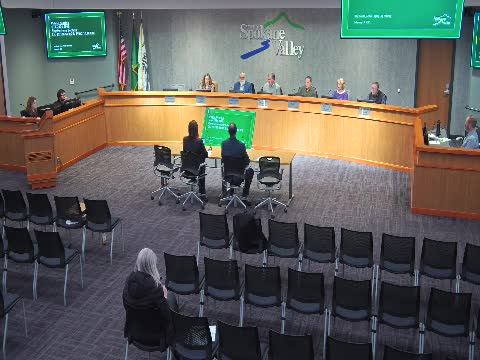
City attorney Tony Beattie and Building Official Jenny Nickerson presented the proposal at a public meeting Feb. 13, saying the text amendment would repeal section 22.1.3100 and related language and move the permitting rules into a new chapter in Title 9 (or another council-directed title). Beattie described right-of-way permits as "licenses to to conditionally utilize the right of way or allow construction activities therein," and said the permits are processed quickly, "2 to 3 days is pretty much the max time that it takes to process these."
The proposal would remove a broadly worded exemption in Title 17 that said "normal or emergency repair or maintenance of public or private building structures, landscaping, or utilities is exempt." Staff and commissioners said the term "normal" is subjective and has been cited by contractors and businesses to justify work carried out without permits. Beattie said removing the exemption is intended to reduce dangerous, unpermitted work that sometimes occurs without traffic control or insurance.
Why it matters: Staff said the changes are intended to make the code clearer for the public and for enforcement. Commissioners raised concerns about not making permit requirements more burdensome for homeowners and about ensuring utilities and developers can still coordinate necessary infrastructure work. Beattie and Nickerson emphasized that developers and utilities will still obtain right-of-way permits when they must block or trench into the roadway and that staff will publish new regulations and outreach once the relocation and replacement text are adopted.
Key details and clarifications - Staff proposed repealing the section labeled 22.1.3100 and related references and replacing it with a new chapter in Title 9 (final placement to be decided by council). - Right-of-way permits are handled by the city's traffic engineering group and are typically processed within two to three days, staff said; the code amendment would clarify and codify timeline expectations. - The city follows a regional pavement-cut policy that contains a moratorium period after paving; staff said that moratorium is generally five years and that cuts during that period require more extensive repair standards and sometimes boring instead of cutting. - Staff reported the city issues several hundred right-of-way permits annually; Mary Anne, the city's permit report preparer, stated "11 hundred in 2024." - Staff said emergency repairs (for example, to restore water service in frozen conditions) remain exempt and are treated as emergencies; routine repairs should be permitted.
Commission action and vote After public hearing and deliberation, the commission voted to advance CTA 2042024-20002 to the City Council with the recommendation to move it forward in the adoption process. The motion was seconded and carried; commissioners present voted in favor and no opposition was stated on the record. The commission membership present that evening was Commissioner Meyer, Commissioner Kelly, Commissioner Winkler, Commissioner Wilson and Commissioner Robinson; Commissioner Weathermon was excused.
Next steps Staff said they will prepare findings of fact and bring the draft repeal and the replacement language (the Title 9 chapter) to council in the coming weeks. Beattie said draft replacement language already exists as staff is preparing it, but that the Title 9 rules must be adopted by the City Council because Title 9 is outside the planning commission's usual development-regulation jurisdiction. Staff committed to notifying the development community and utilities and to continuing outreach once the council schedule and final text are set.
Context and public input The item was presented in a public meeting; the commission opened a public hearing but no members of the public provided testimony in person or by email. Commissioners asked whether the change would make permitting more or less onerous for homeowners; staff said the intent is more clarity and, overall, less onerous by removing ambiguity and codifying exceptions and timelines.
Ending The commission advanced the amendment to council; final adoption will depend on council action and the city's forthcoming replacement chapter. Staff said the repeal and the Title 9 adoption would take effect simultaneously after publication so the transition is seamless.