Get Full Government Meeting Transcripts, Videos, & Alerts Forever!
Get email alerts on the Student Safety topic
No spam. Unsubscribe anytime.
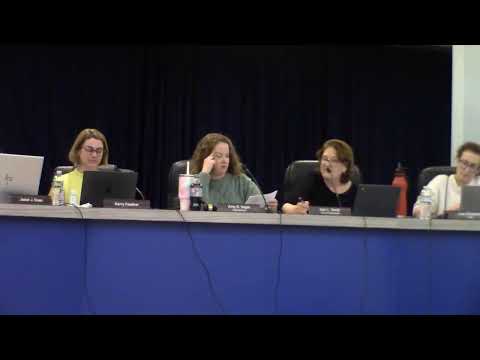
Cumberland committee approves amended high school searches, breathalyzer language after debate
Summary
After a lengthy discussion about student searches and breath screening, the Cumberland School Committee voted 7-0 to amend the high school handbook to clarify screening and breathalyzer procedures for school-sponsored social events, adding uniform screening language and definitions and a confirmation breath test protocol.
The Cumberland School Committee on Feb. 13 voted unanimously to amend the high school student-parent handbook to clarify search and breath-screening procedures at school-sponsored social events.
The committee approved revised language that defines an initial electronic screening (a passive sensor "wand") for all participants at certain social events, and a confirmation breathalyzer when the initial screen is positive. The change also added a definition for "screening" and specified that refusal to submit to screening will be treated as admission for the purposes of enforcing event rules. The final vote approving the handbook as amended was 7-0.
Why it mattered: Committee members raised constitutional and fairness concerns during more than an hour of discussion. Several members said existing handbook language was vague and had been inconsistently applied over years; proponents said clearer language would reduce arbitrary application and support student safety.
What the committee heard - High school administrators described the current process and a two-step approach. Principal Jim Costa demonstrated the passive screener and asked students to "blow out the orange dot like you have blown out the candles in your birthday cake," describing it as a noninvasive, initial check. He said a positive passive result leads to a private, confirmatory breathalyzer test and that administrators had not previously excluded students for low positives at events. - Costa said the district has used electronic screening for about 12 years and that the physical breathalyzer confirmation had been used rarely; one false positive he recalled involved face paint. - Several committee members raised concerns about training, notice to parents and constitutional issues. Committee member Mr. Dean said he had "a lot of issues with the fact that for the last 12 years that this has been done in violation of the school policy that's in the handbook" and asked how staff are trained. Legal counsel noted the policy language should match practice and suggested careful drafting; Mr. Adams (counsel) discussed how motions and amendments should be handled procedurally. - Members debated whether screening should be applied to all students entering an event or only on "reasonable suspicion." Proponents argued that screening every participant reduces claims of selective enforcement; opponents urged more analysis of the legal and training implications.
Votes and next steps: The committee's policy subcommittee had approved amended language and the full committee later voted to add the definitions read into the record, then approved the amended handbook (final vote 7-0). Committee members directed that additional policy details and any outstanding questions about notice and procedure be handled through the policy subcommittee for refinement.
Exact language change: The handbook now distinguishes "screening" (electronic, passive check) and a follow-up breathalyzer (a device requiring a blow into a tube) and adds that screening for the presence of alcohol may be conducted for participants in school-sponsored social events; a positive screen may result in a confirmatory breathalyzer. The handbook text specifies that refusal to submit to screening will be treated as admission for event-entry purposes.
Administrators said the district uses the same class of passive equipment used by some police departments, and training for building administrators is provided by the vendor. The committee did not direct suspension or a change in enforcement practice beyond adopting the clarified handbook language; members asked that notice procedures (posting/handouts/permission slips) be confirmed by administration and the policy subcommittee.