Get Full Government Meeting Transcripts, Videos, & Alerts Forever!
Get email alerts on the Budget topic
No spam. Unsubscribe anytime.
Board hears FY26 budget proposals as departments shift software costs and weigh service cuts
Summary
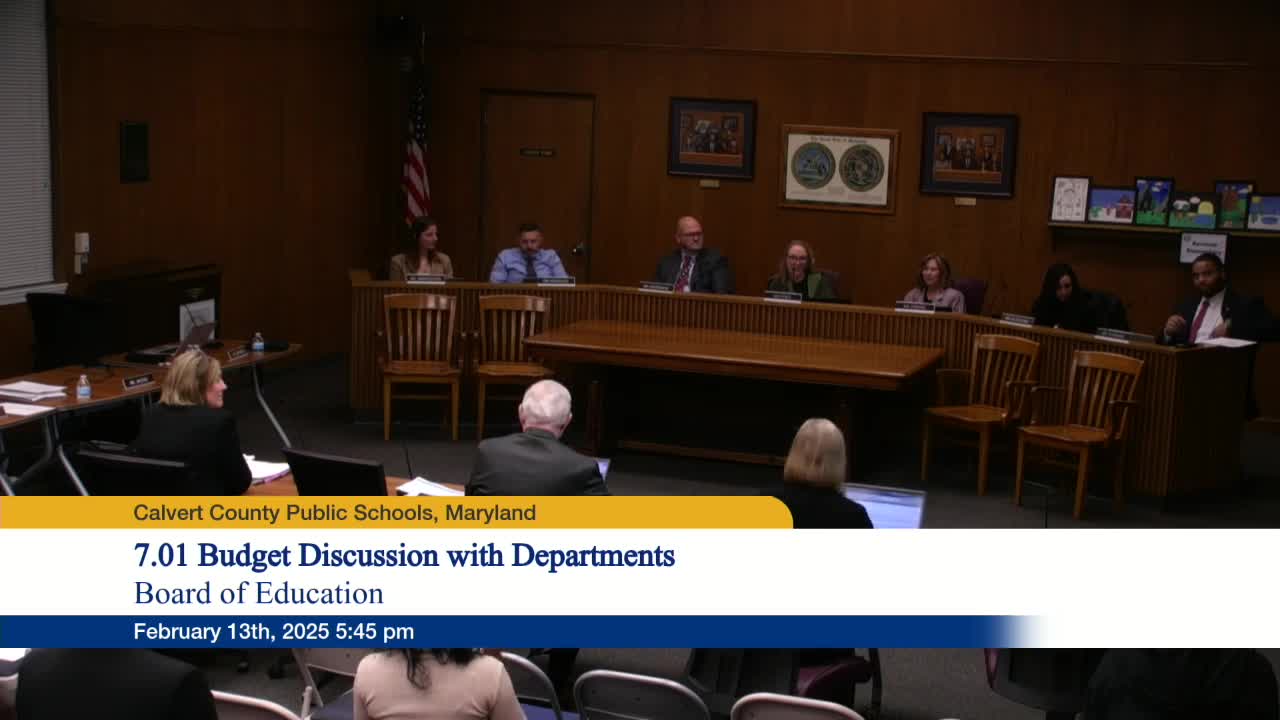
At a meeting of the Calvert County Board of Education, district finance and department leaders outlined the superintendent's proposed FY26 budget and answered board questions about staffing, technology contracts, capital outlay and program funding.
At a meeting of the Calvert County Board of Education, district finance and department leaders outlined the superintendent's proposed FY26 budget and answered board questions about staffing, technology contracts, capital outlay and program funding.
The board heard a high-level overview from Chief Financial Officer Scott Johnson, who summarized how the district organizes the budget and flagged two district-wide accounting changes for FY26: moving department-specific software and copier lease/maintenance costs from central IT to the departments that use them, and the need to ensure the district meets the Blueprint for Maryland's Future requirement that at least 75% of certain state funds be spent on a school-by-school basis.
Johnson said the budget development process uses four "tracks" — school principal allocations, director and supervisor budgets, restricted grant budgets, and wage/benefit projections — and that school principals continue to receive per-pupil allocations to spend within assigned budget categories. He told the board that the district is working with a consultant, Affton Partners, to verify compliance with the Blueprint spending requirement.
Why it matters: the shifts discussed would move software and copier expenses into schools and departments, which changes where increases and decreases appear in the budget book and affects principals' discretion; the end of one-time grant funding (ESSER) is also returning recurring digital license and summer-school costs to the local budget.
Key departmental highlights and questions
- Communications and Blueprint coordination: Marcy Gruber, the district's Blueprint and communications coordinator, told the board the proposed budget shows an increase in the section because two FTEs are now shown under the blueprint/communications area rather than one. Gruber said she reduced contracted services by about $20,000 and that Calvert's Blueprint implementation plan has received full approval.
- Equity: Margo Gross, supervisor of equity, said the equity budget covers consultants, supplies and staff development required by the state. Board members noted apparent discrepancies in the percentage changes on the printed budget pages; Gross and CFO Johnson agreed to verify whether a formula or column reference was pointing to the wrong cells.
- Capital outlay and construction: Shuchida Warner, director of planning and construction, explained capital outlay is for feasibility, design and smaller projects while the CIP (capital improvement program) covers larger projects. Warner said the FY26 CIP request was $32.9 million and that capital outlay shows a temporary reduction in some contracted services because design studies are winding down. She noted increased line items for school security and said the district is requesting $350,000 from the county for playground replacements in the CIP.
- Facilities and maintenance: Gregory Gott, director of school facilities, said operation and maintenance budgets include utility costs, building repairs and field upkeep. He said stadium field maintenance averages about $25,000 per field per year, and that some line items show negative contingencies to reflect wage lapse or expected utility savings. Members asked for a breakdown of utility assumptions and the basis for anticipated savings.
- Transportation and athletics: Kevin Hook, director of transportation and athletics, said the FY26 transportation budget shows roughly $900,000 of proposed reductions driven in part by an effort to find about 10% in savings. One option under consideration is replacing some nonpublic out-of-county school bus routes with smaller, alternative vehicles for long runs; Hook said cutting five such routes could yield about $575,000 in savings (about $115,000'$120,000 per route) and that any savings could partly fund leased or purchased smaller vehicles and drivers.
Hook also described other proposed changes: reducing some summer-program bus runs that had been expanded during ESSER funding, keeping two taxi services for limited needs, and planning a phased approach for seat belts if the legislature or local practice requires them. On contracted special-education buses, Hook said the cost per route is roughly $115,000'$120,000.
- Vaping detectors and school security: Directors said an ESSER-funded pilot for restroom sensors was installed in all middle-school restrooms and selected high-school restrooms; staff reported calibration is ongoing and that the pilot cost to equip all middle-school restrooms plus one high-school restroom was about $300,000. The FY26 operating budget does not include funds to expand those sensors to all high schools.
- Capital improvements and playground accessibility: Warner and facilities staff described an identified list of six playgrounds that currently lack accessibility features; staff said ADA-related upgrades tend to be routed through the CIP rather than the capital outlay line and will be done incrementally.
- Information technology and classroom devices: Matt Poteet, director of information technology, said IT moved many software contracts to the departments that manage them, reducing IT's data-processing request by roughly $376,000 while restoring a smart-board replacement line of about $424,000 for classroom displays. Poteet said the district will move to a 15-year replacement cycle for the new "all-in-one" interactive displays to reduce recurring replacement costs but acknowledged boards used heavily every period may wear faster.
Poteet also described the computer donation program that provided hundreds of desktops and monitors last year and estimated those donations saved the district more than $600,000. On 1:1 student device strategy, staff discussed a purchase option that would start issuing laptops at ninth grade and then repurpose devices down to elementary grades after four years; the board questioned assumptions about a 10-year life cycle for some devices and asked for further analysis.
- Instruction and curriculum: Scott McComb, supervisor of system and instructional performance, told the board that roughly $1.1 million of costs that had been paid from ESSER or other grants are moving back into the local instruction budget for FY26. That includes summer school, digital licenses and some professional learning costs. McComb said the department is prioritizing tiered interventions and teacher training to address pandemic-era learning gaps and noted elementary and middle-school textbook and instructional budgets vary by principal-level decisions.
- Student services and special education: Cecilia Lewis, director of student services, described a reclassification of several software contracts (PowerSchool enrollment, Raptor and camera/access control systems) into student services and said contracted psychologist services increased to meet behavioral and mental-health demand where the district cannot fill positions with employees. Kendi Anderson, director of special education, told the board the local special-education budget is built on historical needs but that final grant estimates from state and federal sources were still pending and could shift allocations.
- Fiscal notes and one-time revenue: Board members asked about a one-time credit or payment from the Maryland Association of Boards of Education (MABE) reserves; staff confirmed the FY26 local revenue summary includes a one-time draw from MABE rate-stabilization/reserve funds that the district characterized in the meeting as "over $1 million".
Board questions and next steps
Board members pressed departments for clarifications about items they said looked inconsistent on printed pages (percent changes and formulas), asked staff to provide detailed utility assumptions, requested cost estimates to expand restroom sensors to all high schools, and asked for updated salary and hiring details for positions that appear vacant. Several board members asked staff to provide follow-up documents and to correct any spreadsheet formula errors before the next budget meeting.
Votes at a glance: the meeting recorded routine procedural approvals earlier in the agenda. The printed record shows the board approved the consent agenda and later approved a proclamation recognizing Patuxent High School's state football championship; both items were moved, seconded and approved by voice vote (motion movers and named tallies were not specified in the meeting record).
What's next: staff said the board will receive updated budget numbers and corrections in the coming weeks, the board will deliberate further at a scheduled meeting on Feb. 27 and an additional meeting on Feb. 20 was announced for budget follow-up. The district must finalize the proposed budget for delivery to county government while state legislative actions and final grant figures remain pending.
(Reporting note: article summarizes departmental presentations and board Q&A. Quotes and numeric details are attributed where the meeting record provided them.)