Get Full Government Meeting Transcripts, Videos, & Alerts Forever!
Get email alerts on the Guaranteed Income topic
No spam. Unsubscribe anytime.
Richmond officials outline expansion of guaranteed‑income pilot; city will fund fourth cohort
Summary
Office of Community Wealth Building staff reviewed the Richmond Resilience Initiative’s past cohorts, research partnerships and eligibility for a fourth cohort the city will support with $500,000; staff emphasized program objectives, evaluation partnerships and plans to target single parents.
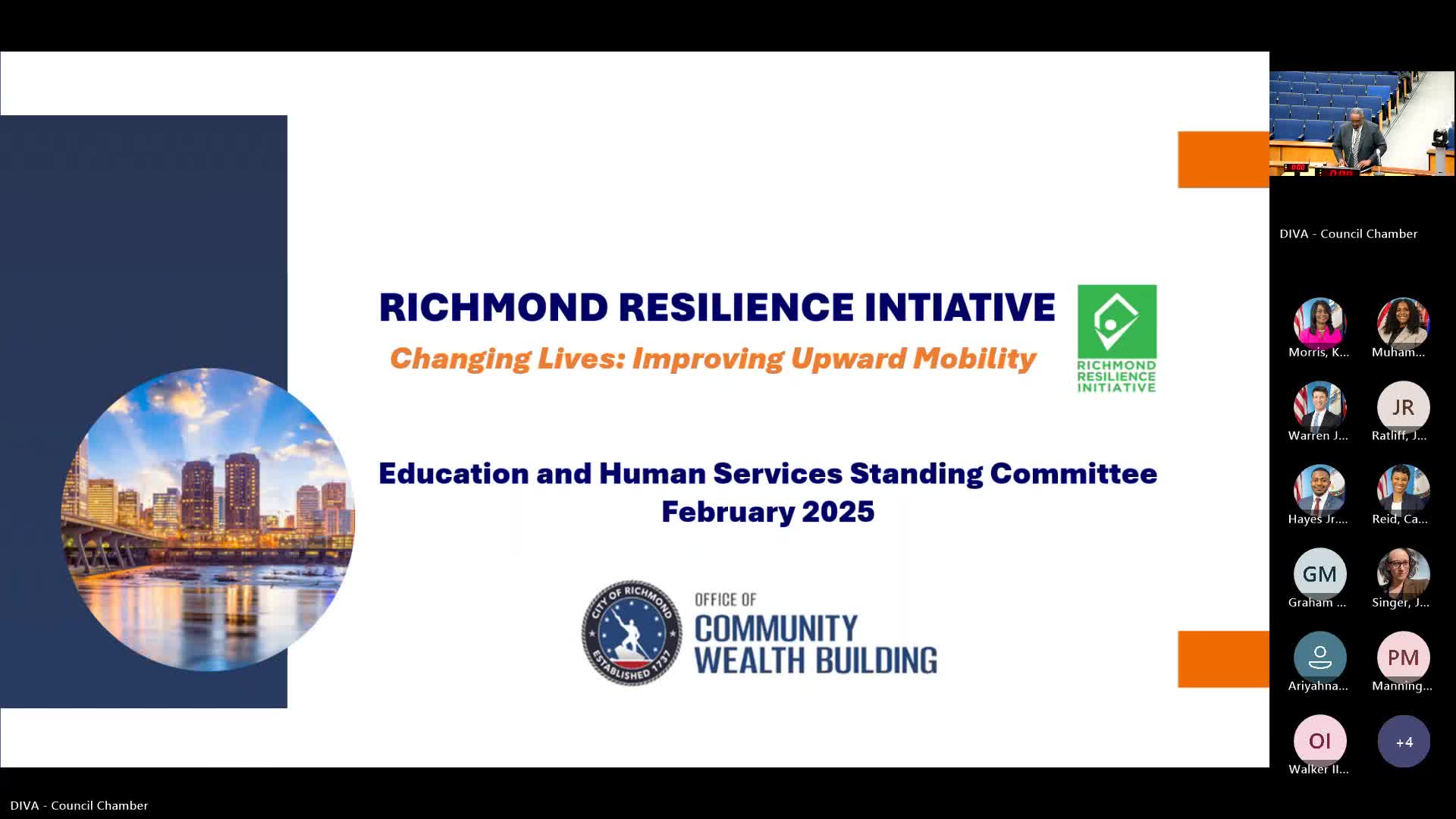
Derek Wadley, program and operations supervisor for the Office of Community Wealth Building and program manager for the Richmond Resilience Initiative (RRI), briefed the Education and Human Services Standing Committee on the program’s design, evidence and next steps.
Wadley described RRI as “designed to specifically help working individuals who earn above the threshold of public assistance, but still struggle to meet the financial needs and their obligations.” He said the program provides $500 a month in unconditional cash payments for 24 months to eligible Richmond residents.
Wadley reviewed past cohorts and funding sources: the first cohort (2020–2022) included 18 participants funded by philanthropic partners including the Robins Foundation and Mayors for a Guaranteed Income; a second cohort served about 46 participants with added community foundation support; and a third cohort worked with returned citizens using ARPA funds and the Help Me Help You Foundation. He thanked the council for allocating $500,000 to fund a fourth cohort, which staff said will be limited to 40 participants and targeted to single parents.
Wadley and colleagues described evaluation partnerships. The University of Pennsylvania’s Center for Guaranteed Income Research produced an impact report on RRI’s first cohort that staff said showed increases in savings, reduced debt and improved credit among participants. Richmond staff are working with Virginia Commonwealth University’s Research Institute for Social Equity to design a longitudinal study of the second and third cohorts.
On eligibility and targeting, Wadley said the fourth cohort will require city residency, at least one child 18 or younger in the household, employment earning at least $12.71 per hour but below the City of Richmond’s estimated living wage. In the presentation, staff cited a living‑wage figure for a single individual of $21.85 per hour and, as described in the briefing, income caps listed by household size: a single individual with one child could earn up to $36.28 an hour, a single individual with two children up to $45.81 an hour, and with three children up to $59.04 an hour (figures stated in the presentation).
Councilmembers asked about community involvement in participant recruitment, evaluation metrics, and overhead costs. Wadley said recruitment will run through community partner organizations as well as a site and application through the Office of Community Wealth Building for those needing paper applications. On overhead he estimated third‑party distribution fees of roughly 5% and said the remainder of the $500,000 would be used for participant stipends.
Several councilmembers and staff noted the program’s aim to move from piloting toward policy and broader advocacy at the state and federal level. Staff said they would provide the University of Pennsylvania cohort report and subsequent evaluation results when available.
Ending: Staff committed to follow up with detailed budgeting and evaluation plans and to provide the committee copies of the University of Pennsylvania report and future VCU research deliverables.