Get Full Government Meeting Transcripts, Videos, & Alerts Forever!
Get email alerts on the Organized Militia topic
No spam. Unsubscribe anytime.
Members of Governor’s Horse Guard warn HB 6440 privatization would imperil unit’s operations
Summary
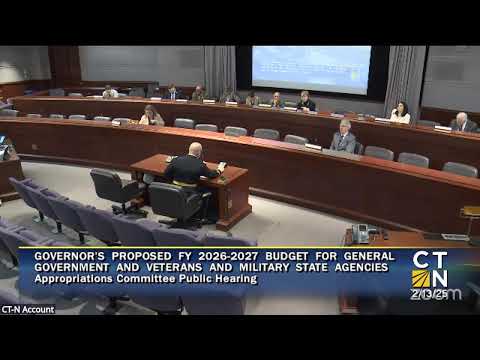
Representatives of Connecticut’s Second Company Governor’s Horse Guard told the Appropriations Committee that House Bill 6440, as written, would remove the organized militia from the Connecticut Military Department and force the unit to operate as a private entity, endangering its finances and community services.
Members of the Second Company Governor’s Horse Guard and allied militia units urged the Appropriations Committee to reject or amend House Bill 6440, saying the bill’s language would remove the organized militia from the Connecticut Military Department and require the units to operate as private entities.
First Lieutenant Barbara Mazara, serving as adjutant for the Second Company Governor’s Horse Guard in Newtown, told lawmakers the unit has a long history of public service and public-facing historical programming but lacks consistent, transparent financial accounting from military staff. She outlined concerns about reported operational cost estimates, saying she was told by generals that the electric cost for the guard’s property was $25,000 and that water cost $6,000 annually, but that a state electrician and an Eversource representative said there was no electric meter on the property.
Captain Paul Mazara, executive officer of the Second Company Governor’s Horse Guard, said that if the unit were privatized, it would have to become a “pay for service” organization and charge communities for performances. He said the volunteer-run group has never raised enough to cover full operations and estimated—based on testimony to the committee—that a private organization would need to raise approximately $300,000 a year to sustain the guard’s operations, a level he called “nearly impossible.”
Speakers also reported concerns about unaccounted donations: Barbara Mazara stated that more than $15,000 in fundraising and honorarium checks from 2024 was unaccounted for and that the last known balance in June was “over $50,000.” She said the proposed drafting of HB 6440 could allow the military to claim donated funds that donors intended for the horse guard.
No committee action or vote was taken during the hearing. Testimony focused on financial transparency, the operational relationship between the militia and the Connecticut Military Department, and the potential fiscal implications of removing the units from state command.
The transcript does not include the bill text or a staff analysis; those materials will be needed for precise fiscal impact calculations and any recommended statutory changes.