Get Full Government Meeting Transcripts, Videos, & Alerts Forever!
Get email alerts on the Street Safety topic
No spam. Unsubscribe anytime.
Cedar Park approves $625,000 contract to install high-visibility crosswalks
Summary
City council voted unanimously to contract DIJ Construction to convert existing transverse markings to high-visibility crosswalks across the city, a project drawn from the 2023 Mobility Master Plan and funded in part by the 4B Community Development Corporation.
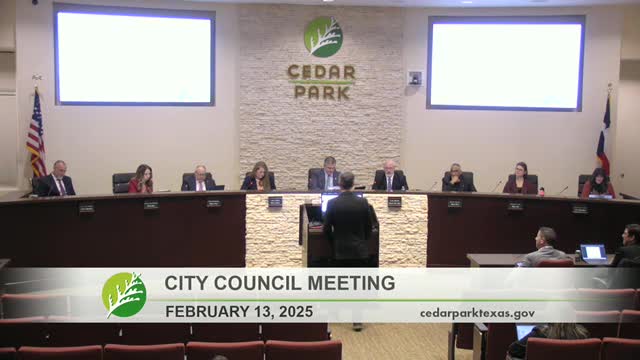
The Cedar Park City Council unanimously approved a resolution authorizing the city to execute an agreement with DIJ Construction for the installation of high-visibility crosswalk markings, in an amount not to exceed $625,000.
City staff presented the project as part of the Mobility Master Plan adopted in 2023 and said the 4B Community Development Corporation funded the effort. Steven Hannison, assistant director of public works, told council the striping program will replace traditional transverse crosswalk markings with “high-visibility” markings at existing crossings that do not yet have them and add markings where ramps exist but markings do not. Staff estimated there are approximately 900 crosswalks at about 550 intersections citywide; the contract would cover about 700 of those with the remaining 200 to be done by city crews.
Hannison said high-visibility crosswalks are more readily seen from a driver’s perspective, citing city photographs taken at varying distances to illustrate improved visibility at 50, 100 and 200 feet. He told council staff issued a competitive request for proposals, received three bids and determined DIJ Construction offered the best value by price, experience and schedule. Staff estimated the work would reach substantial completion in roughly six months, weather permitting.
Council members asked how long the markings last and how they would be phased. Hannison said longevity depends on traffic, sun exposure and other factors: arterial striping typically lasts three to five years while neighborhood markings last longer; staff will monitor striping and refresh locations as needed rather than place every location on a fixed multi-year rotation. He said crews have already begun converting arterial crosswalks and will then move into neighborhoods.
Council member Kirkland moved to approve the item; a second was recorded and the motion passed unanimously. Council members and the mayor described the change as a safety improvement for pedestrians, especially near schools and residential areas where people walk to nearby amenities.
The resolution directs the city manager to execute the contract with DIJ Construction on terms described in the council packet.