Get Full Government Meeting Transcripts, Videos, & Alerts Forever!
Get email alerts on the Forestry Recovery Markets topic
No spam. Unsubscribe anytime.
Forestry leaders detail Hurricane Helene losses, market challenges and proposed relief bills
Summary
The Georgia Forestry Commission, Georgia Forestry Association and allied groups briefed committee members on storm damage, inventory methods, market pressures and legislative proposals to aid reforestation and industry recovery.
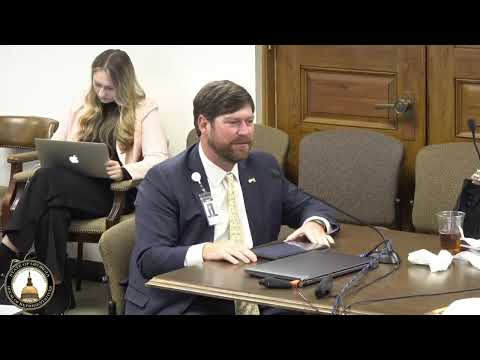
Johnny Saba, director of the Georgia Forestry Commission, told the Economic Development & Tourism Committee that Georgia is the nation’s largest forestry state and outlined the agency’s role in forest protection, inventory and market support.
“Georgia is the number 1 forester state in the nation. A $42,000,000,000 economy and we're the biggest exporter of forest products out of our port in Savannah,” Saba said. He described the commission’s prescribed-fire and forest‑management work, its fixed-plot inventory program (roughly 6,000 permanent plots on a five‑year cycle) and timber‑products output surveys used to measure growth versus harvest.
Saba and other presenters said Hurricane Helene caused large-scale timber damage. The commission deployed ground cruise plots to estimate losses in impacted counties; Saba said early field work showed severe to catastrophic loss (90%+ tree loss) in portions of the affected area and noted that salvage opportunities are limited — historically only about 10–20% of impacted timber is salvageable after such storms. He warned that oversupply in the immediate aftermath depresses salvage prices and that longer-term market corrections can take years.
Jake Matthews of the Georgia Forestry Association described current legislative priorities to support recovery and markets. Matthews identified House Bill 164 (legislation to retain higher gross vehicle weights for timber haulers) as pending before lawmakers and noted measures under consideration to support reforestation and tax relief after the storm. He said the governor’s reforestation proposal (similar to the program after Hurricane Michael) would establish a reforestation tax credit (up to $400 per acre) to encourage replanting. Matthews also named Senate Bill 52 (temporary suspension of harvest tax) and other proposals allowing state deductions for timber losses.
Committee members asked technical questions about assessment methods and whether property‑tax or disaster relief mechanisms would cover timber losses. Saba explained that registered forester cruises, stump‑and‑volume analysis and haul tickets are used to document loss for landowners and that a combination of federal disaster funds, state tax relief and other measures is likely needed — “there is no one silver bullet,” he said.
Speakers also discussed market challenges predating the storm: declines in pulp and paper demand, mill closures in the Southeast and the need to develop new markets such as mass timber, sustainable aviation fuels and lignin‑based products under research at Georgia Tech. Presenters urged legislative action to keep transportation weights that reduce log‑trip costs, to provide reforestation incentives and to support markets so landowners have an economic reason to replant.
The forestry presenters provided contact information and offered to work with legislators on bill language and recovery planning.