Get Full Government Meeting Transcripts, Videos, & Alerts Forever!
Get email alerts on the Parking Downtown topic
No spam. Unsubscribe anytime.
Poulsbo council weighs paid parking, enforcement and phased rollout for downtown
Summary
A months‑long review of downtown parking moved toward a decision after hours of public comment and council debate. Staff proposed three timing options; council asked for a March follow‑up and directed further outreach and enforcement planning.
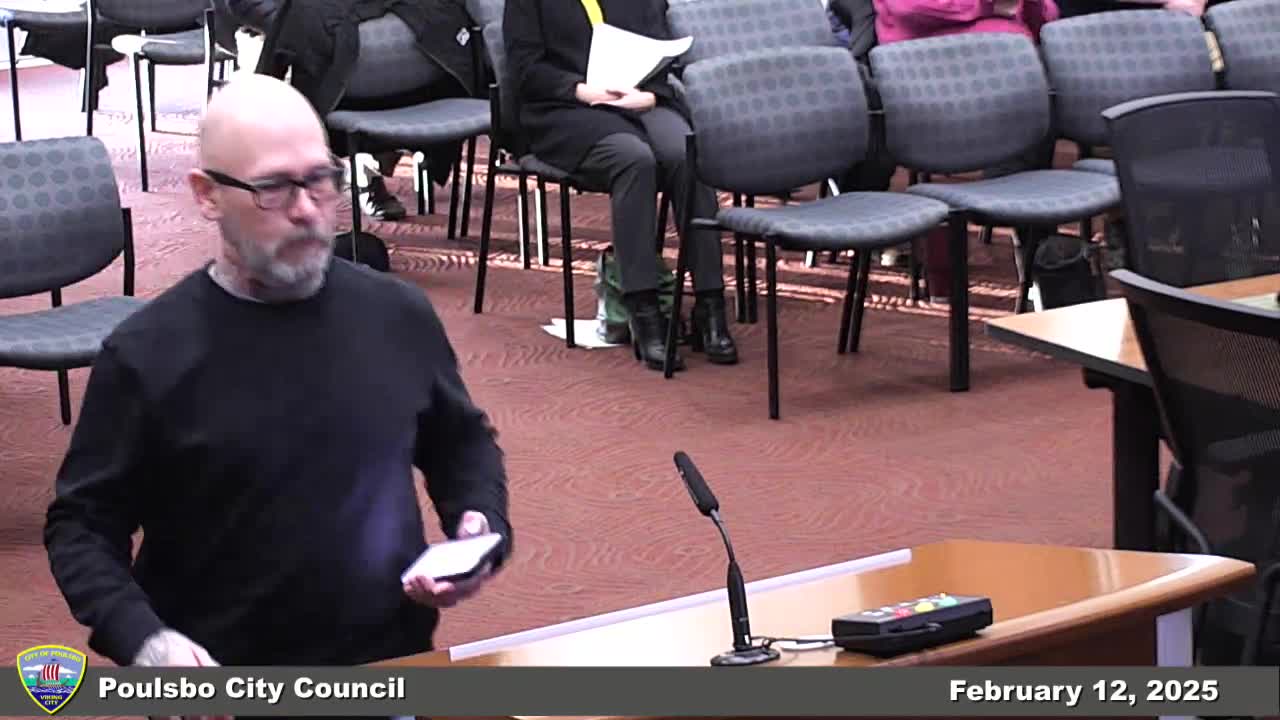
The Poulsbo City Council discussed implementing paid parking in portions of downtown after public comments urged attention to enforcement and business impact.
Supporters of enforcement over paid parking said stricter application of existing time limits could increase turnover without charging visitors. Resident Mike Perry told the council enforcing existing limits would “improve turnover without additional costs” and suggested learning from Bainbridge Island’s non‑sworn parking enforcement model. Business owner Megan Martin warned that charging for parking could deter customers: “If the paid parking goes into effect, there will be numerous people who will not stop downtown.”
Staff said the issue has been under study for two years. Heather (Planning/Transportation staff) summarized work by Walker Consultants, a community survey, and outreach to the Historic Downtown Poulsbo Association (HDPA). Walker’s model showed a hybrid approach — charging for close “front‑row” public spaces while leaving other on‑ and off‑street spaces free — could cover operating costs for enforcement and generate revenue for future parking projects. Heather said the city owns 413 of the 1,289 downtown spaces; the consultant’s proposal would place paid meters on about 274 city‑owned spaces (roughly 44% of city‑owned spaces). She said weekday hours in Walker’s draft were 10 a.m.–6 p.m. with a sample price of $2 per hour.
Council members focused on enforcement, turnover, and impacts on small businesses. Councilmember Eckert said enforcement must be central to any plan: “If we just enforce what we have now, we’re relying on existing resources to do that, which are already stretched.” Councilmember Stern said many business owners prefer a technological, pay‑to‑stay model over ticketing, arguing that a modest fee with remote payment can let customers extend a stay without receiving a citation. Councilmember Tabor favored moving forward to create a sustainable revenue stream for future parking capacity.
Staff proposed three timing alternatives: (1) full implementation in summer 2025 (signage, enforcement and paid parking), (2) all changes in 2026 (phased delay), or (3) a hybrid — signage, designated employee parking and enforcement in 2025 with paid parking in summer 2026. Councilmembers expressed mixed views but supported continuing work and additional outreach. Staff later asked to bring the item back to a business meeting; the council agreed to schedule further discussion on the Feb. 19 meeting agenda to allow more staff preparation and stakeholder input.
Among issues raised by merchants and residents were employee parking supply, possible use of private lots, enforcement method (human patrol vs. license‑plate recognition), equity for seniors and low‑income users, and how to use any net revenue (for example, toward future parking structures or shared‑parking agreements). Staff reported progress on shared‑parking discussions, including a draft agreement under review for approximately 16 potential employee spaces near First Lutheran Church’s lot and outreach to other private lot owners.
The council directed staff to continue public outreach, finalize signage and enforcement RFP language, and return with a recommendation at the next business meeting so council can decide whether to pursue the full implementation this year or phase changes into 2026.