Get Full Government Meeting Transcripts, Videos, & Alerts Forever!
Get email alerts on the Data Centers topic
No spam. Unsubscribe anytime.
Board advances Phase 1 of data center standards and locations; asks staff to return with grandfathering options
Summary
After a staff presentation showing rapid growth of data center development in Loudoun County, the Board forwarded Phase 1 of the Data Center Standards and Locations CPAM/ZOAM to a March business meeting and directed staff to return with draft grandfathering options and guidance on minor evolutionary changes for existing campuses.
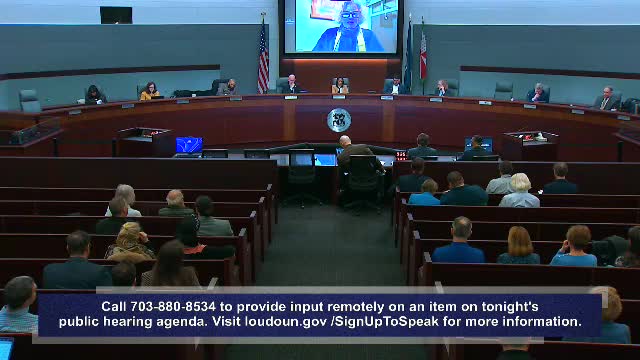
The Loudoun County Board of Supervisors heard a detailed staff presentation on Phase 1 of the Data Center Standards and Locations comprehensive plan amendment (CPAM‑2024‑0001) and zoning ordinance amendment (ZOAM‑2024‑0001) Feb. 12, 2025, then voted to forward Phase 1 to the March 18, 2025 board business meeting and to direct staff to return to the board on March 4 with draft grandfathering options and guidance on limited, evolutionary administrative changes for existing data center campuses.
Staff presentation and data: Abdul Jaffrey, Loudoun County project manager, joined by Department Director Dan Galindo, presented Phase 1 text and map amendments. Staff said Phase 1 would designate data centers as a conditional use in play types where they were previously core or complementary uses and would change three cells in the zoning use table to require special exceptions in the three zoning districts where data centers were permitted by right. Staff described both text and limited map amendments that would redesignate some areas (for example, Arcola from suburban employment to suburban neighborhood and portions of the Leesburg JLMA employment to residential place types). Staff emphasized that Phase 2 would address broader policy updates, site and building design, sustainability, energy, water, noise and landscaping standards.
Staff presented multiple data points used to illustrate growth and scope: as of Feb. 2024 the county approached about 45,000,000 square feet of data center development; in 2024 the county received applications for roughly 26,000,000 additional square feet and issued building permits for about 5.2 million square feet. Staff reported a combined existing and unconstrained pipeline estimate of approximately 105,000,000 square feet as of Dec. 1, 2024; an alternative “constrained” estimate provided by the Department of Economic Development puts practical capacity at about 75,000,000 square feet without additional legislative approvals. Staff said roughly 77% of existing and pipeline square footage is concentrated in the suburban policy area and that the industrial park (IP) zoning district holds the largest share by zoning (approximately 50,000,000 square feet). Staff also noted approximately 300 parcels remain governed by the 1972 zoning ordinance.
Planning Commission and staff recommendations: Staff recommended approval of Phase 1 as drafted. The Planning Commission recommended denial of Phase 1’s limited scope but provided supplemental recommendations (including a grandfathering resolution, clarifications to allow some administrative flexibility, and criteria for potential waiver of a special exception). Staff said Phase 2 would consider the commission’s suggestions, including technical standards and incentives.
Public comment: The board heard more than three hours of public testimony from municipal leaders, business groups, environmental and community organizations, labor unions, and residents. Key themes from public speakers: - Many Loudoun town mayors and municipal officials (including the mayor of Leesburg) supported requiring a special exception for data centers and urged strict, measurable standards (noise, building design, generator siting, lighting, facades). They opposed blanket grandfathering. - Environmental groups (Piedmont Environmental Council, Loudoun Wildlife Conservancy, Center for Biological Diversity) urged no grandfathering, stronger environmental and noise safeguards, and quicker Phase 2 action to address energy, water and habitat impacts. - Industry representatives and business groups (Data Center Coalition, Loudoun Chamber of Commerce, NAIOP, Steamfitters Local 602, IBEW Local 26) urged protections for existing investments, a measured grandfathering approach, and flexibility to allow upgrades and integration of new technologies (on‑site generation, battery storage, retrofits) without imposing a special exception for purely minor, evolutionary changes. - Several speakers raised concerns about transmission line projects and the regional power build‑out needed to serve large data centers, asking the board to consider the collateral impacts of energy infrastructure.
Board discussion and outcome: Supervisors debated the scope and timing of grandfathering and whether to allow limited administrative flexibility for existing campuses to make minor changes without special exception. Supervisor Matt Turner moved to forward the CPAM and ZOAM (data center standards and locations Phase 1) to the March 18, 2025 board business meeting and directed staff to prepare a grandfathering resolution; the motion directed staff to return to the board on March 4 with draft grandfathering options that would, if adopted, identify which administrative or legislative applications accepted by Feb. 12, 2025 should be grandfathered. The motion also asked staff to develop notional guidelines returning to March 18 about parameters for when existing campuses could make evolutionary changes without requiring a special exception.
The board voted to forward Phase 1 to the March 18 business meeting (motion passed 7–2; Supervisors Umstead and Kershner voted no). The board later approved the direction to staff to return on March 4 with draft grandfathering options (vote recorded later as 7–1–1 with one supervisor opposed and one not on the dais). The Board did not adopt a grandfathering resolution at this meeting — instead it directed staff to present options and the effects of different cutoffs and thresholds at the March 4 work session so supervisors could debate specific language before any grandfathering is adopted.
Why it matters: Loudoun County is a major data‑center market and tonight’s vote advances a policy change that will require case‑by‑case legislative review (special exceptions) for future data centers in specified districts while staff develops Phase 2 standards. The decisions could affect land use, transmission and generation planning, industrial land inventories, and future county revenues and infrastructure needs.
Next steps: Staff will return March 4 with draft grandfathering options showing the practical effect (which applications would meet each cutoff). Staff will also work with Economic Development during Phase 2 to refine constrained vs. unconstrained capacity estimates and to scope technical work on noise, water, energy and substation policies, with anticipated Phase 2 completion in fall 2026.