Get Full Government Meeting Transcripts, Videos, & Alerts Forever!
Get email alerts on the Regional Projects Water topic
No spam. Unsubscribe anytime.
Fox Canyon board hears county web map, Calleguas strategy and Oxnard recycled-water update
Summary
At its Feb. 12 meeting the Fox Canyon GMA received presentations on a countywide water resources web map funded with ARPA funds, Calleguas Municipal Water District’s regional resilience and storage plans, and the City of Oxnard’s Groundwater Recovery Enhancement and Treatment (GRADE) program and ASR pilot.
The Fox Canyon Groundwater Management Agency on Feb. 12 received three informational presentations focused on regional water data, imported-water portfolios and local recycled‑water projects.
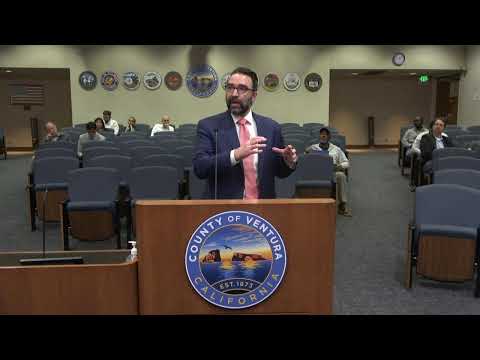
County web map — The county and consultant Water Systems Consulting described a new, ARPA‑funded interactive web map that compiles public datasets about water suppliers, service areas, water‑availability letters and state vulnerability assessments. Spencer Waterman of Water Systems Consulting said the initial release will rely on layers maintained by state and other agencies so the county will not need to manually refresh every dataset. “We are working with the county’s IT and GIS staff to add layers to their PWA web map,” Waterman said, and the map will be released for public input before next steps are recommended.
Board members asked how the web map will be updated; Waterman and county staff said the first phase relies on externally maintained sources (for example, the state drinking‑water needs assessment) so those layers refresh as source agencies update them. The county described the tool as intended for emergency response and planning — helping responders and purveyors quickly identify which agency owns a fire hydrant or who to call after a main break.
Calleguas regional portfolio — Christine McCaffrey, general manager of Calleguas Municipal Water District, and Ian Pichard, deputy general manager, summarized Calleguas’ water‑supply portfolio work. Calleguas emphasized its historical role as a wholesaler of imported water and the importance of local storage and interconnections. McCaffrey said Calleguas currently delivers “100% imported water from the Metropolitan Water District of Southern California” to its retail purveyors and serves roughly three‑quarters of Ventura County’s population through 19 retailers.
Pichard outlined the Las Posas Aquifer Storage and Recovery (ASR) well field, which Calleguas has invested in for decades and now owns outright after buying out Metropolitan’s share. Calleguas staff described in‑lieu programs, stored water balances and the judgment‑required ASR project operations plan, in which Calleguas will pay 80% of project costs and the GMA 20%. Calleguas identified two priority areas in the Las Posas basin where targeted in‑lieu deliveries or infrastructure could make measurable progress toward sustainability, and said additional coordination on monitoring and a groundwater‑banking framework will be essential to advance projects.
Oxnard GRADE and ASR pilot — The City of Oxnard presented its Groundwater Recovery Enhancement and Treatment (GRADE) program, centered on an Advanced Water Purification Facility (AWPF) that has operated since 2016 and on a pilot ASR well under construction. Michael Wolf, Oxnard public works director, said the AWPF’s current design capacity is 6.25 million gallons per day (about 7,000 acre‑feet per year at continuous full‑time operation), and the city is planning phased expansion. Tim Beeman, Oxnard assistant public works director, said the ASR pilot well and three monitoring wells were drilled in 2017 and civil/mechanical work was awarded in 2021; construction completion of the current work is expected in 2025.
Beeman said the pilot well was designed for about 2,200 gallons per minute (roughly the output of one reverse‑osmosis train) and that early piloting and conservative run/retention assumptions yield an estimated annual injection equivalent of about 1,200 acre‑feet for a full year of operation, accounting for backflushing and testing. Oxnard staff said they have coordinated modeling with neighboring agencies and are pursuing a storage and banking governance approach that would rely on the GMA.
All three presentations were received and filed; no board action was required. Board members asked follow‑up questions about monitoring data gaps, maintenance and long‑term ownership of datasets and governance for shared storage. Agency staff said the web map and district proposals are intended to improve emergency response, inform future investment and reveal opportunities for regional partnerships.