Get Full Government Meeting Transcripts, Videos, & Alerts Forever!
Get email alerts on the Sales Marketing Strategy topic
No spam. Unsubscribe anytime.
Visit Austin sales and marketing teams outline strategies to replace lost convention room nights
Summary
Visit Austin's sales and marketing presentations on Feb. 12 detailed strategies — campus/many‑wide hotel collaborations, incentives, sports and esports bookings, and expanded advertising — intended to offset room‑night losses while the Austin Convention Center is closed.
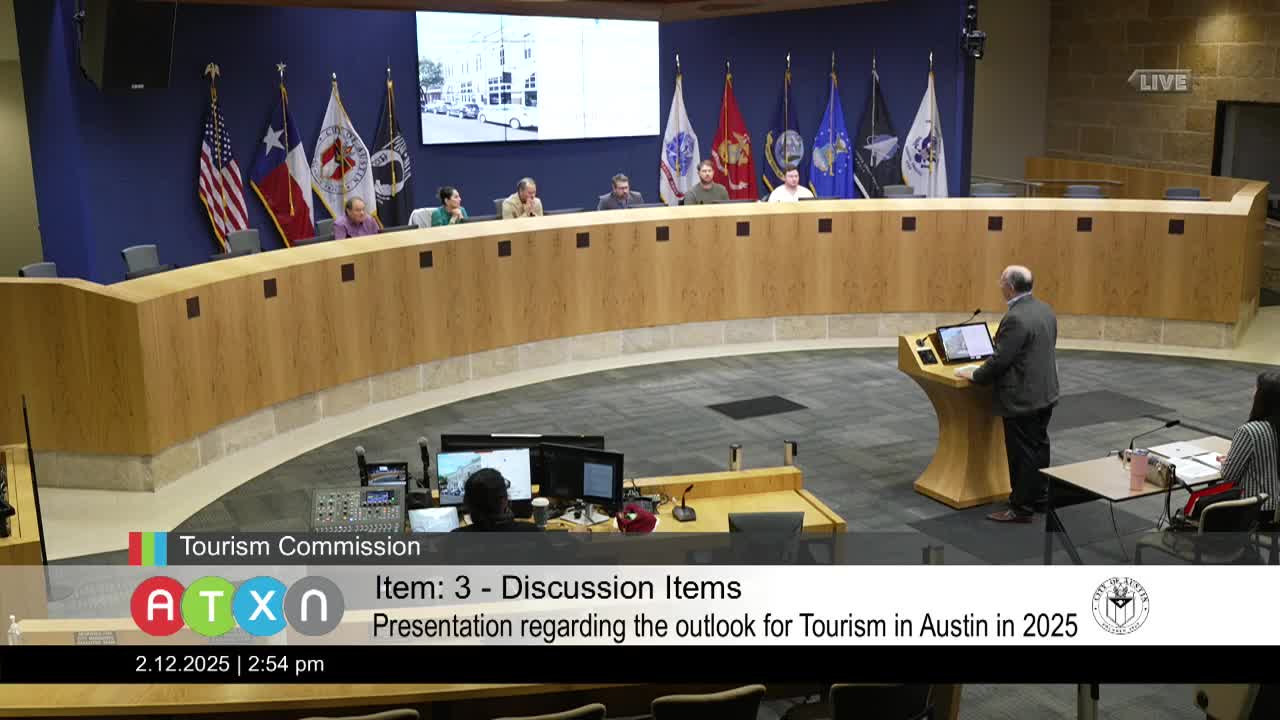
Steve Genovese, Visit Austin's executive vice president for sales, and Shelley Hall, vice president of marketing, briefed the Austin Tourism Commission on Feb. 12 on how the organization plans to sustain hotel occupancy during the convention center closure.
Genovese reviewed 2024 and early 2025 booking patterns and described a two‑track sales response: 1) increase “in‑house” bookings (events not using the convention center, including sports and other off‑site venues) and 2) promote a "many‑wide" campus approach where multiple nearby hotels and off‑site venues host portions of a formerly single‑site meeting. He cited previous incentive spending by Visit Austin: “We provide about a hundred thousand dollars in incentives and booked about 74,000 room nights,” which he described as strong return on investment.
Genovese also highlighted sports and esports as growth areas. He described an upcoming Counter‑Strike esports event at the Moody with a $1,250,000 prize pool and said Visit Austin is hosting Major League Soccer’s All‑Star Game in July, which the agency expects to draw tens of thousands of attendees. He and staff said sports bookings often draw room nights across a wide range of hotel types and can be deployed to fill non‑convention demand windows.
Genovese provided market context: downtown Austin has about 15,000 hotel rooms and the broader market about 50,000; new supply is continuing, with 1,300 rooms opened last year, roughly 600 this year, and about 2,500 rooms in planning for 2026 and later. He said Visit Austin has increased sales staffing to pursue more, smaller group business and to convert more site visits into bookings.
Hall reviewed Visit Austin's marketing performance and strategy. She said nearly two‑thirds of visitors to Austin come from nearby "drive" markets (Houston, Dallas–Fort Worth, San Antonio, Waco), but that higher spend per visitor comes from "fly" markets (Los Angeles, New York, Chicago, Denver). Hall said Visit Austin attributes more than 250,000 hotel searches to its paid advertising and about 40,000 hotel nights to ad exposure during the prior campaign period.
Hall added that Visit Austin is preparing an "always‑on" marketing approach for fiscal year 2025–26, refining flighting and audience mixes (drive vs. fly) based on updated visitor profile research, and continuing partnerships that promote Austin internationally. She noted an increase in direct support to local musicians and work with the film commission to leverage production activity for destination visibility.
Commissioners asked about hotel supply and how new rooms affect occupancy. Genovese cautioned that supply growth changes the competitive landscape, requiring more targeted sales and incentives. Both presenters emphasized collaboration across hotels and with local event venues to construct many‑wide options that can absorb groups that previously would have used the convention center.