Get Full Government Meeting Transcripts, Videos, & Alerts Forever!
Get email alerts on the Federal Funding topic
No spam. Unsubscribe anytime.
San Miguel County officials review exposure to potential federal funding cuts; PILT, human services top risks
Summary
County staff presented a high-level inventory of federal funds and potential exposure if federal appropriations or pass-through grants are reduced. Payment in lieu of taxes (PILT) and human services funding together account for the largest share of identified federal revenue.
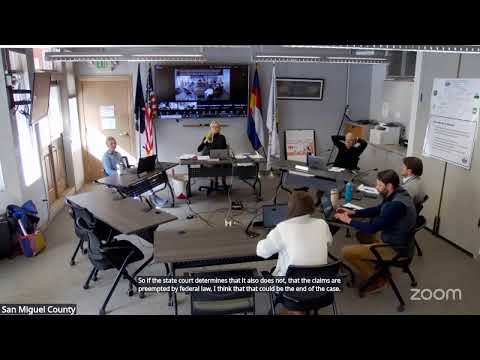
San Miguel County officials reviewed a spreadsheet of federal funding streams at the Board of County Commissioners' Feb. 12 work session, highlighting areas the county would monitor if federal appropriations or pass-through grants were reduced.
The review, led by Finance Director Ramona Rommel and presented to the three commissioners and county staff, compiled direct federal payments and federal dollars passed through the state. Ramona said the review was a "very, very high level" exercise based on the county's 2025 fiscal year and on a worst-case scenario for budgeting.
The nut of the analysis: two items dominate the county's exposure. Payment in lieu of taxes, or PILT, is a pending federal payment that Ramona identified as roughly $1.4 million for the county; human services revenue (federal and federal pass-through funds administered by the state) was budgeted at about $1.9 million for 2025. Ramona summarized the total identified federal funding at about $5.277 million for fiscal year 2025.
"PILT and human services are the lion's share," County Manager Mike Bordonia said during the presentation. Assistant County Manager Jared Biggs noted that PILT funding has varied historically and depends on congressional appropriations and legislative action.
Ramona and Jared walked the board through other line items still outstanding or at risk, including: - EMPG (Emergency Management Performance Grant) funding used in part to support the county's emergency manager (about $59,000 noted as tied to staffing), - an EPA Brownfields grant for assessments and stabilization work at the Matterhorn Mill site and other brownfield locations (a $500,000 grant with some drawdowns already invoiced), - a USDA composting grant (approximately $160,000) with active community partners working on program delivery, and - CDOT TAP funds and a TAP application for a Lawson Hill trail spur that Ramona described as relatively secure through CDOT.
Ramona cautioned the board that the county, the state and the federal government operate on different fiscal calendars (San Miguel County January–December, Colorado July–June, federal October–September), which complicates timing of reimbursements and the appearance of risk. She recommended continuing to operate on a "business as usual" basis while monitoring developments in Washington and at the state level.
Commissioners discussed contingency and monitoring steps: continuing regular contact with federal and state legislators, watch for contract or grant pauses, and tighten billing and reimbursement reporting so the county minimizes cash-flow exposure if a federal contract is paused. Jared said the county has not yet received notices of rescinded federal contracts but that agencies have reported pauses in some programs elsewhere.
The board did not take formal action but asked staff to keep the commissioners informed and to present a refined timeline and next steps at a subsequent meeting.
The county manager said he expected staff to continue processing and billing eligible expenses unless the county receives explicit direction not to do so.
Next steps include continued outreach to federal legislators, monthly billing where possible on open grants to reduce outstanding exposures, and a follow-up briefing to the board if the federal posture changes.