Get Full Government Meeting Transcripts, Videos, & Alerts Forever!
Get email alerts on the Traffic Signal Operations topic
No spam. Unsubscribe anytime.
Board approves $700,000 Centrax traffic‑signal monitoring agreement and cellular rollout
Summary
The Board of Public Works approved a two-year SLAMSA with Traffic Control Corporation not to exceed $700,000 to deploy Centrax centralized traffic-signal monitoring and cellular modems, enabling remote monitoring and alerts for intersections across Indianapolis.
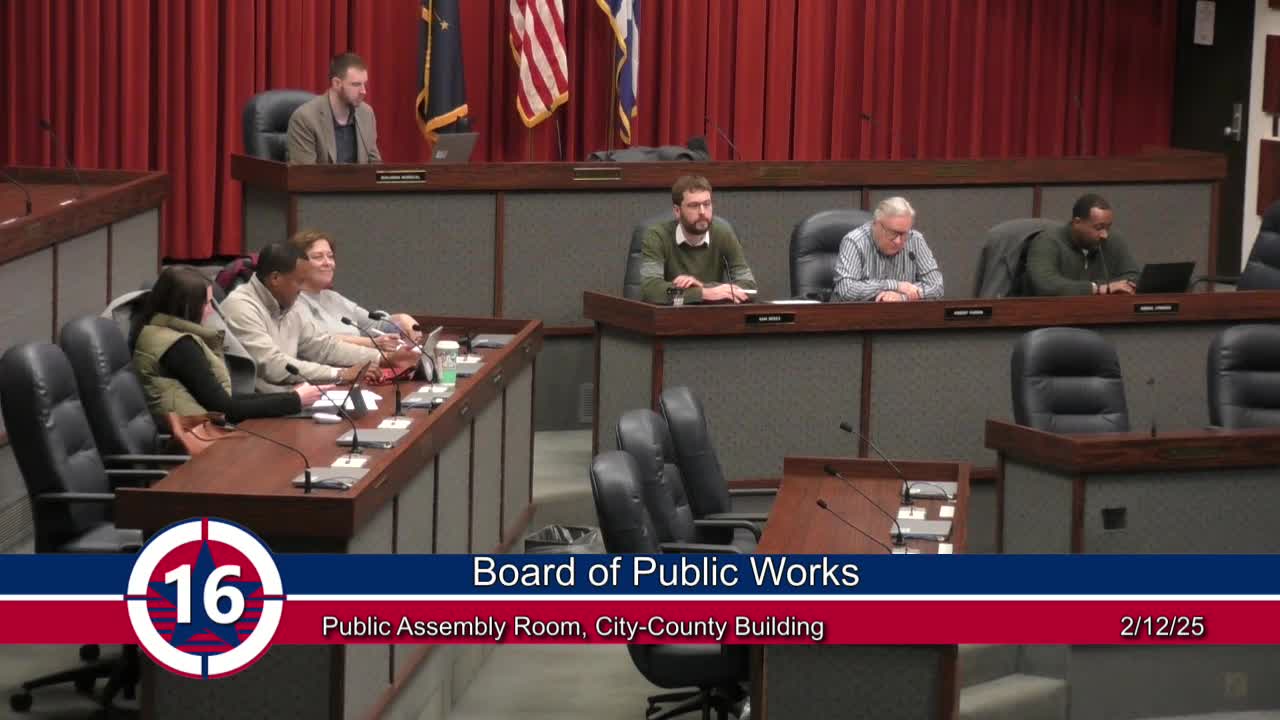
The Indianapolis Board of Public Works on Feb. 12 approved a two-year sales, licensing, maintenance and service agreement (SLAMSA) with Traffic Control Corporation for Centrax, a centralized traffic-signal monitoring and management platform, with compensation not to exceed $700,000.
Nathan Sheets, deputy director of engineering for the Department of Public Works, told the board the purchase replaces an aging, fiber-dependent system the city installed in the late 1990s. "This is a very exciting, exciting project," Sheets said. He said the upgrade will move many traffic controllers to cellular connectivity and give operations staff remote monitoring, remote programming and automated alerts when signals go to flash.
Sheets described the planned initial rollout and licensing: the city holds a license for up to 250 intersections with an initial deployment "in that 115 range," and the system can expand to reach additional corridors where cellular modems are already installed as part of recent capital projects. He said the SLAMSA will allow the operations group to receive notifications when signals go into flash and to identify failing pedestrian push buttons and damaged vehicle-detection loops.
Sheets summarized key budget elements reported to the board: roughly $150,000 for setup and training to convert old signal timings; about $50,000 to establish hosted virtual servers; roughly $150,000 total in modem costs; and additional funds for prepaid cellular connectivity and licensing. "A lot of this is upfront cost and licensing and getting the new system rolled out," he said. The contract is structured as a turnkey procurement and includes prepayment for two years of cellular service so the city will not receive per-intersection monthly bills directly from carriers during that period.
Board members asked about cybersecurity. Sheets said the IT review found no unresolved security concerns; the system will be hosted off-site and separated from the city's financial network. "There was previously, there were some concerns the way the system was tied into the city's overall IT network. This is actually hosted off-site so there is a complete separation between the traffic signals and the city's financial network," he said.
A motion to approve the agreement was made and seconded; board members voted in favor and the motion carried. Sheets estimated initial deployments could begin in summer 2025 and staff said they would return to update the board when the system is operational.
The city has responsibility for roughly 1,127 signals; staff said the Centrax system can accommodate the existing inventory and that many future signals or corridors could be brought online as capital projects install compatible modems.