Get Full Government Meeting Transcripts, Videos, & Alerts Forever!
Get email alerts on the Coal Severance Tax Rate topic
No spam. Unsubscribe anytime.
Committee approves half-point cut to coal severance rate, citing competitiveness concerns
Summary
The Senate Revenue Committee voted 3–1 to reduce the coal severance tax rate from 6.5% to 6.0% in House Bill 75 after testimony from coal-industry representatives, county officials and taxpayer groups arguing the change levels the rate with oil and gas and supports mine investment.
The Senate Revenue Committee advanced House Bill 75 on a 3–1 roll-call vote, approving a reduction in the coal severance tax rate from 6.5% to 6.0% to bring coal’s rate into parity with oil and natural gas.
Representative Clauston, the bill sponsor, said the change aims to enhance Wyoming’s business climate for coal and to make the state’s coal more competitive against other fuels and out-of-state producers. “This would put coal on equal footing with what we charge oil and natural gas in the state of Wyoming,” Clauston told the committee.
Travis Detai of the Wyoming Mining Association and other industry witnesses said the coal sector bears a heavy tax burden compared with other industries and that modest tax relief helps companies reinvest in equipment, reclamation and workforce stability. Detai said coal companies also pay into the federal black lung fund and listed multiple state and local taxes the industry pays.
Campbell County Commissioner Jim Ford testified in favor of the bill and said local officials had observed prior severance-rate reductions lead to reinvestment staying in county operations. Hank Coversland, executive director of the Wyoming Taxpayers Association, said the reduction is justified and equitable because it establishes parity with other energy resources and could be offset by production if output increases. Chris Mickey of the Wyoming Business Alliance also voiced support.
Witnesses and representatives cited statewide figures: committee testimony said Wyoming produced about 41% of U.S. coal and that Wyoming coal producers paid about $600,000,000 in taxes last year plus roughly $134,000,000 into the federal black lung fund. Industry witnesses estimated the proposed half-point reduction could translate to savings of roughly $500,000 to $3,000,000 per mine depending on size.
Industry testimony included concrete operating-cost examples to illustrate the impact of cost inflation: witnesses described haul-truck tire prices rising significantly in recent years and said increases can add millions of dollars to a single operator’s six- to 15‑month operating cycle.
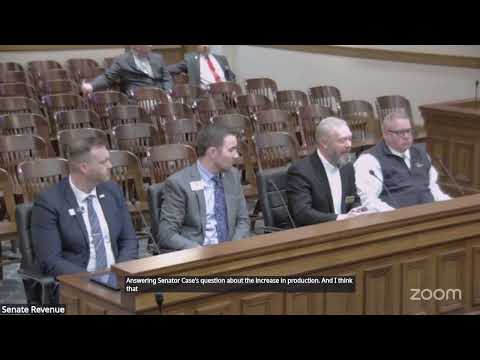
Senator Case questioned whether a rate cut meaningfully increases coal production, noting prior studies that found little production elasticity. Witnesses replied that while production is driven by market demand, lowering the cost of production can help make Wyoming coal more competitive in contract negotiations and dispatch decisions.
The committee moved the bill (moved by Senator Eyde, seconded by Senator French) and on roll-call recorded three ayes, one no and one excused; the measure passed out of committee. The bill now advances according to the Senate Revenue Committee’s procedures.
Supporters framed the reduction as a fairness and competitiveness measure to preserve jobs and investment in Wyoming mining communities; opponents and some questioning senators emphasized the limited empirical evidence that small changes in severance rates would increase production, and raised concerns about forgone state revenue.