Get Full Government Meeting Transcripts, Videos, & Alerts Forever!
Get email alerts on the Traffic Calming topic
No spam. Unsubscribe anytime.
DPW board removes stop signs from citytraffic-calming guidance to align with federal MUTCD
Summary
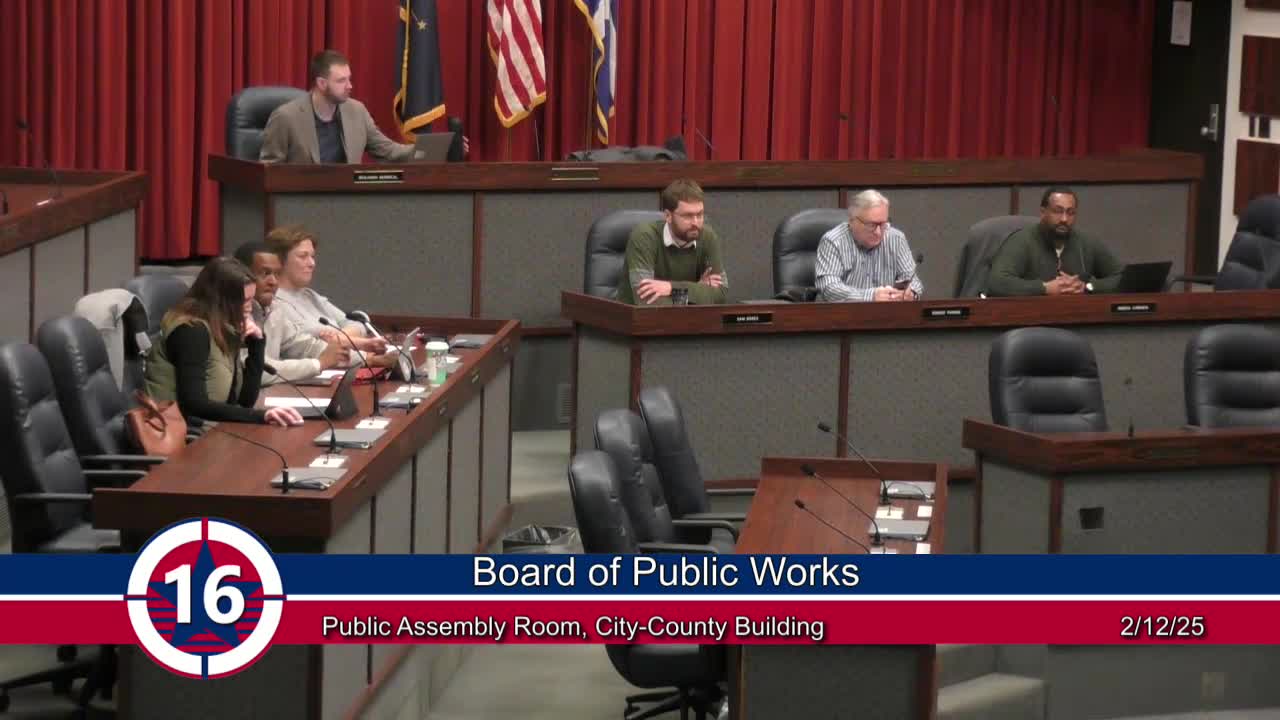
The Indianapolis Board of Public Works on Feb. 12 approved a resolution to amend chapter 800 of the Transportation Standards Manual, removing stop signs from the list of recommended traffic-calming measures to conform with a recent Manual on Uniform Traffic Control Devices (MUTCD) provision.
The Indianapolis Board of Public Works on Feb. 12 approved a resolution directing the Department of Public Works to modify chapter 800 of the Transportation Standards Manual to remove stop signs from the department's list of traffic-calming measures.
The change follows a federal update to the Manual on Uniform Traffic Control Devices. John Bowen, chief engineer for the Department of Public Works, told the board the amendment responds to the MUTCD and city ordinance changes: "This modification comes as a result of the city county general ordinance number 77 from November 2019..." Bowen said and summarized the practical change as: "So we're basically just eliminating stop signs as traffic calming, measures."
The board's action updates guidance used when neighborhoods or developers request traffic-control devices. Nathan Sheets, deputy director of engineering, told the board his office has seen neighborhoods request "always stops" on many contiguous blocks and that the department wants to avoid blanket use of stop signs where they are not warranted. "What we are really trying to get away from is neighborhoods approaching the city and saying, We want always stops, throughout the entire neighborhood at every block," Sheets said, describing traffic-engineering concerns and potential safety trade-offs.
The engineering staff said the MUTCD provision cited in the presentation (section 2B.06) states that "yield or stop signs shall not be used for speed control" and that the city's revision is intended to bring local standards into conformity with that federal guidance. Bowen said the manual's traffic-calming section will be redlined to remove the outdated reference.
Board members pressed for operational clarity. Staff said the change does not mean crews will remove existing stop signs; rather, the manual will no longer list stop signs as an approved traffic-calming technique for future installations or standard design guidance for new subdivisions. Sheets also noted that engineering judgment and a variance process remain available: if the department determines a stop sign is warranted after analysis, it can still be recommended and ultimately approved by the legislative body that controls traffic-control changes.
A motion to adopt the resolution was moved by Board Member Idris Redman and seconded by Board Member Susie Cordy. The board voted in favor and the motion carried.
The change affects how future neighborhood requests and new subdivision designs will be evaluated; staff said the manual is a "living document" and will be updated to reflect newer tools such as rectangular rapid-flashing beacons (RRFBs) and HAWK signals that were not available when the city's traffic-calming guidance was drafted in the 1990s.
Implementation questions remain at the neighborhood level: staff noted that some alternative traffic-calming tools (roundabouts, signals, targeted alternating block stops, detection and signal timing changes, and pedestrian-safety devices) can be more costly than a single sign and may require capital funding or right-of-way changes.
The board approved the resolution to amend chapter 800 of the Transportation Standards Manual to remove stop signs as a listed traffic-calming measure, citing conformity with the MUTCD.