Get Full Government Meeting Transcripts, Videos, & Alerts Forever!
Get email alerts on the Reading Screening And Reporting topic
No spam. Unsubscribe anytime.
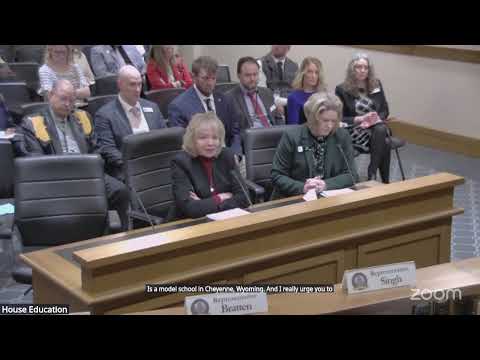
House Education Committee advances bill tightening reading screening language
Summary
The House Education Committee on Feb. 12 passed Senate File 13, a housekeeping bill that removes certain data-collection requirements and clarifies that required screening instruments — not broader assessments — are to be reported. The committee adopted an amendment to remove language adding “or assessment.”
The House Education Committee voted Feb. 12 to pass Senate File 13, a committee bill that narrowly revises state law on early reading screening and reporting requirements.
Supporters and agency staff described the measure as a cleanup of existing statute intended to reduce burdensome or unclear reporting requirements. Shelley Hamill of the Wyoming Department of Education told the committee the bill removes a requirement that school districts report nebulous data items and clarifies that individual reading plans — not grouped plans that would require redaction of other students’ information — are the practical norm.
Hamill said the bill also prompted a question about the addition of the words “or assessment” in two places on page 4 of the draft. “A screening instrument is specifically developed to be able to be a very quick check to look for a red flag,” Hamill said. “Screeners are usually expected to take no more than 5 minutes. 3 times a year is what the current statute requires.” She told the committee that treating a full assessment as equivalent to a screener could undermine the purpose of collecting screening data.
During public comment, Bill Winnie of Sublette County described a personal account of delayed identification of his son’s reading needs and urged early detection. “You need to figure these things out early,” Winnie said, recounting diagnostic work his family pursued.
Vice Chair Lolli proposed an amendment to remove the inserted phrase “or assessment” from the bill language. The committee adopted Lolli’s amendment (seconded by Representative Bratton) without debate.
After the amendment, the committee voted to pass the bill as amended. The roll call recorded nine ayes and no recorded no votes.
Committee members asked that the bill be floor-managed as a committee bill; no individual primary sponsor was identified during the committee action. The committee record shows the bill will move forward to the next stage of consideration in the Legislature.