Get Full Government Meeting Transcripts, Videos, & Alerts Forever!
Get email alerts on the Commercial Property topic
No spam. Unsubscribe anytime.
Clark County Board upholds assessor valuations in a series of Walgreens property appeals
Summary
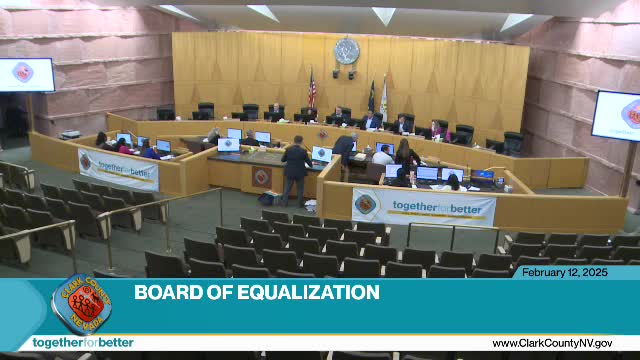
The Clark County Board of Equalization on Feb. 12 heard multiple appeals from Walgreens property owners and largely sustained the assessor’s 2025 taxable values after testimony and cross-examination on lease comparables, deed restrictions and depreciation.
The Clark County Board of Equalization on Feb. 12 heard a series of appeals from petitioner representatives for multiple former and active Walgreens properties across the county and, after consolidated testimony and rebuttal, sustained the assessor’s 2025 taxable values in the cases presented.
Zachary Whitaker, representing several Walgreens property owners, argued to the board that national store closures, deed restrictions and the limited pool of second-generation users have reduced market demand for standalone drugstore buildings. Whitaker presented fee-simple analyses, Marshall & Swift cost approaches, and an income pro forma for multiple properties. He emphasized a recent January 2025 sale of a former Walgreens for $2.8 million (about $172 per square foot) and argued that fee-simple sales and current lease-up listings supported lower values and higher depreciation than the county applied.
Assessor staff — including Troy Campa, Troy Kemper, Tom Verheyen and Daryl Pawlowski — presented land-sales charts, lease comparables and an income-capitalization analysis. The assessor used a generally conservative rental assumption for the county’s income approach (about $1.50 per square foot in many East-side cases), a cap rate near 6.5% for freestanding retail, and the statutory Marshall & Swift schedule (1.5% depreciation per year) for cost approaches. Assessor witnesses noted some appealed lots had been adjusted in prior years and that certain sales cited by petitioners involved deed restrictions or special circumstances (liquidation sales) that, in the assessor’s view, reduced their weight as fee-simple comparables.
Board members questioned petitioners and staff about rental-rate sources, cap rates, whether subleases or short-term agreements were appropriate comparables, and the effect of deed restrictions and tenant limitations on market value. The board heard examples of local reuse (Goodwill, Dollar Tree, AutoZone, a food-court conversion) but also testimony that multi-tenant conversions are rare and costly.
After deliberation the board voted to sustain the assessor’s values in multiple individual cases, including specific rulings recorded during the hearing: case 539 (FC Income Properties — land-only appeal at Flamingo & Maryland Parkway), case 543 (Walgreens, Sahara & Boulder Highway), case 545 (GLK Holding — vacant former Walgreens on East Lake Mead), case 548 (former Walgreens at Tropicana & Eastern), case 549 (former Walgreens at Flamingo & Boulder Highway, where the assessor stipulated a reduced value to $3,127,240), case 559 (Walgreens, Sahara & Nellis), and case 560 (Walgreens, Flamingo & Cloud). In several instances the board incorporated testimony from earlier hearings into subsequent decisions and consolidated multiple docketed Walgreens appeals for efficiency; the consolidated decisions were recorded as sustaining the assessor’s determinations. Where the transcript records a stipulation or a change recommended by the assessor, the board used the revised recommendation in its ruling.
The board’s rulings were procedural determinations that the assessor’s valuations did not exceed full cash value as presented; several motions passed unanimously or by voice vote. Petitioners were reminded they retain the right to appeal decisions to the state board of equalization. Assessor staff indicated many of the Walgreens appeals were reviewed in bulk and that some files had been corrected for factual errors before hearing, and the county noted which properties were corporate-owned versus investor-owned when weighing comparables.
Votes at a glance
- Case 539 (FC Income Properties — land-only): motion that the assessor’s value does not exceed full cash value — motion passed (assessor recommended no change). - Case 543 (Walgreens, SW corner Sahara & Boulder): motion that the assessor’s value does not exceed full cash value — motion passed (assessor recommended no change). - Case 545 (GLK Holding / vacant former Walgreens, East Lake Mead & Nellis): motion that the assessor’s value does not exceed full cash value — motion passed (assessor recommended no change). - Case 548 (vacant former Walgreens, Tropicana & Eastern): board upheld assessor’s revised/stipulated recommendation — motion passed. - Case 549 (former Walgreens at Flamingo & Boulder): assessor stipulated to a reduced taxable value to $3,127,240; board adopted revised assessor recommendation — motion passed. - Case 559 (Walgreens, SE corner Sahara & Nellis): motion that the assessor’s value does not exceed full cash value — motion passed. - Case 560 (Walgreens, SW corner Flamingo & Cloud) and a consolidated group of additional Walgreens cases on the docket: motions sustaining assessor valuations were passed for the combined set of cases.
The board and assessor repeatedly noted the technical distinction between lease-fee sales, fee-simple transactions, and sales with deed restrictions; the assessor argued deed-restricted or liquidation sales should be treated as limited-rights transactions and given less weight when determining fee-simple taxable value. Petitioners pressed the board to incorporate higher functional and economic obsolescence and higher depreciation schedules to reflect higher vacancy risk and conversion costs.
The board recorded the outcomes as determinations that the assessor’s current taxable values did not exceed full cash value. Individual property owners and the assessor retain appeal rights to the Nevada State Board of Equalization. Several cases on the agenda were stipulated, withdrawn, or decided in absentia per assessor recommendation; the board voted to accept assessor recommendations for petitioners who did not appear.