Get Full Government Meeting Transcripts, Videos, & Alerts Forever!
Get email alerts on the Property Taxes topic
No spam. Unsubscribe anytime.
Board trims taxable value for Moapa Valley vacant lot to $20,000 after equity appeal
Summary
The Clark County Board of Equalization reduced the 2025 taxable value of a 2.58-acre vacant parcel in Moapa Valley from the assessor's recommended $24,750 to $20,000 after the property owner argued neighboring lots rose only about 10% and a third of the parcel lies in a flood zone.
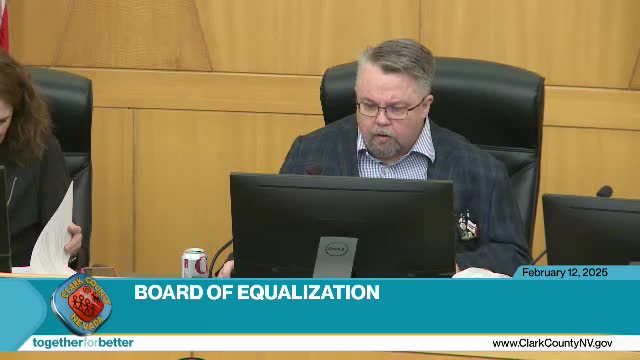
The Clark County Board of Equalization reduced the 2025 taxable value of a vacant 2.58-acre parcel in Moapa Valley to $20,000 on Feb. 12 after hearing an equity appeal from the property owner.
The appellant, Dieter Stussy, told the board the subject parcel sits next to his home and that most lots in the neighborhood experienced roughly a 10% increase in land value from 2024 to 2025. Stussy said the assessor’s recommended taxable value of $24,750 represented a roughly 37.5% increase and relied on comparables more than three miles away in Overton, which he argued are not comparable to his floodplain parcel.
The assessor’s office presented an equity grid and land-sales analysis and explained that the subject had a 70% downward adjustment for being in a wash last year and that the parcel’s value returned to a standard base lot amount that was increased 10% across similarly sized parcels. Nick Brown of the assessor’s office pointed the board to the land grid and comparables located in the flood zone and recommended no change to the assessor’s 2025 taxable value.
Board members discussed the limited usable area on the site and prior stipulation that lowered the parcel to $18,000 in the prior year. After deliberation a motion was made to set the 2025 taxable value at $20,000 — described by a board member as “a rough 10% increase over the stipulated value last year.” The motion passed. The assessor retains the right to appeal the board’s decision to the state board of equalization.
The board’s decision was procedural and limited to equalizing assessed values; members reminded parties that changes in assessed value do not necessarily translate directly into changes in property tax obligations. The hearing record and appeal instructions were provided to attendees; forms for further appeal were noted as available in the hallway outside the chamber.
Stussy and assessor staff were sworn before testimony. The board announced its schedule for additional hearings and administrative business at the close of the session.