Get Full Government Meeting Transcripts, Videos, & Alerts Forever!
Get email alerts on the Oil Gas Bonding Pool topic
No spam. Unsubscribe anytime.
Committee backs voluntary industry-funded bonding pool to help small oil operators meet federal bond increases
Summary
Senate File 20 creates a voluntary bonding pool and related rulemaking for oil- and gas-operator financial assurance, aiming to help small operators comply with recent federal increases in lease and statewide bond minimums.
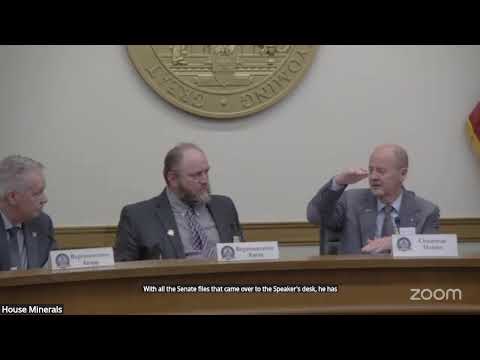
The Minerals, Business & Economic Development Committee voted to give Senate File 20 a due-pass recommendation after extended testimony from the Oil and Gas Conservation Commission, industry representatives and small operators.
The bill establishes a voluntary, industry-funded financial-assurance program administered or contracted by the Oil and Gas Conservation Commission. The program would let participating operators pool resources and receive third-party-backed financial assurance as an alternative to individually posting larger surety bonds or letters of credit.
Tom Kropatch, state oil and gas supervisor, told the committee the bill is a response to a federal rule (issued June 2024) that raised minimum bond amounts for fluid mineral leases. Under the federal rule, a single-lease bond rose from $10,000 to $150,000 and a statewide bond rose from $25,000 to $500,000; the federal agency delayed the effective implementation for some requirements until June 2026 but the new amounts already affect operators who must replace expiring bonds or post new bonds. Kropatch said those amounts exceed annual gross revenue for more than 25% of operators in Wyoming.
Senate File 20 directs the commission to promulgate rules to implement a bonding pool and authorizes three funding and operating mechanisms: (1) a third-party contract to establish and manage the pool; (2) a commission-run pool if a third-party arrangement is infeasible; and (3) a “backstop to the backstop” that permits use of existing conservation-tax funds in WY Statute 35-1-16 (the conservation tax account) only after other funding sources are exhausted. Participating operators would pay an assessment modeled on the commission’s mill levy; the bill sets the assessment initially at zero and allows the commission beginning July 1, 2030 to set it up to 0.5 mills on the dollar (for comparison the existing conservation tax range is 0–0.8 mills and is currently 0.5 mills).
Tom Van Cleef, a small operator who participated in the interim working group, described the program as a lifeline for small companies facing federal rebonding costs and estimated roughly 470 small operators would be affected statewide. Industry groups and the Petroleum Association of Wyoming supported the measure. Van Cleef and other witnesses emphasized three features they said were crucial: voluntary participation, transferability of bonding to successor operators when a well or lease is sold, and a layered funding structure that prioritizes operator assets and surety before any state conservation-tax funds.
Representatives asked about risk management and how fee levels would be set. Kropatch said the commission would rely on surety expertise and rulemaking to evaluate operator risk and set appropriate fees; participation would be restricted to operators in good standing and the commission could remove participants who fell out of compliance. The bill requires annual reporting to the joint minerals and joint appropriations committees if the program uses conservation-tax funds as a backstop.
After discussion Representative Lolli moved and Representative Schmidt seconded advancing the bill; the committee recorded eight ayes, zero nays, and one excused. Representative Lawley volunteered to carry Senate File 20 to the floor.
Committee members and witnesses framed the measure as an industry-funded, state-administered mechanism intended to preserve small operators, protect jobs and reduce the likelihood that the state or taxpayers would be called on to cover orphan-well plugging costs.