Get Full Government Meeting Transcripts, Videos, & Alerts Forever!
Get email alerts on the Oil And Gas Produced Water topic
No spam. Unsubscribe anytime.
Committee approves change to oil-and-gas statute to allow centralized produced-water reservoirs
Summary
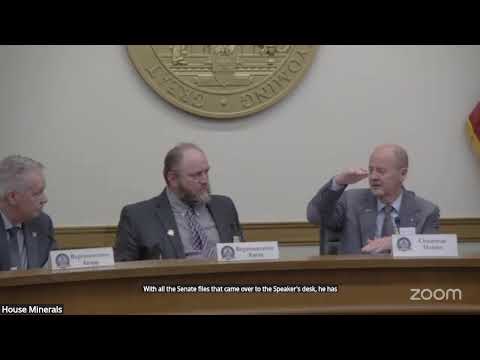
The Minerals, Business & Economic Development Committee gave a due-pass recommendation to Senate File 15, which removes language limiting regulation of produced-water reservoirs to lease units or communitized areas so operators can locate centralized reuse reservoirs across multiple leases.
The Minerals, Business & Economic Development Committee voted to give Senate File 15 a due-pass recommendation after hearing testimony from the state Oil and Gas Supervisor and industry representatives.
The bill strikes language in Wyoming Statute 30-5-104(d)(a) that historically limited the Oil and Gas Conservation Commission’s authority to regulate oilfield pits to locations ‘‘on a lease unit or communitized area,’’ allowing the commission to permit centralized produced-water reuse reservoirs that may lie outside a single lease or unit.
Tom Kropatch, state oil and gas supervisor for the Oil and Gas Conservation Commission, told the committee the change responds to technological shifts such as horizontal drilling and the increasing reuse of produced water in hydraulic fracturing and completions. “As industry starts to reuse the produced water, restricting the location of where these reservoirs could be constructed... essentially made industry permit more of them,” Kropatch said. He added the bill does not change construction, monitoring, or leak-detection requirements for those reservoirs.
Committee members asked how the change would interact with the Department of Environmental Quality (DEQ). Kropatch said DEQ retains authority to permit commercial oilfield waste disposal facilities but that centralized reuse reservoirs—used by a single operator to store produced water for reuse—are not disposal facilities and are not commercial operations. “If, for example, there was a leak… then we’d work together with the DEQ to make sure it was remediated appropriately,” he said. He described required safeguards, including double liners with leak detection between liners and routine monitoring.
Pete Obermueller, president of the Petroleum Association of Wyoming, offered brief industry support. There were no members of the public who opposed the bill.
Vice Chair Tarver moved and Representative Campbell seconded the motion to advance the bill; the committee took a roll-call vote. The clerk recorded ayes from Representatives Campbell, Knapp, Larson, Schmidt, Tarver, Weber and Chairman Heiner; two members were noted as excused. The committee reported the bill as “due pass.” Representative Campbell volunteered to carry Senate File 15 to the floor.
The committee record indicates the change is limited to where the commission may permit produced-water reservoirs and does not relax technical or monitoring requirements for reservoir construction or operation. The commission and DEQ retain their existing authorities for permitting and remediation.
Looking ahead, the commission will implement the statutory change through its permitting process and continue coordinating with DEQ on leak response and remediation when necessary.