Get Full Government Meeting Transcripts, Videos, & Alerts Forever!
Get email alerts on the Mission Rock topic
No spam. Unsubscribe anytime.
Port Commission approves Phase 1 acceptance and management agreements for Mission Rock
Summary
The San Francisco Port Commission voted Feb. 11 to accept Phase 1 public infrastructure at the Mission Rock development and approve leases, management agreements and long-term utility licenses; full city acceptance by the Board of Supervisors remains required.
The San Francisco Port Commission on Feb. 11 approved acceptance of Phase 1 public infrastructure at the Mission Rock development and authorized a package of leases, management agreements and utility licenses that will govern operation of China Basin Park and adjacent open spaces.
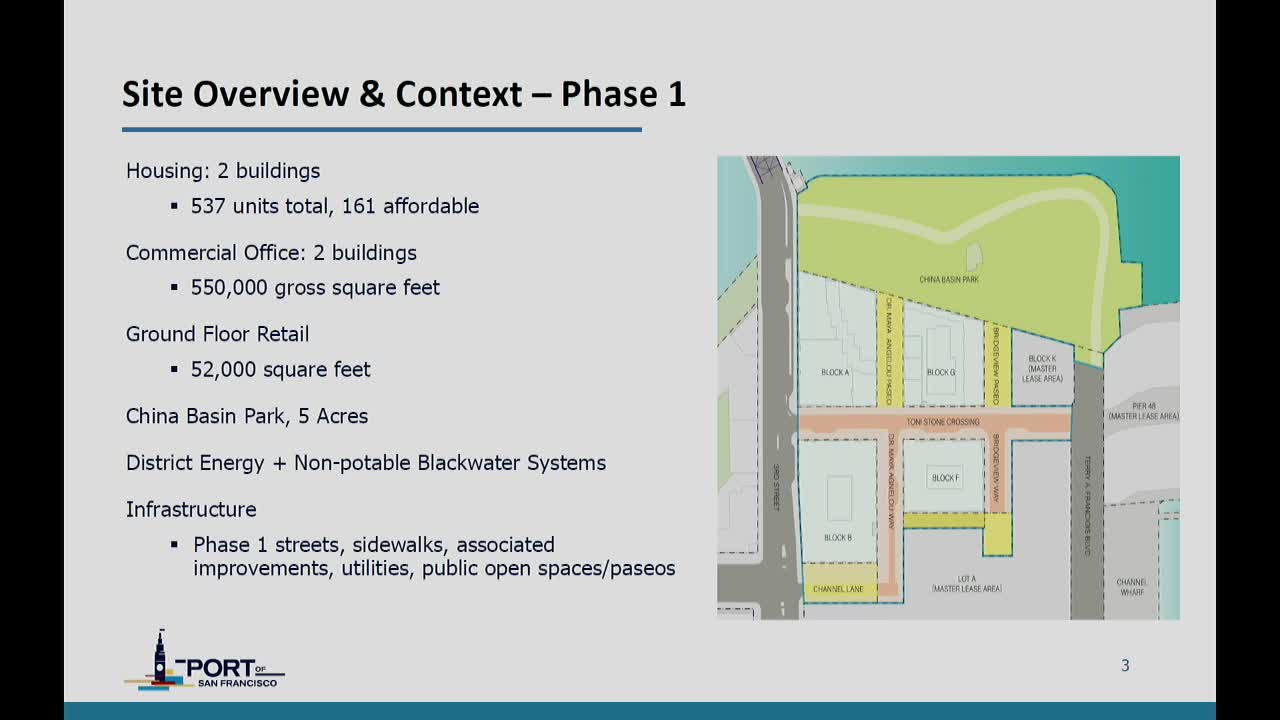
Port Waterfront Development Manager Wyatt Donnelly Landau told commissioners that Phase 1 includes four buildings with a total of 537 residential units (61 designated affordable), two commercial office buildings, about 50,000 square feet of ground-floor retail, the nearly 5-acre China Basin Park, a district energy system and a blackwater recycling system. The port will accept streets, sidewalks, open spaces and underground utilities as part of the action.
The commission approved a 15-year China Basin Park lease and loan agreement that would let an affiliate called Mission Rock Commons operate, maintain and program the park; the lease includes three five-year extension options and an early operating loan through Recreation and Parks of $300,000 per year for three years (up to $800,000 total) to support start-up operations, the staff presentation said. A separate 15-year management agreement with three five-year extension options would transfer maintenance responsibility for the Paseos and other nonpark open spaces to Mission Rock Commons, with a $10,000 annual management fee and reimbursement of maintenance costs from a master association funded by property owners and a contingency special tax.
The package also includes long-term utility licenses: two PG&E maintenance licenses (including a 66-year gas-line license transferring maintenance responsibility to PG&E), a PG&E electrical license that requires an absolving services agreement with the city, and a license with Mission Rock Utilities to operate and maintain the district energy and blackwater systems. Staff emphasized that these licenses transfer liability for maintenance to the licensees.
Commissioners and staff said the management arrangements were driven partly by financing constraints. Landau said the park and many nonstandard assets (custom benches, planters, wayfinding elements and special surfacing) were financed with tax-exempt bonds; the lease-and-management structure is intended to support programming and sponsorships while protecting the tax-exempt financing (private use is limited under bond rules).
The commission also consented to a capital improvement sponsorship by a Giants-affiliated group to install commemorative pavers along the pedestrian side of the Bay Trail through China Basin Park. Jack Baer of the San Francisco Giants said the first phase would reinsert existing tiles from the earlier park and that a subsequent phase would be marketed to the public to help fund ongoing park operations; the agreement requires removal and site restoration if the park lease terminates.
Wyatt Donnelly Landau gave a financial snapshot: the total Phase 1 budget is roughly $218 million with about $3 million remaining in contingency; city costs related to the project are about $19.5 million. Staff reported local business equity metrics for the broader Mission Rock program: roughly $170 million of $934 million in contracting awarded to local business enterprises (about 18 percent) and 105 LBE vendors engaged (22 percent of vendors), per the presentation.
The Port Commission vote sends the package to the San Francisco Board of Supervisors for final acceptance and execution of the agreements; staff said they expect introduction at the board in late February or early March and execution in late May or June depending on legislative timing. The Port Commission motion carried unanimously; the record shows the commission adopted Resolution 25-05 and Resolution 25-06 to effect the actions described.
The port staff presentation and commissioners’ questions also noted several follow-up points, including a small number of deferred infrastructure items that must be closed out during the formal acceptance process and continued coordination with Public Works, the Public Utilities Commission and San Francisco Municipal Transportation Agency on acceptance of city-owned infrastructure.
Mission Rock partners in the room included representatives of the San Francisco Giants and Tishman Speyer, and staff said some final paperwork remains before full city acceptance.