Get Full Government Meeting Transcripts, Videos, & Alerts Forever!
Get email alerts on the School Bond Election topic
No spam. Unsubscribe anytime.
Stafford boards approve resolution, call $150 million school bond election
Summary
The Stafford Municipal School District board voted 7-0 to ask voters to approve a $150 million school-building bond and the City of Stafford council approved an ordinance calling the election, with the package broken into four propositions for academics, debt refunding, stadium work and technology.
The Stafford Municipal School District board voted 7-0 to request a $150,000,000 school-building bond and the City of Stafford council approved an ordinance calling the election during a joint special meeting, district and city officials said.
District leaders presented a four-part bond proposal that would appear on the ballot as separate propositions: Proposition A for general academic facilities ($113,350,000); Proposition B to refund maintenance tax notes ($5,250,000); Proposition C for stadium facilities ($21,400,000); and Proposition D for technology ($10,000,000). Clarence Greer, the district’s financial adviser from RBC, told the joint bodies the plan would cost about 9.6 cents in tax rate — roughly $12.15 per month, or about $145 a year, for the median home in the district after exemptions.
The bond proposal is the product of an extended planning process that the district described as community-led. Superintendent Dr. Bassey said the district and city had been working with consultants from LAN and RBC Capital for about seven months and that a long-range facilities planning group and a 71-person key-communicator panel vetted and ranked projects. “If they plan to move forward with putting anything on a ballot at all for voters to consider in the city of Stafford, they must do it before the February 14,” Dr. Bassey said, noting the calendar deadline for putting a question on the ballot.
Bond counsel Marcus Deetz of Orrick Herrington & Sutcliffe read the statutory ballot language and explained why the proposals are separated. “This is a property tax increase,” Deetz said while summarizing the legal ballot text for each proposition. He said state law requires certain items — including stadium and many portable-device technology purchases — be presented in separate propositions.
Officials and consultants walked trustees and council members through a long list of projects derived from LAN’s comprehensive needs assessment. Staff described an initial “wish list” of roughly $214 million that was narrowed by community prioritization and board deliberations first to about $157.6 million and then further to $150 million after an additional round of cuts the board approved the night before the joint meeting.
Several residents who spoke during the public-comment period asked for more detail on specific line items and raised concerns about scope reductions. One commenter who had participated in the long-range planning group asked why the funding for deferred maintenance had changed and whether the reduced scope for the baseball and softball complexes removed synthetic turf; district staff said the turf option was removed to save roughly $7 million and that the current proposition funds renovations minus turf. Another resident pointed out two separate entries for early childhood projects (8 and 8a) and asked staff to clarify the difference; staff said some entries reflected earlier options tied to other site scenarios and that the spreadsheets shown at the meeting included both historical options and the current recommended package.
Consultant Greer provided the financial example the district will include in voter information materials: using a median market value of $313,000 for a Stafford homestead and current local exemptions, the $150 million package would increase the tax rate by an estimated 9.6 cents. Greer also noted the district had applied conservative assumptions for interest and construction inflation and that actual cost per homeowner could be lower if property values continue to rise.
Trustees and council members emphasized the district’s priorities in pairing student needs with fiscal responsibility. Trustees said the bond focuses on academics, athletics and technology while removing some higher-cost options and aiming to limit future return-to-voter requests within five years, where possible. Several council members and residents urged clearer voter-facing materials, and bond counsel confirmed that a voter information document (separate from the ballot language) will provide the estimated dollar impact and details on projects.
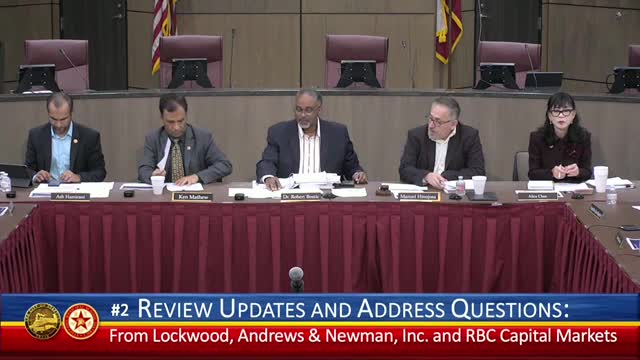
At the meeting’s close the SMSD board president called for the resolution; a trustee moved the resolution with the four proposition amounts and Board Secretary Jean Baptiste seconded. The president then called the roll; the motion passed 7-0. The city council then approved an ordinance calling the bond election; the council vote was recorded as passing during the meeting.
Next steps include finalizing the district’s published voter information materials and scheduling the election on the ballot per the statutory timeline. District and city staff said they will circulate the formal voter information document that lists total principal and interest costs and typical homeowner impacts. Public commenters at the meeting urged trustees and council members to ensure ample outreach and clearer item-level explanations before voters go to the polls.