Get Full Government Meeting Transcripts, Videos, & Alerts Forever!
Get email alerts on the Humanitarian Crisis Drc topic
No spam. Unsubscribe anytime.
UN humanitarian coordinator warns of worsening crisis after Goma fighting, funding freeze hampers aid
Summary
Bridal Lemaki, the United Nations humanitarian coordinator for the Democratic Republic of the Congo, said renewed fighting, the capture of Goma and a suspension of U.S. funding have sharply constrained relief operations and raised risks of epidemics and further displacement in eastern DRC.
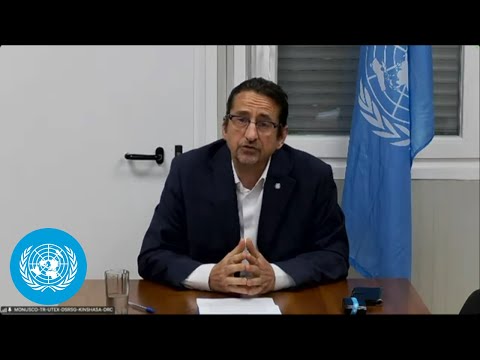
Bridal Lemaki, the United Nations humanitarian coordinator for the Democratic Republic of the Congo, told media that escalating fighting in eastern DRC — including the January 27 capture of Goma by the M23 armed group — has caused mass displacement, strained hospitals and interrupted aid deliveries.
Lemaki said the province’s security situation remains “extremely volatile,” citing advances by M23 and other armed groups, including an attack in Ituri that he said killed at least 52 civilians. He warned that fighting is ongoing and that M23 “may use alternative routes to progress towards the town of Bukavu in the coming days,” raising the prospect of further civilian harm and displacement.
The United Nations official described extensive humanitarian disruption in the city of Goma and surrounding areas: public services are only partly functional, water and electricity are not fully restored, hospitals are overwhelmed, mortuaries are saturated, and the risk of epidemics such as cholera and Mpox is high. “Our job is just to prevent and alleviate suffering wherever it may be found,” Lemaki said.
Humanitarian supply losses and transport bottlenecks have compounded the crisis, Lemaki said. He reported that UN and international NGO facilities were looted during the peak of the fighting and that millions of dollars’ worth of supplies were lost. Goma’s airport — the main humanitarian lifeline for air evacuations and deliveries — remains closed and “non operational,” he said, and urged all parties to cooperate to reopen it to humanitarian flights.
Lemaki gave specific figures for the 2024 humanitarian operation: the humanitarian response plan requested $2.5 billion, of which $1.3 billion was received; he said $910 million of that came from the United States, representing roughly 70% of the financing for the DRC response that year. He told reporters that a recent U.S. contracting stop order froze much U.S. funding to UN agencies and international nongovernmental organizations, causing many programs to halt for several weeks. He said emergency food assistance was exempted and has continued, but that other areas — including emergency health, shelter and coordination capacity — were affected.
On displacement, Lemaki said there were about 2.8 million internally displaced people in North Kivu as of December 2024, including roughly 700,000 around Goma. He reported that some displaced people had begun returning to territories such as Nyiragongo, Masisi and Rutshuru, but warned against coerced returns after he said M23 representatives issued a 72-hour ultimatum on Feb. 9 for people in sites around Goma to return to their villages. He reiterated that returns must be “safe, dignified, and voluntary” under international humanitarian law.
Lemaki also described threats to human rights defenders and journalists, including reports of forced disappearance and summary executions. He said UN and humanitarian partners are operating under strict humanitarian principles of humanity, neutrality, impartiality and independence while trying to restore capacity that had been reduced during the worst days of fighting.
In response to questions, Lemaki said he was not able to provide operational details on the repatriation of fallen soldiers discussed by others; on funding resumption he said some partners had received partial “resume orders” but he did not have a complete list of which program areas were restarting. He said the UN is engaging with all parties in order to secure access for aid deliveries, including discussing customs, border, airspace and utility-management issues with de facto local authorities in areas the M23 now controls.
Lemaki closed by urging all parties to end hostilities and calling on the international community to intensify support for humanitarian response in eastern DRC. “Despite these challenges, we are here to stay and deliver,” he said.