Get Full Government Meeting Transcripts, Videos, & Alerts Forever!
Get email alerts on the Math Curriculum topic
No spam. Unsubscribe anytime.
West Bend committee narrows math curriculum options for grades 6–12 after multi-year review
Summary
The West Bend School District curriculum committee heard a report from the curriculum coordinator on a multi-year review of math resources for grades 6–12 and a plan to field-test final options before recommending a selection in March.
The West Bend School District Curriculum Committee on Feb. 11 heard a presentation from curriculum coordinator Kelly Downs on a multi-year review of math curriculum resources for grades 6–12, and the committee was told the review has been narrowed to two middle-school options and two high-school options for teacher trials and public review.
Downs told the committee the goal of the work was “to ensure that our primary curriculum resource provides all students and teachers the opportunity to achieve at high levels.” She described a process that began with a 2022–23 program analysis and continued with professional development, coaching, and a multi-stage materials screening.
The report said the district developed and used local “lesson elements” to define expected instructional practices, offered professional development and coaching involving outside consultants and the district instructional coach, strengthened professional learning communities and focused the teams on common formative assessments. Downs said the Math Institute of Wisconsin and consultants Eric Kanters and Sarah Brown worked with district staff; the district also provided an on-site instructional coach.
For materials screening, the team used EdReports, a nonprofit curriculum review organization. Downs said the initial EdReports list contained more than 150 resources; applying EdReports’ three “gateway” filters left 21 middle-school and 20 high-school candidates, which the district’s team further narrowed to eight middle-school and four high-school resources using scripted indicator scoring. The team then applied a third rubric aligned to the district’s lesson elements to arrive at the final two middle-school choices—Imagine Learning’s Illustrative Math and I‑Ready—and two high-school choices—Kendall Hunt’s Illustrative Math and Open Up.
Downs said the district’s current adopted resource, College Preparatory Mathematics (CPM), was adopted in 2016 (published 2013) and that EdReports ratings and local review showed CPM did not meet expectations for grades 6 and 7. She characterized the decision to seek alternatives as difficult because teachers had invested time developing assessments and instructional practice with CPM; she said the team used a consensus process for decisions.
Next steps described to the committee include vendor presentations on a professional development day, classroom visits so teachers can see options in practice, and a teacher feedback form. Downs said the team hopes to bring a final recommendation to the curriculum committee on March 11, followed by public viewing and a survey before the full board process.
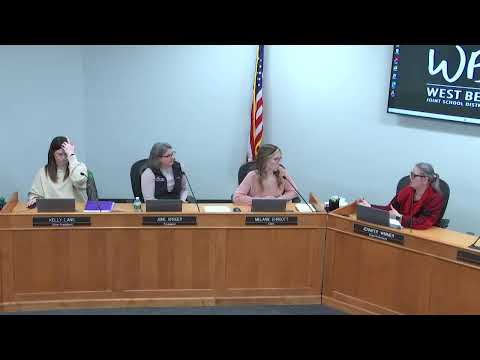
Questions from board members focused on scheduling and implementation logistics. Kelly Lang asked whether sixth-grade teachers who also teach other subjects would be affected; Downs said the district will phase implementation so teachers who teach two courses will not have both courses implemented simultaneously. No formal board action was taken at this meeting on the math resource.
The committee thanked the curriculum team and teachers for the multi-step review and noted the planned teacher trials and public feedback prior to a March recommendation.