Get Full Government Meeting Transcripts, Videos, & Alerts Forever!
Get email alerts on the Elected Officials Compensation topic
No spam. Unsubscribe anytime.
Committee advances ordinance raising justices of the peace pay; measure goes to full court
Summary
Washington County Finance and Budget Committee voted to send an ordinance to the full quorum court that would change justices of the peace compensation from a per-meeting rate to a salary structure with a $19,118 maximum; committee members debated timing, budget impacts and legal questions.
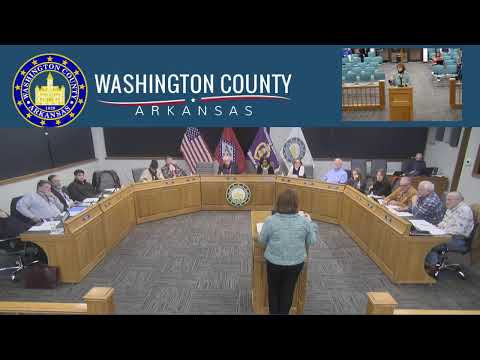
At a Washington County Finance and Budget Committee meeting, members voted to advance an ordinance that would change how justices of the peace are paid, moving from a per-meeting rate to a salary framework with a stated maximum of $19,118.
The committee voted to send the ordinance to the full quorum court with a “due pass” recommendation after extended discussion about budget implications, fairness and process. Justice Kyle Lyons moved the measure; JP Dean seconded the motion and the committee approved it.
The proposed ordinance would set a maximum annual pay for each justice of the peace at $19,118, with a stated minimum of $18,000 in the ordinance text. The committee heard competing views on whether the change should take effect immediately and whether the county had already budgeted for the increase. Comptroller Schaller said the county’s 2024 amended budget previously included the higher maximum but the ordinance language did not, which created the current discrepancy. “When we passed the budget we put the max in there,” Schaller said during the discussion, adding that line items for salaries, FICA and workers’ compensation would be required when formalizing the ordinance.
Supporters argued the update corrects a long-standing pay gap. Justice Lyons said Washington County is “one of the three largest counties in Arkansas” and noted the current pay rate had left the county near the bottom of the state ranking. JP Washington said the change was meant to bring pay parity with similarly sized counties and to broaden who can afford to serve. Several members urged the committee to consult the Association of Arkansas Counties to confirm the approach fits state guidance before the full-court vote.
Opponents raised concerns about optics and timing. JP Koger called the increase “way too much” in light of county employee pay decisions and asked whether the public would view the change negatively. JP Burns and others asked whether the action should wait until the next budget cycle so constituents could comment.
Committee members discussed mechanics for implementing the change. Sherman's staff (comptroller) reported the committee would need additional appropriations to match the ordinance if the full-court adopts it: the staff estimate presented in committee identified approximately $70,770 in additional salaries and roughly $5,400 in employer FICA/Medicare matching, for a combined additional appropriation of about $76,183.90 beyond the amount budgeted under a $300-per-meeting assumption. The committee discussed how missed meetings would be treated under the salary model; the ordinance language ties forfeited pay to absences and includes a rule that missing half of a meeting will be considered an absence for pay purposes.
Legal questions were raised about whether the court can make the pay change effective immediately. County legal counsel, Brian Lester, said he had not researched that specific timing question and offered to provide a written opinion before the quorum court meeting: “I’ve never looked into that, to be real honest with you,” Lester said, and agreed to follow up with research for the full court.
After roughly two hours of discussion, the committee voted to send the ordinance to the full quorum court with a due pass recommendation. The committee vote was recorded as a majority “ayes” following a motion by Justice Lyons and a second from JP Dean.
The ordinance will now go to the full Washington County Quorum Court for debate and a final vote, where more detailed budget line items and any legal clarifications requested by committee members are expected to be provided.