Get Full Government Meeting Transcripts, Videos, & Alerts Forever!
Get email alerts on the Education Accreditation topic
No spam. Unsubscribe anytime.
Newport News officials point to test gains and set benchmarks toward 2030 accreditation goal
Summary
School officials reported double-digit assessment gains at some schools, outlined new magnet programs and a Journey 2030 strategic-planning process, and flagged attendance and work-based learning as priorities for reaching full accreditation by 2030.
Newport News school officials told a joint City Council–School Board meeting that recent assessment data show measurable academic gains, and they described a multiyear strategic-planning effort intended to move all schools to full accreditation by 2030.
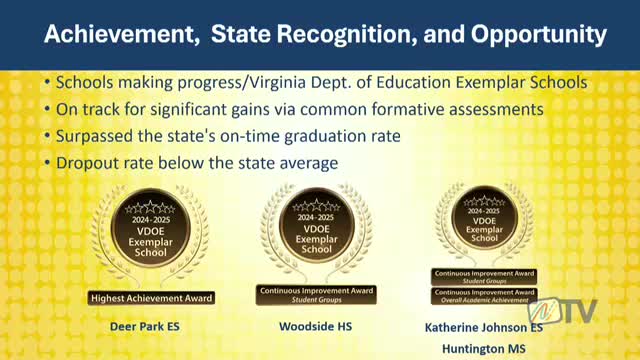
Superintendent-level staff said the division has seen “literally double digit gains in common assessments as compared to last year,” citing a 26% increase in a second-quarter science assessment at Newsome Park as an example. The officials outlined efforts that include strengthening magnet academies and specialty programs, launching a Maritime Engineering and Environmental Studies Academy (MESA) in partnership with Old Dominion University next fall, and adding a STEAM program at Huntington Middle School the following year.
Officials said the division is building a benchmarking system tied to key performance indicators to evaluate which programs to keep, consolidate or discontinue. “We just had a meeting today during our senior staff meeting where we are embarking upon our strategic planning process for Journey 2030, where we will create…a benchmark system to take a close look at our existing programs,” a school division staff member said.
Board and council members asked how accountability measures under the state’s new system would affect schools now accredited with conditions. School staff said they ran predictive modeling and expect some schools currently “with conditions” to shift to “on track” under the new accountability rules; they estimated the number of schools with conditions could fall from 17 to roughly 12–13, but did not give a firm final count.
School leaders noted specific subgroup issues that factor into accreditation. Staff said English-language learners now have 18 months to reach English proficiency under the new accountability framework, and students with disabilities are assessed and weighted under the same framework as other students. Officials told the meeting that five schools missed full accreditation previously by five or fewer students in science, indicating small margins separate some schools from full accreditation.
Attendance and work-based learning surfaced repeatedly as areas for city–school collaboration. School staff said attendance counts toward accreditation and that local policy or community supports that increase attendance could help meet 2030 targets. The board asked the council to engage employers on internships and other work-based learning opportunities, saying those experiences are part of the accreditation mix.
Officials also described regular enrollment monitoring and outreach, including monthly reports and efforts to re-engage families using homeschool or virtual options. The division reported 2,827 military-connected students this year, a decline of 172 from the previous year.
School leaders flagged continued staffing and transportation challenges, including teacher retention and bus-driver shortages, as operational risks that affect instructional continuity.
Board members asked for annual joint coordination with the council—ideally a meeting in the fall after school-year results are available and timed to inform the city’s budget cycle—to align the school division’s planning and the city’s capital and operating budgeting.
The presentation included several requests for continued council support in conversations about resources needed to accelerate academic progress and implement Journey 2030.