Get Full Government Meeting Transcripts, Videos, & Alerts Forever!
Get email alerts on the Comp Plan 2025 topic
No spam. Unsubscribe anytime.
Skagit planning staff brief commissioners on 2025 comprehensive‑plan update; climate and housing are focal points
Summary
Planning and consultant teams presented draft policies and a climate vulnerability assessment for Skagit County’s 2025 comprehensive‑plan update, and outlined proposed changes to housing targets and rural options to meet new state requirements.
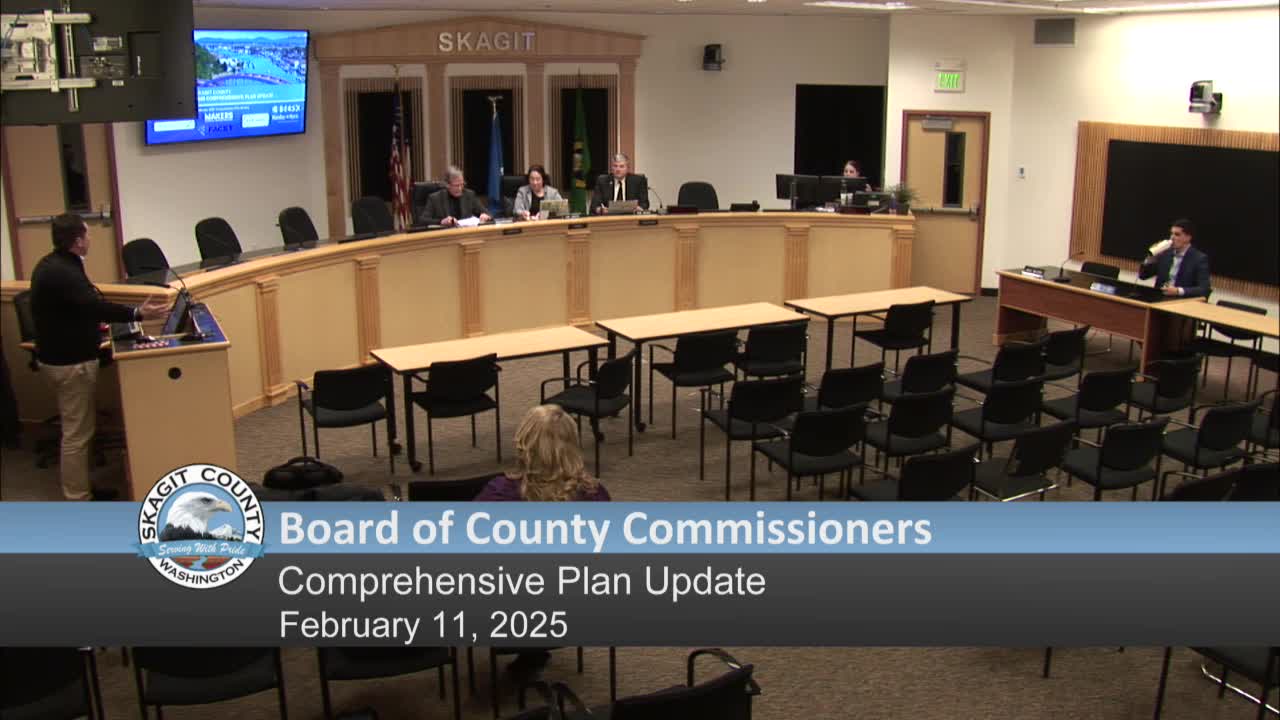
Skagit County planning staff and consultants on Tuesday briefed the Board of County Commissioners on the 2025 comprehensive‑plan update, highlighting new climate‑element work and state‑driven changes to the housing element and related implementation steps.
Senior planner Robbie Eckroth and consultants from Kimley‑Horn said the update integrates state law changes, community engagement and technical analyses to produce revised policies and an implementation chapter designed to translate plan goals into deliverable actions.
The briefing focused on two areas where state law or local feedback has driven changes: a new climate element requirement and changes to the housing element adopted in recent state legislation. The county’s climate vulnerability assessment examined locally relevant stressors — drought and reduced snowpack, shifts in precipitation, flooding, wildfire and sea level rise — and recommended resilience policies and coordination steps with federal, state and local partners.
Kimley‑Horn climate director Heidi Rouse described the vulnerability assessment as a first systematic evaluation that combines scientific data with local input and department expertise. She said the assessment prioritized short‑ and medium‑term actions the county can influence, including protecting natural areas, strengthening flood and sea‑level‑rise resilience, improving transportation options and preparing county infrastructure and watersheds for long‑term water‑security issues.
On greenhouse‑gas (GHG) policy, staff proposed county goals to protect and manage natural lands, reduce vehicle miles traveled per person over time and promote renewable energy, EV infrastructure and energy‑efficiency in buildings. Rouse and staff emphasized that implementation will require coordination, incentives and access to federal and state funding.
Planning staff also summarized housing‑element work driven by recent “housing element” state requirements (participants referenced state changes such as House Bill 1220 in discussion). The new rules require jurisdictions to plan for housing by income bands so local zoning and capacity align with likely housing demand at different affordability levels. Staff said most low‑income multifamily housing is appropriate in urban growth areas with sewer and public services; for county rural areas, staff proposed targeted tools — such as expanding allowable accessory dwelling units and limited multi‑unit options in identified rural nodes where public water and sufficient services exist — to help meet portions of the county’s allocation without encouraging sprawl or conversion of resource lands.
Eckroth said the planning team will publish a draft comprehensive plan this week that compiles prior rounds of public engagement, planning‑commission input and staff edits; a public comment period and planning‑commission hearings are scheduled in coming weeks. He said planning staff will follow with critical‑areas regulation updates tied to best available science and with implementing development‑regulation changes.
Commissioners asked about implementation and accountability. Staff said they are drafting an implementation chapter with measurable tasks and responsible departments so the county can track progress and consider the work program during budgeting. A commissioner asked that food‑access and disaster‑resilience considerations also be integrated into implementation planning.
Ending: Staff said the draft plan and supporting materials will be posted for public review; the planning commission will hold hearings and deliberate in March and April, and the Board will consider the package later in the 2025 comprehensive‑plan schedule.