Get Full Government Meeting Transcripts, Videos, & Alerts Forever!
Get email alerts on the Lake Erie Gravel Pit Appeal topic
No spam. Unsubscribe anytime.
Skagit County hears closed‑record appeal over Lake Erie gravel‑pit expansion; opponents cite groundwater and bluff risks
Summary
A closed‑record appeal hearing drew residents, neighborhood groups and county staff to argue over whether a proposed 36‑acre expansion of the Lake Erie gravel pit can be conditioned to avoid groundwater and bluff‑stability impacts; the hearing examiner previously denied a special‑use permit and the Board will issue a decision Feb. 24.
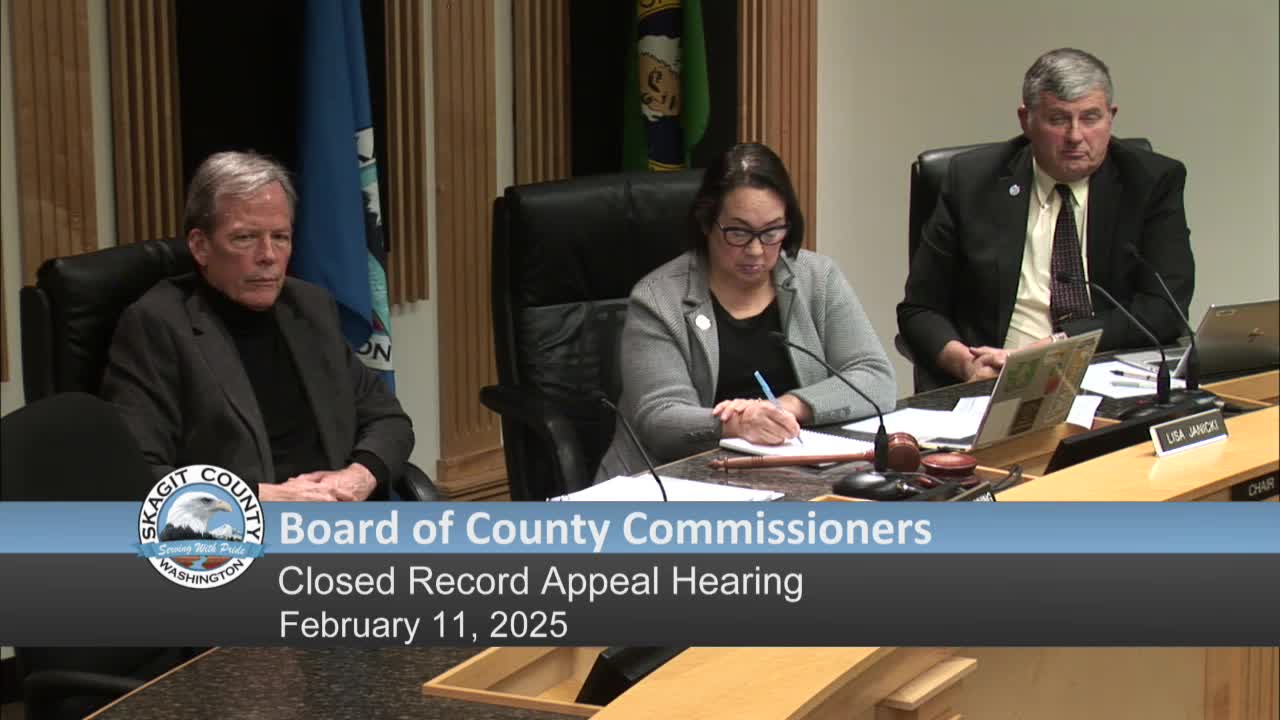
Skagit County on Tuesday held a closed‑record appeal hearing on a long‑running dispute over a proposed expansion of the Lake Erie gravel pit on Fidalgo Island, where opponents said the expansion could increase groundwater flow toward unstable coastal bluffs and endanger homes, while the applicant’s attorney and county experts said available hydrogeologic analyses do not show flow toward the bluffs.
The appeal concerns a May 22, 2024, hearing‑examiner decision denying the special‑use permit (PL16‑0556) for an approximately 36‑acre expansion of an existing gravel mine operated by applicant Bill Wooding. The applicant appealed that denial to the Board of County Commissioners; Tuesday’s proceeding was a closed‑record legal review restricted to evidence already in the administrative record and testimony presented to the hearing examiner.
Attorney Michael Carmichael, speaking for the applicant, asked the Board to remand the decision for further investigation rather than uphold the hearing examiner’s denial. Carmichael said two licensed hydrogeologists in the record — one hired by the applicant and one retained by the county as a third‑party reviewer — both concluded after reviewing well monitoring, well logs and water chemistry that groundwater beneath the mine site flows north and northeast, not northwest toward the coastal bluffs and nearby springs.
Opponents — represented by Evergreen Islands and the Sunset Lane Association and by multiple nearby residents — said the record lacks a comprehensive geologic and hydrogeologic assessment of potential impacts to bluff stability and springs west of the site. Kyle Loring of Evergreen Islands told commissioners the permit denial should be upheld because the hearing examiner reasonably found the evidence insufficient to demonstrate that mining impacts could be mitigated under the county’s critical‑areas code.
Sunset Lane Association representatives and residents described visible slope erosion and springs near the bluff and said the applicant did not provide a ‘‘geologically hazardous site assessment’’ that the remand order requested. Frank Parker, representing the association, pointed to lidar maps in the applicant’s materials and to what residents call a known sand blowout on Sunset Lane, saying the county was correct to require a full geologic analysis before approving new mining.
County planning staff summarized the procedural history. Senior planner Kevin Curcchio said the file dates to 2016, was remanded and later returned to the hearing examiner after the applicant submitted supplemental geologic materials prepared by Northwest Groundwater Consultants and reviewed by a county‑retained third‑party consultant (Facet). Staff said it recommended approval to the hearing examiner after the remand but the hearing examiner — exercising independent judgment — denied the permit on the grounds that the information presented was insufficient to determine whether mitigation could prevent harm to public health, safety and welfare.
Several nearby residents and community organizations urged the board to uphold the hearing examiner’s denial, describing current and potential impacts to homes, water supplies and a Del Mar Community Services water system that serves several hundred households and water storage tanks near the mine property.
In rebuttal, Carmichael stressed his client’s willingness to seek additional conditions and studies but argued the county’s hydrogeologic reviewers both reached the same professional conclusion that groundwater flow was not toward the bluffs. He said a remand — to allow focused follow‑up on specific questions — would be in the interest of resolving outstanding items and of preserving mineral resources subject to state Growth Management Act protections.
The Board did not rule Tuesday. County staff advised parties that commissioners will consider the closed‑record appeal and render a written decision on Monday, Feb. 24, at 2:30 p.m. Commissioners cautioned that as the matter is quasi‑judicial they cannot discuss it outside the formal record and asked parties to direct inquiries to the county prosecuting attorney’s office.
Ending: The commissioners closed the hearing and scheduled their written decision for Feb. 24. Parties on both sides said they would await the Board’s ruling and reiterated a desire for any remaining technical questions to be resolved within the administrative record or via remand as the Board directs.