Get Full Government Meeting Transcripts, Videos, & Alerts Forever!
Get email alerts on the Property Tax Exemption Dispute topic
No spam. Unsubscribe anytime.
Clay County hearing spotlights dispute over whether homestead and conservation easement exemptions can apply to same 1-acre
Summary
At a Clay County Value Adjustment Board hearing, the property appraiser and the owner of a 274.6-acre parcel disputed whether a 1-acre homestead curtilage can also receive a 50% conservation easement exemption. The special magistrate heard legal arguments and said he will issue a written ruling.
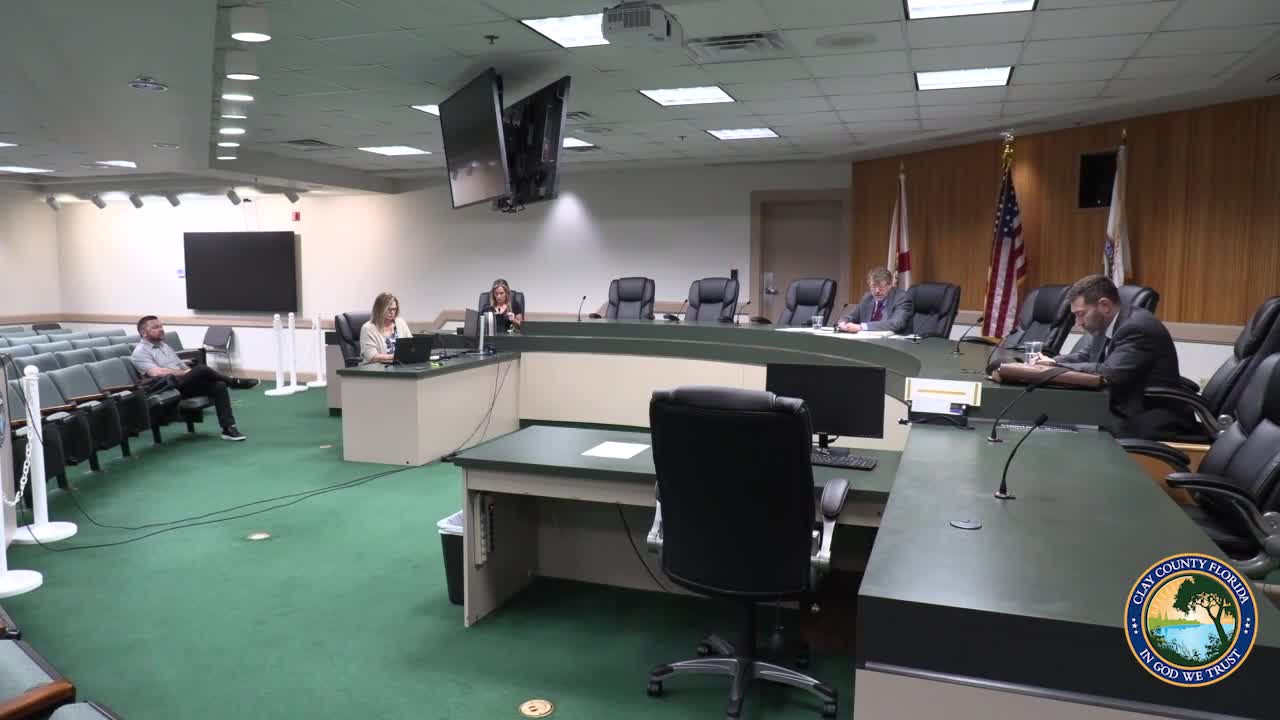
A special magistrate for the Clay County Value Adjustment Board heard arguments on whether a 1-acre area around a residence that currently receives a homestead exemption can also receive a 50% conservation-easement exemption, with both sides asking the magistrate to apply Florida law and Department of Revenue guidance to the 2024 assessment year.
The matter concerns a 274.6-acre parcel owned by the Stephen W. and Jane S. Connor Family Trust. The property appraiser’s office denied a conservation-exemption application on a 1-acre portion that the owner claimed as homestead; the remaining 273.6 acres remain classified as agricultural and subject to the conservation exemption, the appraiser said.
The dispute matters because the exemptions use different valuation methods and tax benefits: homestead exemption and the Save Our Homes assessment limitation are applied to owner-occupied residential property and curtail assessed-value growth, while conservation-easement exemptions reduce assessed land value for land dedicated in perpetuity for conservation purposes. How those rules interact on the same parcel determines taxable value and future tax bills.
Tracy Drake, Clay County property appraiser, told Special Magistrate Paul Sanders that the office denied the one-acre conservation exemption because the parcel’s declaration of permanent residency and homestead status precludes commercial uses on that portion of land. “My answer has been no and it continues to be no,” Drake said, summarizing the appraiser’s position that homestead and the conservation exemption cannot be applied to the same portion of land because the statutes require different valuation methods and Save Our Homes protection applies only to property assessed under the homestead provisions.
Drake described the evidence the office submitted, including the 2024 property record, the conservation-exemption application (filed late March 13, 2024), and an email from the Department of Revenue’s Property Tax Oversight (PTO) unit. He said the appraiser granted the late filing for review but issued a denial effective July 1, 2024, for the 1-acre portion because allowing both exemptions on the same dirt would create an erroneous assessment under the PTO’s data-edit standards.
The property owner, trustee Steve Connor, argued the statutes and PTO guidance permit applying the conservation-exemption deduction to the assessed value of all land on the parcel — including the dwelling and its curtilage — while still allowing a homestead exemption to be computed for the residence and curtilage. Connor handed the magistrate a written rebuttal and a PTO bulletin (referenced in hearing evidence as Bulletin 22-03) and said the bulletin shows the computation method the owner used to claim both exemptions for 2024.
Connor said the dwelling and the 1-acre curtilage were separately assessed under the just-value rules, as required, and that nothing in the conservation statute prevents granting the conservation deduction to structures deemed auxiliary to conservation purposes. “There is no double dipping here,” Connor said, arguing the conservation deduction can apply to the assessed value of structures and the land if the encumbrance and statutory language permit it.
Lauren Levy, counsel for the property appraiser, told the magistrate the board should consider the unusual procedural posture: prior litigation and VAB rulings. Levy said a lawsuit arising from earlier tax years was dismissed in 2022 and that the VAB issued a decision in 2023 denying the one-acre exemption (or finding any entitlement waived for lack of timely application). She also said a separate circuit-court de novo review has been filed for the 2024 tax year and that proceedings in court are underway, including a summary-judgment motion.
Both sides cited Florida law and statutory sections during argument, identifying the interplay of homestead rules, Save Our Homes (the homestead assessment cap), agriculture-classification statutes, and the conservation-easement exemption statute. Drake emphasized that properties assessed pursuant to special classifications (for example, agricultural classification or conservation easement assessment) are not eligible for the Save Our Homes cap unless the residence and curtilage are separately assessed under the just-value provision. Connor countered that the statutes and PTO guidance instruct how to perform those computations and allow the homestead deduction while still applying conservation easement deductions to the parcel and auxiliary structures.
At the hearing Drake presented the county’s figures: the parcel’s total area is 274.6 acres; the 1-acre curtilage was assessed separately and remains the subject of the dispute; the non-curtilage land was reported as having an assessed agricultural value of $127,229 and, after a conservation deduction equal to 50% of assessed land value, a taxable value of $63,615 for the non-homestead acreage. Connor provided a PTO-example computation and referenced a market-value figure reported on the certified property card and the property-assessor’s assessment roll.
Special Magistrate Paul Sanders closed the hearing after both sides rested and agreed to accept submitted evidence. Sanders said he would review the record and issue a written ruling. “I will be in touch with everyone shortly with what my ruling is,” Sanders told the participants.
No formal vote or final board action was recorded at the hearing; the magistrate’s written recommendation will be provided to the Value Adjustment Board for final disposition under the board’s procedures.
The hearing record shows the parties debated (1) whether the conservation-easement deduction may be applied to land and improvements that are auxiliary to conservation purposes when an owner also claims homestead on part of the parcel; (2) whether the PTO email and Bulletin 22-03 are definitive for program edits or whether they are guidance that must be weighed with statute and case law; and (3) procedural issues arising from prior years’ submissions, late filing, and parallel litigation. The magistrate accepted evidence from both sides and indicated a written ruling would follow.