Get Full Government Meeting Transcripts, Videos, & Alerts Forever!
Get email alerts on the Durable Medical Equipment topic
No spam. Unsubscribe anytime.
Durable medical equipment, cranial prostheses and chiropractic services among benefits priced in EHB review
Summary
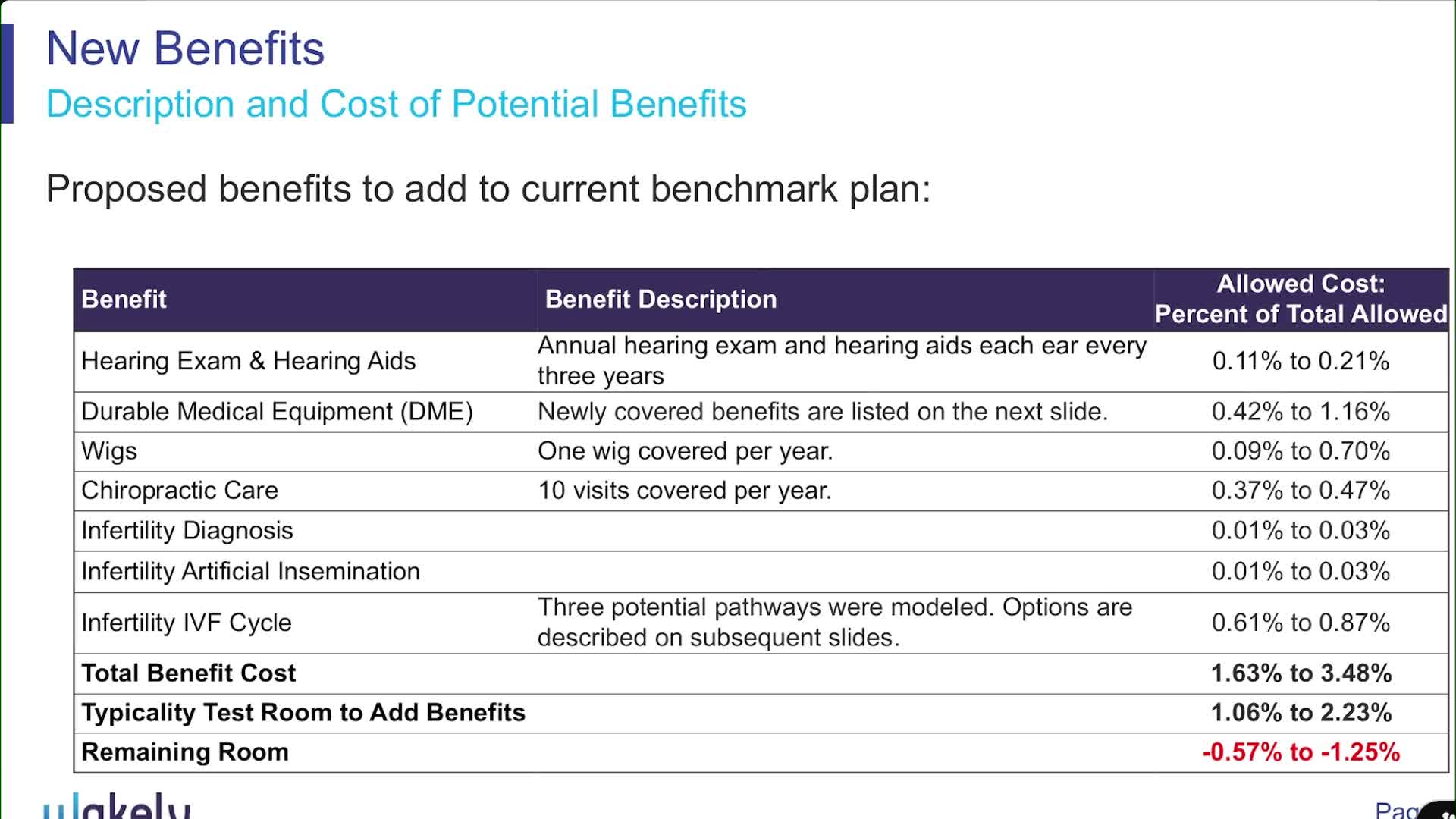
Consultants priced DME (including wheelchairs and CPAP), cranial prosthesis (wigs/hairpieces), and chiropractic care as candidate additions to California’s EHB benchmark; the total menu exceeds the state's actuarial room so the committee must prioritize additions.
The informational hearing on California’s EHB benchmark included detailed pricing for three categories of benefits frequently raised in stakeholder comment: durable medical equipment (DME), cranial prostheses (wigs/hairpieces) and chiropractic care.
Why it matters: Adding DME, cranial prosthesis and chiropractic care would require minimum benefit definitions and actuarial justification and would affect plan allowed costs and member premiums in individual and small‑group markets.
What the actuaries said: Wakely said DME pricing is driven by specific items — for example, CPAP machines represented a major share of the DME cost estimates — and that wheelchair and powered mobility device unit costs vary widely. In Wakely’s breakout, the DME total had a wide range because some high‑cost items have low utilization while others have broader use. Wakely priced cranial prosthesis (wigs/hairpieces) across a range of unit types from synthetic to high‑end human‑hair units and noted a wide unit‑cost variance; the firm had priced a single wig per year as an illustrative option. For chiropractic care, Slaughter noted the comparison benchmark plans varied in visit limits; his tally of the ten CMS benchmark options showed chiropractic coverage was one of the items that made some plans richer in the typicality comparison.
CHBRP estimates: CHBRP provided illustrative silver‑plan PMPM estimates for some categories: the program estimated adult wigs/cranial prosthesis at about $0.31 PMPM and chiropractic coverage at $0.78 PMPM; CHBRP estimated a DME category (including CPAP, walkers and wheelchairs) at about $1.64 PMPM. CHBRP noted assumptions include use of step therapy or prior authorization for high‑cost devices and that unit costs and utilization assumptions materially affect estimates.
Public testimony and equity concerns: Patient advocates urged coverage for cranial prosthesis for patients with cancer, alopecia, thyroid disease and burns. Several witnesses said prostheses are not cosmetic for individuals experiencing medically‑related hair loss and urged coverage that allows durable options for those who cannot afford high‑end pieces. Advocacy organizations and clinical witnesses also emphasized that insufficient DME coverage forces people into lower‑quality devices or publicly funded programs.
Outstanding issues: Committee members sought more granular lists of which specific DME items would be covered and clearer definitions for prosthesis frequency and quality (synthetic vs. real hair). Actuaries said more precise benefit definitions and issuer practices on utilization management would narrow the pricing ranges.
Ending: The hearing showed DME, cranial prostheses and chiropractic services are candidates for EHB expansion but that adding them all would exceed the actuarial room identified by Wakely. The committee directed staff to refine definitions and unit‑cost detail for future deliberations.