Get Full Government Meeting Transcripts, Videos, & Alerts Forever!
Get email alerts on the Hearing Aids topic
No spam. Unsubscribe anytime.
Parents and advocates press state to add hearing aids to EHBs after committee hears access gaps
Summary
Multiple parents, advocacy groups and clinicians urged legislators to include hearing aids — particularly for children — in the 2027 EHB benchmark. Actuaries said hearing‑aid coverage is not currently in California’s benchmark and would increase allowed costs; CMS rules prohibit age‑limited benefits.
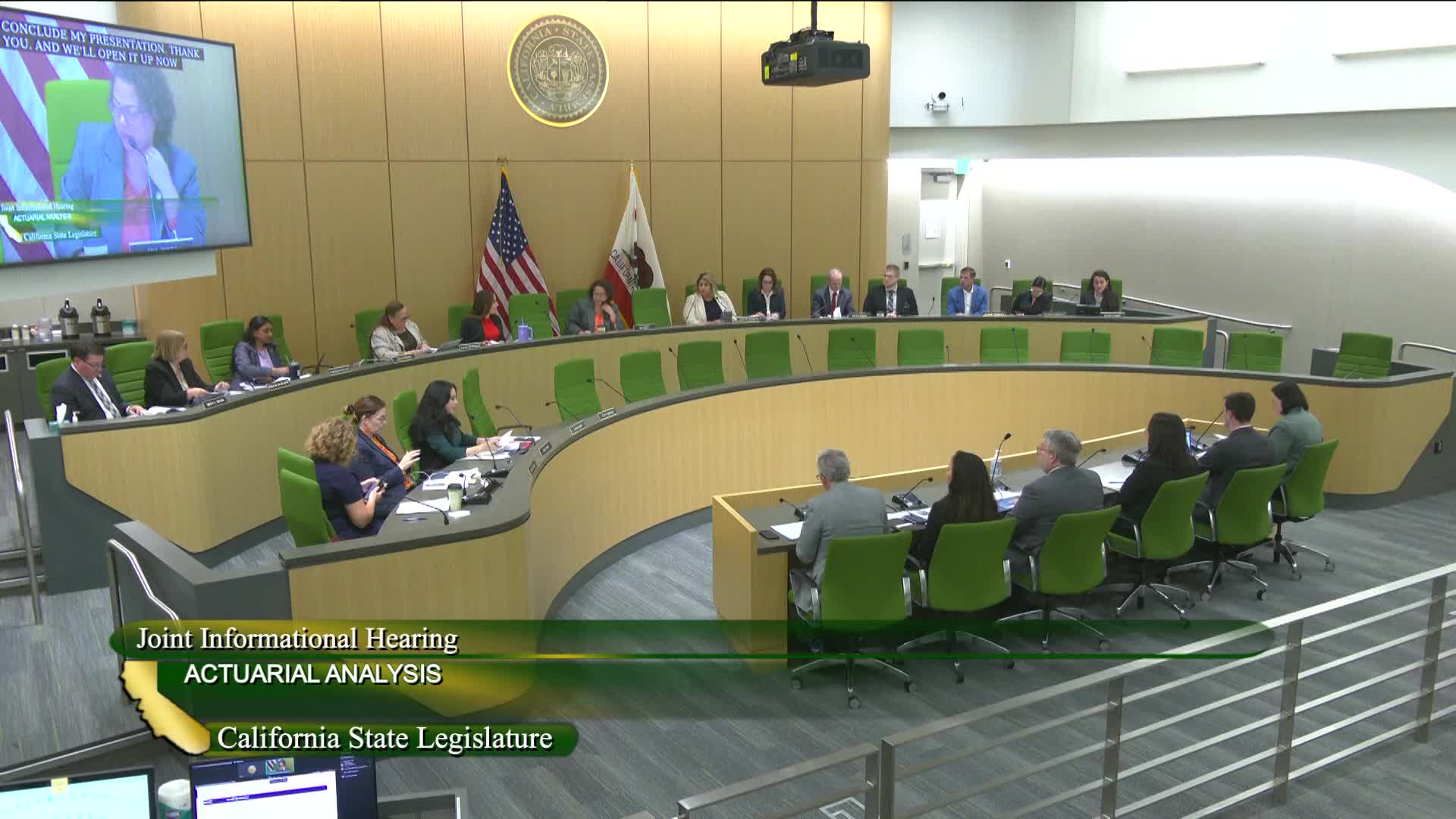
At a joint hearing on California’s essential health benefits benchmark, advocates, clinicians and parents urged the Legislature to add hearing‑aid coverage — especially for children — to the state benchmark plan.
Why it matters: Hearing aids are costly and, for children in critical language development periods, experts say lack of coverage can impair development and increase special‑education needs. If added to the EHB benchmark, hearing‑aid coverage would become a required benefit for plans in the individual and small‑group markets.
Evidence and estimates: Wakely actuary Matt Slaughter said that California’s current benchmark contains no hearing‑aid coverage. "The hearing aids here, currently in the benchmark plan, there is no hearing aids covered," Slaughter said; he noted Wakely priced hearing aids in its menu and that the firm produced ranges for unit costs and utilization. CHBRP’s analysis included a silver‑plan PMPM estimate of about $1.52 for hearing aids. Wakely and CHBRP emphasized their estimates use different bases (allowed cost vs. premium impacts) and that both sets of numbers carry ranges driven by utilization assumptions.
Legal constraint: Agency counsel and actuaries noted CMS has said a benefit limited by age or condition can run afoul of its anti‑discrimination standard. Panelists said CMS has told other states that child‑only hearing aid coverage must be expanded to all ages if included in an EHB.
Public testimony: Parents and children described personal experiences: several families said hearing aids enabled meaningful development of speech and social interaction; a parent said her child’s speech and school participation improved after receiving devices. Advocacy groups, including Children Now and the California Academy of Audiology, urged addition of hearing aids and pointed to state special education costs linked to unaddressed hearing loss.
Unresolved items: Committee members asked DMHC and actuaries for more granular unit costs, issuer pricing and confirmation on whether pediatric‑only language would be acceptable to CMS; DMHC explained CMS’s recent guidance makes pediatric‑only language likely impermissible.
Ending: Advocates urged rapid action; agency staff cautioned the state must choose benefits that fit under the CMS typicality ceiling and provide defensible actuarial documentation if it pursues hearing‑aid coverage in a May filing.