Get Full Government Meeting Transcripts, Videos, & Alerts Forever!
Get email alerts on the Infertility Ivf topic
No spam. Unsubscribe anytime.
Lawmakers and patients press to add infertility and IVF to California’s essential health benefits
Summary
Stakeholders urged inclusion of infertility diagnosis and in‑vitro fertilization in the EHB benchmark. Wakely and CHBRP presented differing price ranges; advocates urged pathway aligned with SB 729. Lawmakers asked for clearer unit costs and covered services.
Assembly and Senate health committee members spent substantial time at the informational hearing on whether to include infertility services — including in‑vitro fertilization (IVF) — in California’s EHB benchmark package.
Why it matters: Infertility services are expensive and, if adopted as part of the EHB, would become required benefits in individual and small group plans. The choice affects access and out‑of‑pocket costs for people who need fertility care and has measurable premium implications across the individual market.
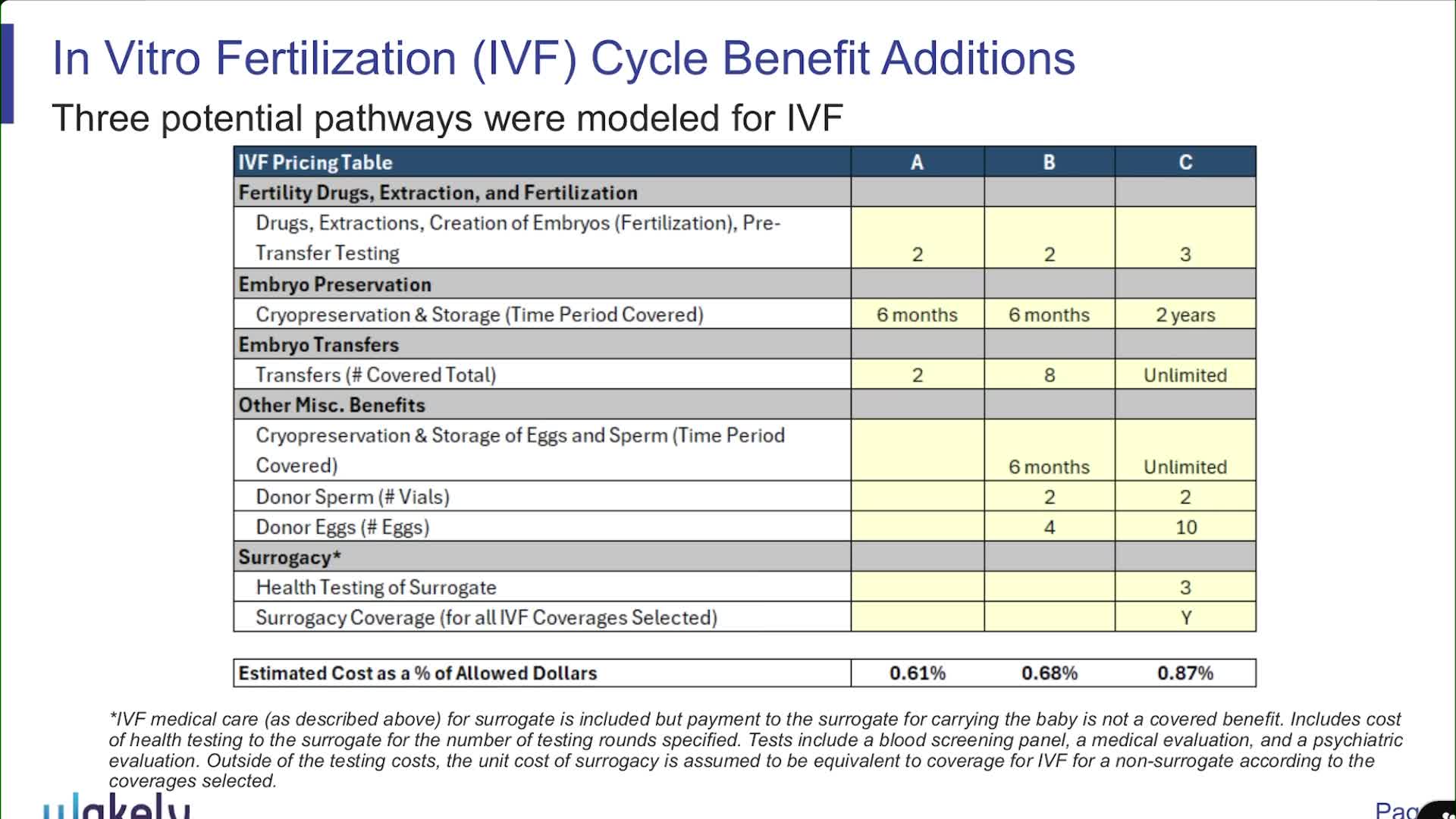
Actuarial viewpoints: Wakely actuary Matt Slaughter explained the firm priced multiple IVF benefit packages, reporting broad ranges driven by benefit design. Slaughter said the three illustrative IVF pathways Wakely priced produced marginal allowed‑cost impacts in a per‑allowed‑cost percentage range (examples shown in Wakely materials) and that the IVF options Wakely provided ranged roughly from 0.61% to 0.87% of total allowed costs depending on richness and storage assumptions. He emphasized Wakely’s numbers were steady‑state allowed costs and do not include pent‑up demand or downstream savings.
CHBRP (California Health Benefits Review Program) provided a silver‑plan per‑member‑per‑month (PMPM) estimate focused on an option aligned with last year’s legislation, SB 729. CHBRP director Darren Corbett said the program produced a $5.36 PMPM estimate for infertility services under the SB 729 package, noting CHBRP built its estimate on assumptions of no baseline coverage and included administrative load and current medical trend projections.
Stakeholder testimony: Multiple patients and advocacy groups urged robust coverage. A series of public commenters described high out‑of‑pocket costs: one couple said they spent more than $50,000 on out‑of‑state treatments; another said they paid about $20,000 for a successful cycle and called the financial and emotional burden “overwhelming.” Medical groups including physicians, SEIU representatives and family‑building coalitions urged adoption of a pathway comparable to SB 729 — which sponsors and clinicians described as permitting multiple retrievals, storage and multiple transfers in keeping with professional guidance.
Equity and definitions: Testimony from LGBTQ+ advocacy groups and others urged a nondiscriminatory infertility definition and inclusion for people seeking assisted reproductive care regardless of sex, gender identity or family structure. Panelists and counsel noted CMS scrutiny of condition‑specific or age‑limited language; CMS expects nondiscriminatory, medically necessary language rather than coverage limited to a particular subgroup.
Unresolved questions: Committee members and actuaries requested more transparent unit‑cost data, a clearer comparison of Wakely and CHBRP assumptions, and issuer‑level premium impact modeling that Covered California said it could not produce within the near‑term timeframe. Lawmakers asked whether donor sperm/egg and surrogate medical care would be included; actuaries and panelists said some definitions and coverage elements vary by option and need explicit drafting.
Ending: Advocates urged the committee to adopt a comprehensive IVF pathway; actuaries and regulators said California can choose a pathway but must remain under the CMS typicality ceiling and provide defensible actuarial justification. No final selection was made at the hearing.