Get Full Government Meeting Transcripts, Videos, & Alerts Forever!
Get email alerts on the Essential Health Benefits topic
No spam. Unsubscribe anytime.
California health panels press for fast decisions as state reviews 2027 essential health benefits
Summary
Legislators and regulators heard actuarial and legal overviews of the Affordable Care Act process to set California’s essential health benefits benchmark, the May submission deadline for a 2027 effective date, and a federal “typicality” cap that limits how much benefit richness the state can add.
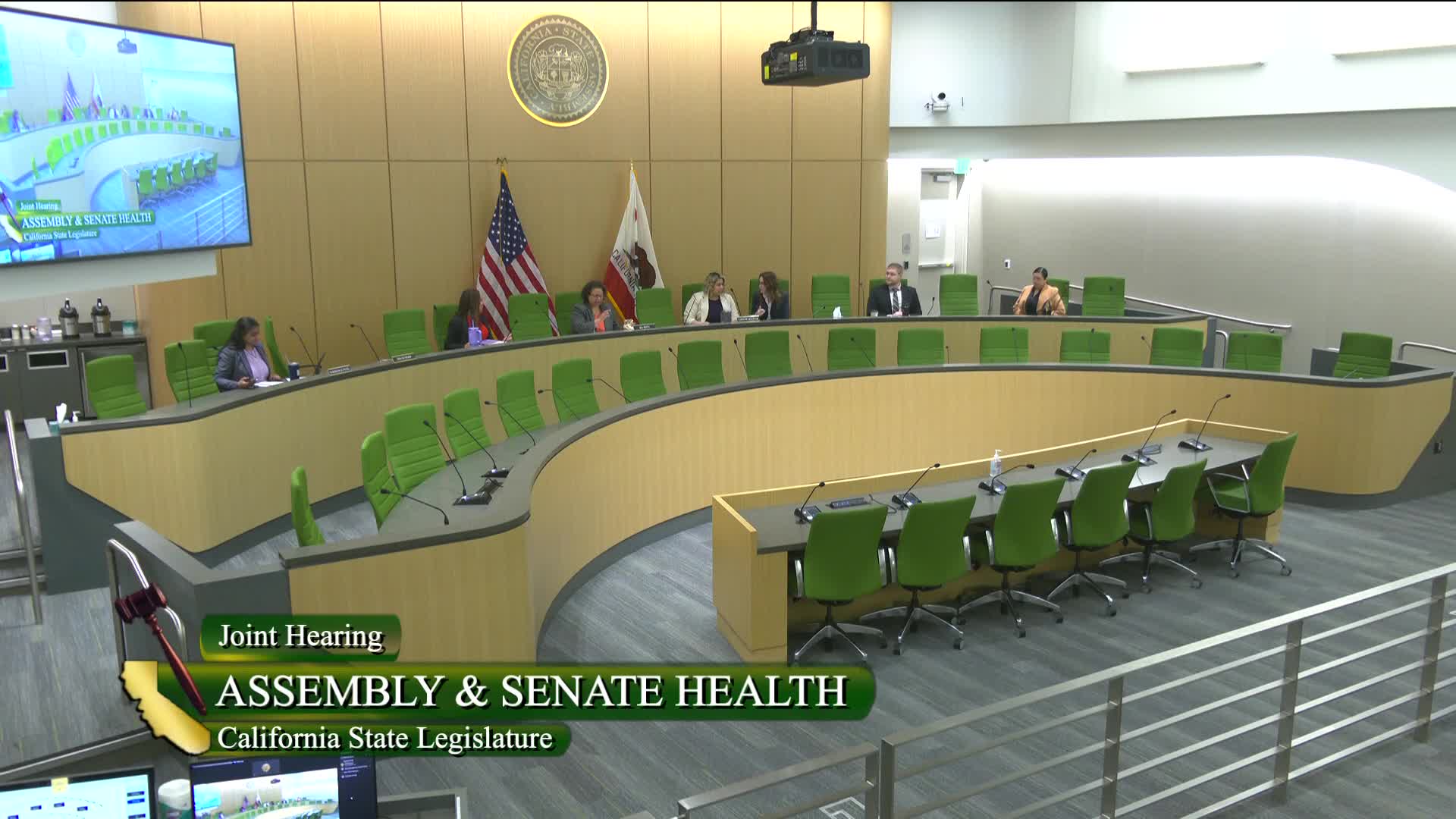
Assemblymember Mia Bonta, chairing a joint informational hearing of the Assembly and Senate health committees, opened the session by saying the hearing would consider options for California’s essential health benefits (EHBs) benchmark and the actuarial work behind any changes. "The Affordable Care Act requires health plans sold in the individual and small group markets to offer a comprehensive package of items and services known as essential health benefits or EHBs," she said, noting the state must submit any new benchmark package to the federal government by May in order for changes to take effect Jan. 1, 2027.
Why it matters: changing California’s benchmark determines which services individual and small-group plans must cover across the state. The committee’s work will constrain or expand coverage — and can affect premiums for millions of consumers and the state’s exchange, Covered California.
Mary Watanabe, director of the Department of Managed Health Care (DMHC), outlined the procedural steps already taken and the schedule ahead. She told members the DMHC began stakeholder meetings in June and shared preliminary actuarial work in January. Watanabe said the department seeks committee input so it can finalize a package for public notice and the required actuarial report, with a short comment window before a May submission to the Centers for Medicare & Medicaid Services (CMS). "We do need to make a decision on the final set of benefits that will be part of the submission," Watanabe said.
Wakely Consulting Group actuary Matt Slaughter summarized the federal regulatory constraints that shape any application. Newer 2019 and 2024 federal guidance allows states more flexibility to assemble an a‑la‑carte benchmark, but Slaughter emphasized a central test: the CMS “typicality” or benefit‑richness ceiling. That ceiling is derived by comparing ten federal benchmark options and choosing the most generous plan as a cap; states may not adopt a package richer than that comparison. Slaughter said Wakely’s pricing work shows the benefits under consideration would increase allowed costs by between roughly 1.6% and 3.5% under several definitions; the typicality test ceiling in the firm’s comparison produced a maximum room to add benefits of about 1.06% to 2.23% of allowed costs, meaning the state cannot add everything on the menu at once.
The hearing also clarified scheduling tradeoffs. Legal and agency counsel explained that a state submission in May 2025 would become effective Jan. 1, 2027; if California waits and submits in May 2026, new benefits would take effect in 2028. Wakely and DMHC staff warned that work beyond this year would require updating analyses and possibly re‑pricing benefits if major market or federal changes occur.
What was not decided: the committee did not vote on any benchmark package. Committee members asked for tighter cost definitions, more detail on benefit definitions, and confirmation of how CMS treats condition‑specific language; staff and consultants said more work would be needed before a final decision and stressed the short windows for public comment if the state seeks a 2027 effective date.
Looking ahead: committee leaders said they planned to use the public comment record, the actuarial analyses and additional rates impact modeling to reach a near‑term decision about which subset of benefits to include in the May filing. DMHC will post a draft package for a three‑week comment period, with an anticipated second comment window in April if changes are made.
Ending: The hearing framed the EHB exercise as a constrained menu of choices rather than an open budget: federal rules and the typicality test limit how much California can add, and the state must weigh coverage gains against premium impacts and the practical deadlines tied to CMS review.