Get Full Government Meeting Transcripts, Videos, & Alerts Forever!
Get email alerts on the Fleet Electrification topic
No spam. Unsubscribe anytime.
Laguna Beach approves plan to electrify city fleet, seeks SoCal Edison rebates for chargers
Summary
The City Council directed staff to issue an RFP for electric vehicle (EV) charging construction, pursue a SoCal Edison Charge Ready Transport agreement and return with a funding plan after hearing an 18–24 month implementation timeline and a five‑year vehicle replacement schedule.
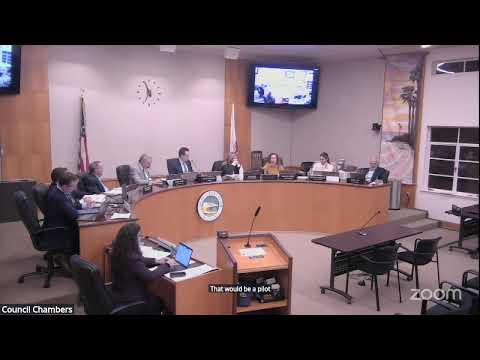
Laguna Beach City Council voted unanimously to direct staff to seek contractors to build electric vehicle charging infrastructure and to pursue a SoCal Edison Charge Ready Transport (CRT) agreement as part of a five‑year plan to begin converting the city’s fleet to zero‑emission vehicles.
City staff presented a progress update that recommends installing chargers and electrical upgrades now and phasing vehicle purchases over time to meet regulatory mandates and the council’s sustainability goals. Assistant City Engineer Frank Lopez said the initiative is driven both by statewide rules and local emissions targets: “This initiative is a critical step in the city's commitment to sustainability, compliance with state mandates, and fulfilling one of the council's strategic priority initiatives,” he told the council.
The plan presented by the city and consultant ICF would target about 22 vehicles for electrification in the next five years and install 47 chargers at two primary sites (City Hall and the city vehicle courtyard). ICF program manager Emma Sullivan said the proposal focuses on implementation after two years of feasibility work and recommends issuing an RFP for EV‑charging construction now.
Why it matters: the Advanced Clean Fleet regulation from the California Air Resources Board requires local government fleets to increase purchases of zero‑emission vehicles, moving toward electric‑only purchases for many vehicle classes in the coming decade. The council action starts the procurement and grant‑application steps that staff say are needed to access utility and state incentives and to avoid later bottlenecks in vehicle replacement.
Key numbers and costs discussed: the staff and consultant estimates include roughly $12.87 million in vehicle capital costs for the recommended five‑year vehicle acquisitions, $2.87 million in EV‑charger hardware costs for 47 chargers, and about $335,000 for so‑called “make‑ready” electrical upgrades. Together, the presentation showed a total capital cost near $18.78 million before incentives. Sullivan told the council staff estimates that incentives and grants could reduce the city’s net additional spending to roughly $2.4 million over the five‑year window; the team estimated about $4 million of potential incentives overall.
SCE program and timing: staff reported the city submitted the initial application to the SoCal Edison CRT program in October 2024 for 16 chargers at City Hall and 31 chargers at the Courtyard. The CRT program can reimburse a portion of equipment and make‑ready costs; staff said the CRT make‑ready rebate could cover up to 80 percent of customer‑side upgrades and that the utility’s funding window is limited (SCE staff indicated availability through 2026). The presentation noted an administrative requirement tied to participation in the SCE program: if the city signs the CRT agreement it would be obliged to purchase at least two EVs within about 18 months of the application step.
Council members asked about cost, phasing and vehicle types. Council discussion emphasized options to defer high‑cost items (notably trolleys) if budget pressures warrant; testimony from staff and the transit director explained trolleys account for a large share of vehicle capital cost because of specialized equipment and limited suppliers. Council members also asked whether leasing or trial purchases could reduce risk while the market matures; the transit director said he planned a phased test purchase of EV trolleys alongside existing vehicles to evaluate performance.
What the council did next: the council voted to approve staff’s recommendation to issue an RFP for selection of an EV‑charging contractor, pursue the SCE CRT agreement and return in April or May with a selection and a funding plan. The motion passed on a unanimous voice vote.
Next steps and follow up: staff will continue SCE negotiations, finalize the RFP for construction of charging infrastructure, and prepare a funding plan and contract recommendations for council review in the coming months. Staff also said they will coordinate the charger design work with other long‑range facilities plans to reduce future relocation costs if public projects (for example, a parking structure or facility rebuild) move forward.