Get Full Government Meeting Transcripts, Videos, & Alerts Forever!
Get email alerts on the Internal Service Fund Rates topic
No spam. Unsubscribe anytime.
County outlines internal service fund rates, highlights broadband, radio and cybersecurity projects
Summary
Ventura County officials presented proposed internal service fund rates for fiscal year 2025–26 and described major ongoing technology and facility projects including a potential $20 million broadband grant, the county radio replacement, property tax and criminal-justice system upgrades, and GSA investments in fleet electrification and solar.
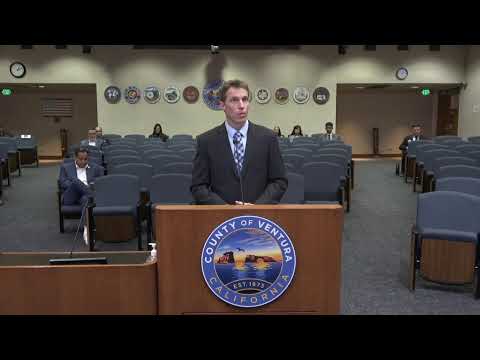
Ventura County officials on Feb. 11 presented the county’s proposed internal service fund (ISF) rates for fiscal year 2025–26 and described how those rates will support a slate of large technology and infrastructure projects including a pending broadband grant, a countywide radio replacement, upgrades to property-tax and criminal-justice systems, and continued investments in facility energy projects and fleet electrification.
County information-technology leadership said the IT internal service fund budget proposed for next year is about $71.5 million, reflecting labor cost increases and the start of several major programs. “It’s coming fast. It’s coming furious,” IT Services’ Terry Theobald said of artificial intelligence and related investments, describing a countywide AI policy and both generative and embedded AI work. Theobald outlined key projects the ISF will help fund: a property-tax replacement system with an estimated cost of about $18 million and planned primary completion by June 2025; a $44 million criminal-justice information systems (CJIS) modernization that is being phased in across agencies; and radio-system migration already in service within the Sheriff’s Department on 700 MHz. The team also said it is awaiting a California Public Utilities Commission decision on a roughly $20 million broadband construction grant that would require completion by the end of 2026 if awarded.
General Services Agency Director Dave Sasek summarized GSA rates and operations that rely on ISF charges. GSA proposed an overall 3.8% increase in its rates, with building square-footage maintenance up about 1.2% and other service lines — including fleet — bearing larger increases. Sasek said fleet costs are under upward pressure from vehicle purchase prices, fuel and parts, and new CARB (California Air Resources Board) compliance requirements. He also noted recent energy projects and conservation work, saying the county “avoided approximately $2,600,000 in electrical costs” in fiscal 2024 through efficiency and solar investments.
Risk management presented recommended funding changes for liability and workers’ compensation ISFs. Danielle Mancuso, deputy executive officer for risk and liability insurance, said the liability ISF would see an average 6% rate increase driven by a difficult insurance market, rising claim severity, wildfire and other catastrophic exposures and market factors such as reduced insurer capacity. Ventura County participates in PRISM, a joint powers risk pool, and maintains a layered insurance program; Mancuso said the liability ISF cash balance remained strong (presented slide: roughly $57.1 million). Catherine LaVette (the transcript uses "Catherine LaVotte/LaVelle" variants) recommended an average 5% decrease in the workers’ compensation ISF rate, citing improved reserve levels, stronger funding and program changes that have reduced indemnity and opioid use; the workers’ comp program is fully self-insured and carries a projected long-term liability in the hundreds of millions.
Presenters and supervisors told the board the ISF increases and decreases reflect both operating needs and a multi-year capital work plan. Supervisors asked follow-up questions about the broadband grant timeline, the radio system’s disaster-resilient virtual core funded in part by a COPS grant, and whether IT’s investment program will allow departments to track and close service requests more quickly.
Why it matters: The ISF charges form the internal billing base used across county departments. Changes to those rates flow into departmental budgets and, in the case of capital initiatives, determine whether large multiagency projects — such as broadband buildout and CJIS modernization — can proceed on the county’s proposed timetable.
Details and context: The board received the presentation and voted to receive and file the ISF materials as part of the broader budget development process. Specific project amounts discussed in the presentation included a roughly $18 million property-tax system implementation, a $44 million CJIS modernization, and an approximately $20 million broadband construction grant application pending CPUC decision. The radio program has received a COPS grant for a virtual backup core of about $963,000 to support disaster recovery and continuity.
Next steps: Staff will incorporate the ISF rates into department budget instructions for FY 2025–26 and return with additional budget materials later in the process.