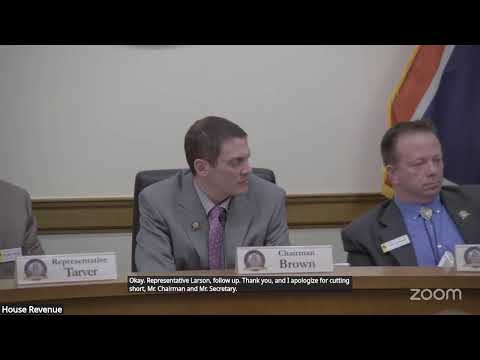
House committee approves statewide electronic lien and title system, sets fees and rules
Loading...
Summary
The House Transportation, Highways & Military Affairs Committee voted to advance Senate File 25, approving creation of a vendor‑operated electronic lien and titling system administered by the Wyoming Department of Transportation and directing rules and a fee schedule before implementation.
The House Transportation, Highways & Military Affairs Committee voted to advance Senate File 25 on a 9‑0 roll call, approving a plan to create a vendor‑operated electronic lien and titling system administered by the Wyoming Department of Transportation (YDOT).
The bill directs YDOT to contract with one or more vendors to build a platform to house title records, title applications, lien filings and title transfers and to interface those records with county clerk systems, lenders, dealers and national databases. The committee adopted an amendment requiring YDOT to promulgate a fee schedule and report back to the committee by Nov. 1, 2026; the legislation sets a target implementation date of July 1, 2027, for the core system.
Why it matters: proponents said the change will speed title processing, reduce mail delays and help prevent title fraud, while stakeholders cautioned about vendor dependence, integration costs and the need for clear fee controls.
Lacey Bruckner, with the Wyoming Department of Transportation's Compliance and Investigation office, told the committee the working group made a point of preserving consumer choice. She said the system would let consumers keep an electronic title or request a printed paper title and that county clerks could still submit paper applications on behalf of customers. "The purpose of it is to create an electronic lien and titling system, that's administered by YDOT that will, house all title records, title applications, lien filings, title transfers, all through 1 system that will interface with the department system, with the county clerk's offices," Bruckner said.
Bruckner also described how the system would connect Wyoming records to national services: YDOT would transmit title data to the National Motor Vehicle Title Information System (NMVTIS) and registration data to national law enforcement teletype systems and consumer title history services.
Financial institutions and dealers who participated in the working group said the project would reduce paperwork and speed lien filings. Bobby Frank, representing Wyoming credit unions, said the change would help lenders know quickly when a county receives dealer paperwork. "In 2023 alone, credit unions granted over 24,000 vehicle loans in Wyoming," he said, urging committee support.
Jeremy Gibson, president and CEO of Trona Valley Federal Credit Union, described two title‑washing incidents that left his institution owed money. "Those vehicles were sold, transferred, transferred to a new title, and the credit union and its members were out $75,000," Gibson said, adding that a statewide electronic system would help prevent similar losses by ensuring liens are visible in national searches.
Vendors and funding: Bruckner said the working group saw demonstrations from multiple existing vendors and that contracting with a vendor that already has a platform is likely the most feasible approach. The bill allows vendors to collect transaction fees to fund the system but forbids charging counties for development or interface work. Bruckner told the committee vendor estimates provided during demonstrations averaged between "$2 and $50 per transaction," depending on the transaction type and volumes.
Security and continuity: committee members asked about resiliency and data backups. Bruckner said some vendors use blockchain and digital‑asset approaches and include backups; counties and YDOT would also continue to house records and could feed data into the system, providing redundancy.
Scope and exclusions: the bill excludes mobile homes from the initial rollout and preserves the consumer's ability to request paper certificates. The Department will define transaction fees and other operational details in rulemaking, and the bill requires YDOT to report its proposed fee schedule to the joint committee by Nov. 1, 2026.
Committee action and next steps: a motion to advance the engrossed Senate File 25 passed on a roll call showing nine aye votes. The committee recorded the motion, noted the adopted amendment requiring a fee schedule report, and advanced the bill for further legislative consideration. The bill sets a July 1, 2027 effective date for the system and makes other provisions effective immediately.
What remains uncertain: committee members pressed for more granular fee estimates and asked how vendor selection and contingency plans would work if a vendor ceased operations. Bruckner said YDOT would run an RFP, include service and security requirements in contracts and rely on county and state system backups if a vendor left the market.
The committee's action sends the bill to the next stage of the legislative process; YDOT and stakeholders will continue RFP work, rulemaking and integration testing ahead of the July 2027 target implementation date.