Get Full Government Meeting Transcripts, Videos, & Alerts Forever!
Get email alerts on the Wastewater Odors topic
No spam. Unsubscribe anytime.
Officials outline multi-pronged odor-control work at Town Branch and West Hickman wastewater plants
Summary
City staff described equipment upgrades, chemical trials and a newly hired odor-control manager as part of an ongoing effort that began after a late-2023 spike in neighborhood complaints. Major contracts and an emergency allocation were discussed.
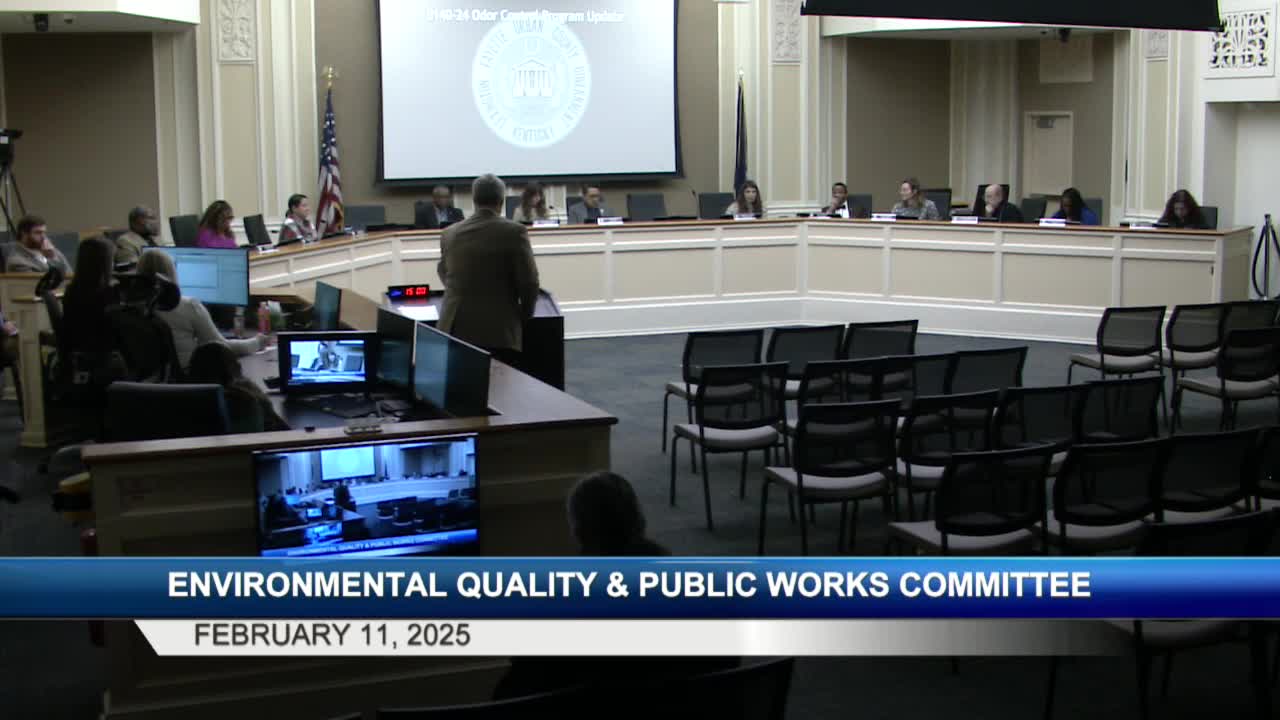
The Environmental Quality and Public Works Committee on Feb. 11 received an update on the city—s odor-control work at Town Branch and West Hickman wastewater treatment plants and on steps to reduce foul odors in surrounding neighborhoods.
Councilmember Reynolds, sponsor of the item, said complaints surged in 2023 around the Town Branch plant and prompted an emergency mayoral order and an outside technical review. "The neighborhoods surrounding that area are the ones that started calling in, and saying that the odor was extremely foul, that they cannot go outside," Reynolds said. The city hired Webster & Associates (with Tetra Tech as a subconsultant) to sample and recommend remedies.
Director Martin of the Division of Water Quality told the committee that Webster—s late-2023 sampling showed roughly two-thirds of measured odorous emissions at each plant came from a few concentrated sources: at Town Branch, two primary clarifier banks and the headworks; at West Hickman, an ash-tank-and-scrubber complex. "We focused on the elements Webster identified as roughly 66% of the problem," Martin said.
Work completed or under way includes replacing exhausted activated-carbon units at the identified Town Branch locations and awarding a contract, which the council approved in late 2024, to install a bio-scrubber to treat and then polish air from primary sources. Martin said the bio-scrubber award was intended as a "belt-and-suspenders" approach: a bio-scrubber to treat the air followed by activated carbon polishing.
At West Hickman, Martin described a combination of process- and equipment-focused fixes. New plant management has changed how ash tanks are loaded and is adding air to reduce odor formation in the collection process. The division replaced or rehabilitated an existing chemical scrubber and awarded a contract to upgrade activated-carbon units serving the ash tank complex.
Martin emphasized the collection system and chemical dosing as critical parts of longer-term control. He described complex sampling results showing seasonal variation: hydrogen sulfide (H2S) levels typically rose in summer and fell in winter, and in some cases increasing chemical feed produced only limited or inconsistent reductions in measured H2S. "We spent a lot of money a lot of money for what I would generously call mediocre results," Martin said, and he identified improving chemical-dosing choices and evaluating remote dosing pilot studies as a priority for 2025.
Financial and timing details given to the committee included the mayor—s emergency allocation of nearly $6 million in response to the 2023 spike. Martin said the low bid for the Town Branch improvements was about $1.9 million and the West Hickman package about $1.3 million; he said supply-chain delays have affected equipment delivery schedules. South Elkhorn and Lower Cane Run were chosen for remote dosing pilot studies because each has a practical mid-point feed location to test dosing closer to odor formation points.
Martin also announced the city hired an odor-control manager, Rick Bowman, to focus full time on odors and customer response. "Rick's only job is odor control," Martin said; Martin described Bowman as a long-time city employee with experience in sewer maintenance and treatment-plant engineering.
Committee members asked several procedural questions. Councilmember Curtis reminded residents to report odor complaints via LexCall/311 so the city can dispatch staff and collect time-sensitive information. Councilmember Morton asked about 2025 funding; Martin said the administration initially allocated nearly $6 million under the emergency action and that he would provide exact project numbers on request. Several members praised the hiring of a dedicated manager and urged continued emphasis on remote monitoring and maintenance contracts to avoid future equipment failures.
No new ordinance or binding action was proposed at the meeting; Martin said staff will continue equipment installations, pilot chemical-dosing studies and longer-term monitoring to reduce odors and inform future capital requests.