Get Full Government Meeting Transcripts, Videos, & Alerts Forever!
Get email alerts on the Land Use Nonconforming Reconstruction topic
No spam. Unsubscribe anytime.
Maui committee advances Bill 105 to ease reconstruction of nonconforming structures after disasters
Summary
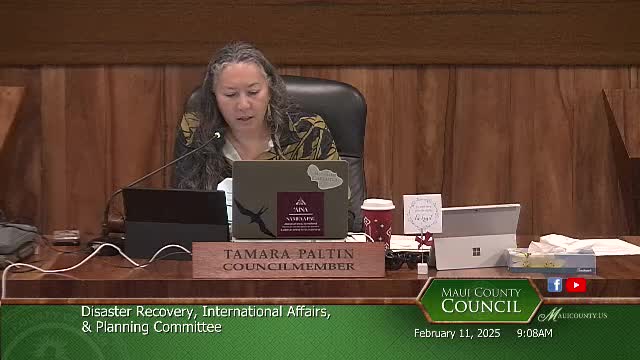
The Disaster Recovery, International Affairs and Planning (DRIP) Committee of the Maui County Council voted unanimously on Feb. 11 to recommend passage on first reading of Bill 105 (CD1), which revises county code on nonconforming lots, structures and uses to clarify fire-safety authority, relocation rules and reconstruction timelines after disasters.
The Disaster Recovery, International Affairs and Planning (DRIP) Committee of the Maui County Council voted unanimously on Feb. 11 to recommend passage on first reading of Bill 105 (CD1), a measure that revises Maui County Code section 19.50.11 to address reconstruction and relocation of nonconforming lots, structures and uses after emergencies and disasters.
The measure, as amended in committee, clarifies that repair and reconstruction of nonconforming structures is permitted if done in compliance with Title 16 building regulations, and gives the fire chief authority to require residential structures to exceed certain Title 16 standards where necessary to improve public safety. It also allows the fire chief to require relocation of a nonconforming use to a more suitable portion of a lot or structure, while placing the burden of proof on the property owner to show the change will not increase the nonconformity; evidence of that burden is subject to review and approval by the planning director.
Why it matters: committee members and departments said the amendments aim to make post-disaster rebuilding safer and clearer for homeowners and reviewers. The bill also contains a provision tailored to properties affected by the August 2023 Maui wildfires, extending specific reconstruction deadlines and offering relief for owners in affected areas.
Key details and debate
Planning staff said the wording changes are clarifications rather than substantive shifts. "The context is the same. We just reworded it merely for clarity and provide more clarity in the section," planning staff member (Mr. Post) said when reading revised language for two subsections that give the fire chief limited authority to impose additional standards and to require relocation of uses when necessary for public safety.
Council member Tom Cook proposed and the committee adopted an amendment to add subsection g, narrowing an exception for nonconforming transient vacation rental uses. Cook's amendment would prevent transient vacation rental uses that were discontinued for 12 consecutive months or more because a structure was damaged or destroyed in an emergency or disaster from resuming, while excluding owner-occupied transient accommodations from that prohibition. Cook cited public testimony about owner-occupied bed-and-breakfast–style operations as the reason for the carve-out. Planning staff noted that "transient accommodations" has the same meaning as Hawaii Revised Statutes section 237D-1 (generally lodgings furnished for less than 180 consecutive days).
Committee members asked several implementation questions. Director Jordan Molina of the Department of Public Works said the bill should not change how the building code review is performed, though public works will coordinate with planning if new workflows are needed. Planning staff and committee members said the department currently has about 15–30 pending permit applications that could involve nonconforming structures; some property owners are awaiting passage of the bill before investing in design work.
Fire Captain Oliver Voss told the committee the Department of Fire and Public Safety is prepared to prioritize and expedite reviews. "I will do my very best to respond to anyone who comes to us with this within a week to answer their questions. And if it's a permit, I will make sure it gets expedited in review in that 15 day mark," Captain Voss said. He added that applicants who do not accept initial mitigation options may require more time and professional help.
Appeals and limits
Committee members asked whether the fire chief's determinations are appealable. First Deputy Corporation Counsel Mimi Desjardins and Office of Recovery Executive Assistant Jordan Hart indicated that director-level decisions are typically appealable to the Board of Variances and Appeals (BVA), and staff said they would confirm whether the fire chief's determinations are explicitly appealable to the BVA. The committee directed staff to confirm that detail before further proceedings.
Other changes adopted
The CD1 version being substituted into the bill already incorporated planning-led technical revisions, a change shortening the reconstruction/reestablishment period from five years to four years from the date of the mayor's or governor's emergency proclamation, and a specific extension that allows properties affected by the August 2023 Maui wildfires to reconstruct until April 1, 2029. The bill also limits the planning director's authority to grant two-year deadline extensions for properties within historic districts or the Special Management Area.
Votes and next steps
The committee approved the two planning-proposed wording amendments and Cook's owner-occupied transient accommodations amendment; each amendment passed unanimously. The committee then voted unanimously to substitute the CD1 version and to recommend passage of Bill 105 (CD1) on first reading. The committee chair indicated first reading would likely occur on March 7, with second reading targeted for March 21.
What wasn't decided or remains to be confirmed
Staff said they will confirm whether fire chief determinations are explicitly appealable to the Board of Variances and Appeals. Committee members also discussed, without adopting, whether to add a statutory time limit for department responses; Fire Captain Voss pledged expedited handling but the committee did not set a firm statutory response deadline.
Ending
Committee members and departmental staff thanked each other for interdepartmental coordination on the bill. The DRIP committee concluded its reconvened meeting after unanimous passage of the amendments and the recommendation to move Bill 105 (CD1) forward to first reading.